
It’s AI’s world, and we’re just living in it.
The bugle had been sounded long back. Its arrival announced all over. However, it was only in 2025 that fact-checking outlets, at least in India, finally confronted the newest ‘school’ of misinformation — AI generated content and deepfakes — head on.
As generative AI (Gen AI) tools, specifically large language models (LLM) designed to create human-like text, code, and images/audio/video become more accessible to the masses, AI-generated content ceases to be ‘niche’. In an era of information explosion, AI stands out as one of the most significant tools for spreading disinformation. For fact-checkers, it poses a new challenge.
In 2025, Alt News fact-checked 39 AI-generated videos or images. Out of those, 10 instances included political parties, politicians or the media actively amplifying such content as real. In spite of all the hullabaloo, in 2024 there were only seven AI-generated images or videos that assumed such importance in the Indian context as to warrant a fact check by Alt News. So, this year, it was a mind-boggling 457% jump.
In the hands of influencers prioritizing visibility and engagement over authenticity, Generative AI is a magic wand. Want a picture with Shah Rukh Khan but never had the luck to meet him? ChatGPT can make it happen. Want an image with a childhood hero who has passed away? Nano Banana Pro will do it for you. Have a paper due tomorrow that you haven’t even started? Don’t worry, Perplexity has you covered.
But there is a flipside to it, and it is quite obvious.
In his seminal work The Ascent of Man, Jacob Bronowski had famously reminded mankind of the moral imperative to use technology with wisdom and ethical foresight. The case of AI is no different. As it becomes more and more commonplace, chances of it being used without wisdom and moral foresight become higher and higher. The result was there for everyone to see in 2025.
AI Videos Used to Drive Communal Narratives
One of the biggest examples of the misuse of AI last year was the way social media handles of BJP Assam indulged in communal propaganda targeting Muslims.
For instance, on September 15, the X account of @BJP4Assam shared an AI-generated video showing a glimpse of “Assam without BJP”. The video, meant to target the Congress and its leader, Gaurav Gogoi, showed AI footage of Muslim “infiltrators” entering the state and acquiring government land; men in skull caps, beards and lungis chopping beef by the roadside while Muslim men and burqa-clad women crowded the state’s tea estates and public spaces, such as the Guwahati airport, theme park, zoo, stadium and the town.
The 31-second ‘ad’ ended with the warning that without the BJP, Assam would have a 90% Muslim population. “Choose your vote carefully,” it said. The caption read, “We can’t let this dream of Paaijaan to be true!!”
In the face of severe criticism from various quarters and FIRs being lodged, Assam BJP eventually deleted the video, but not before it garnered around 5 million views. Read Alt News’s detailed report on this published on October 13 here.
BJP Bengal and BJP Delhi followed suit in December. Making the ongoing SIR process in the state an excuse, they shared AI-generated videos that were brazenly communal in nature. One video featuring famous Bengali fictional characters Goopy and Bagha in present-day Kolkata showed all signboards written in Urdu and only Muslims walking on the streets. In another, Muslims were compared to pests in an AI generated clip which showed them being driven away by a mosquito repellant coil.
Here is our report on how under the garb of sensitising people about SIR, the party’s social media handles indulged in unabashed communal stereotyping, scaremongering and Islamophobia.
While many of these videos were admittedly hypothetical, a more challenging case emerged in September when a highly realistic image of Rahul Gandhi with a woman in sunglasses began circulating online. Several X users claimed that the woman was his partner. Our investigation found multiple anomalies in the viral image. The photo appeared to be based on an image from the early 2000s in which Gandhi was photographed sitting next to a woman wearing black sunglasses and a black outfit, identified as Veronique Cartelli. That older photograph was used as the reference to generate the recent image.
While Gandhi appeared noticeably older in the viral image, the woman did not — largely because there are no other publicly available photographs of Veronique to show how she might have aged. This resulted in striking similarities between the two images, including her attire and sunglasses.
The final confirmation came when we were able to recreate a similar image ourselves using the same reference photograph, demonstrating how the viral image had been artificially generated. Our fact check, published on September 12 can be read here.
Sweet couple ❣️
Daughter of drug lord with Pappu pic.twitter.com/1wbrlp8SZg
— Boiled Anda (@AmitLeliSlayer) September 8, 2025
Political parties have often utilised similar pieces of misinformation. Ahead of the Delhi assembly elections, the Aam Aadmi Party (AAP) shared a video in January on its social media channels claiming it showed the “royal palace” or new residence of Prime Minister Narendra Modi as part of the Central Vista Project. The video featured lavish interiors, chandeliers, and luxury items and was captioned to suggest it was a first look at this supposed residence. Alt News found several visual inconsistencies in lighting, interiors, and objects, suggesting the clip was AI-generated or altered. A watermark from “Sora” (an OpenAI video creation tool) was also visible in the video, confirming AI generation.
Big Breaking 🚨🔥
राजमहल का Video पहली बार आया जनता के सामने‼️😳
क्या इसलिए ही राजमहल के दरवाज़े जनता के लिए नहीं खोले जाते? pic.twitter.com/P52Ph2ak9n
— AAP (@AamAadmiParty) January 27, 2025
Read our fact check of AAP’s video here.
Again, in July, a video circulating on social media claimed that Pakistan People’s Party (PPP) chairman Bilawal Bhutto Zardari had said “our people are sitting in India’s Parliament”. The clip was shared by several Indian figures, including Assam minister Jayanta Mallabaruah and was later referred to by Union minister Kiren Rijiju and quoted by BJP spokesperson Jaiveer Shergill to target Opposition leaders. Alt News found that the audio in the viral video was doctored — it did not match Bilawal’s original speech, and his lip movements were not in sync with the words in the clip, pointing to the fact that it was AI-generated content.
We can deliver our propaganda in front of the Indian Prime Minister. Our agents are sitting in their parliament. Who is a Pakistani leader Bilawal Bhutto referring to? Is he from Assam? pic.twitter.com/dbAHSFTgBa
— Jayanta Mallabaruah (@jayanta_malla) July 31, 2025
More recently, BJP’s unofficial IT cell widely shared a video purportedly showing a Muslim man cooking with sewer water. X users like Jitendra Pratap Singh (@jpsin1), who shares communal propaganda regularly and is followed by Prime Minister Narendra Modi, amplified the video with blatant communal remarks. Many users took it to be true and expressed their disgust. Alt News, however, found that the video was AI-generated as well. There are several factors in the clip that should raise doubts over the authenticity of the video, but our confirmation bias often leads us to ignore tell-tale signs, when we want to believe something.
मुस्लिम होटल में लजीज बिरियानी खाने के शौकीन के लिए बहुत ही आंख खोलने वाली घटना है।
साफ सफाई का स्पेशल व्यवस्था इनके होटल में मिलेगी ही मिलेगी। चाहे कितने भी बड़े होटल हो या फिर सड़कों पर लगाने वाले बिरयानी ठेले के। भाईचारा निभाने के चक्कर में इन होटल में जाकर बिरयानी खाने वाले… pic.twitter.com/7IY0b4HbJn
— 🇮🇳Jitendra pratap singh🇮🇳 (@jpsin1) December 19, 2025
Instances of Media Running AI-generated Content
Mainstream media, too, fell for AI generated content several times. In December, many outlets, including India Today, Hindustan Times, ABP News, Aaj Tak, Dainik Bhaskar, News18 and Zee News, ran reports based on a digitally altered video clip purportedly showing Aleema Khanum, sister of former Pakistan Prime Minister Imran Khan, calling Pakistan Army Chief Asim Munir a “radicalised Islamist” and alleging he engineered conflict with India went viral on social media.
However, Alt News’ investigation found the video had been digitally manipulated with AI-generated audio and altered lip-syncing. The original interview with Khanum on Sky News did not include any statements about Munir’s ideology or the India-Pakistan conflict.
In another instance, a morphed photo showing the man who attacked Delhi chief minister Rekha Gupta in August, standing next to Aam Aadmi Party (AAP) MLA Gopal Italia, went viral, and was run by several news outlets Republic Bharat, Aaj Tak, and Punjab Kesari.
Alt News found that the photograph was digitally manipulated. Italia’s image was actually a screengrab from one of his older videos, which did not feature the accused.
A video clip that went viral in June showed a lioness walking down a street at night and sniffing a man who was sleeping on the roadside, suggesting he had narrowly escaped an attack. This footage was picked up by mainstream news outlets, including Republic and News18, which initially reported the incident as real in India, describing it as a terrifying encounter.
However, Alt News found that the video was AI-generated. The video featured several visual inconsistencies, such as gibberish text on nearby shop signs and unnatural body posture. A reverse search also traced the footage to a YouTube channel that explicitly states the content was digitally created. Both Republic and News18 later updated their articles after being called out online.
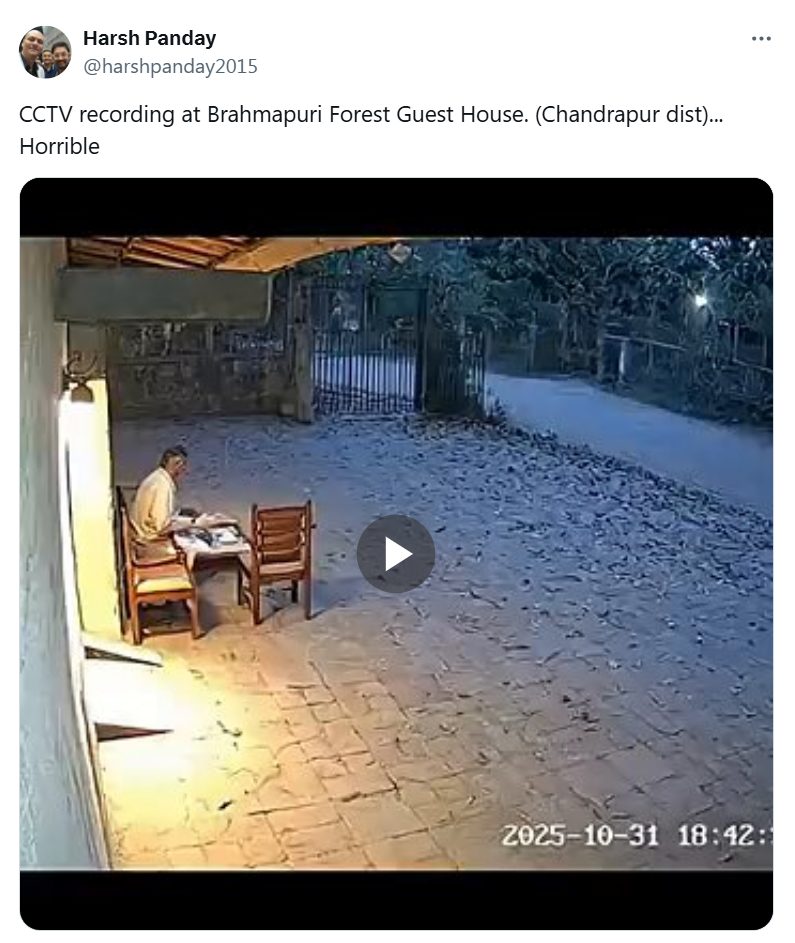
In a similar instance, a 15-second clip, apparently CCTV footage, went extremely viral in November, which showed a tiger pouncing on a man and dragging him away. Users claimed it was an incident from Brahmapuri, in Maharashtra’s Chandrapur district. Alt News received requests on its WhatsApp helpline to verify the video.
Our fact check confirmed it was AI-generated. Again, a close examination of the video revealed multiple inconsistencies, but many failed to spot them or got swayed by the strange seduction of AI.
‘It’s Deepfake!’: Hiding Behind AI
Another distinct use of AI emerged when public figures began using it as a convenient cover. For example, when an old clip of National Security Advisor Ajit Doval went viral on social media, showing him saying that Pakistan’s ISI had recruited more Hindus than Muslims for intelligence tasks in India, he was quick to claim that the video was a deepfake. He spoke to CNN-News18 exclusively, which was then run by other outlets like Moneycontrol.
However, Alt News traced the footage back to a 2014 lecture Doval gave at the Australia India Institute, where he did make the statement in full context, while discussing historical ISI recruitment statistics and urging that terrorism should not be viewed through communal lenses. The video actually predates widespread deepfake technology, making it highly unlikely to be AI-generated.
Rajasthan Police, too, found itself in a fix when YouTuber Elvish Yadav posted a vlog titled “Rajasthan Me Full Protocol” claiming that Rajasthan Police vehicles had escorted him and helped his convoy during a visit to Jaipur for a music video shoot. The footage shows police vehicles ahead of his car and actions like bypassing toll payment, prompting public questions about the police’s role.
After the video went viral, the Jaipur Police denied providing any escort, claiming the video was “edited with AI” and thus misleading. To counter the narrative, the police even filed an FIR against Elvish Yadav at a cyber police station, accusing him of tarnishing the reputation of the Rajasthan Police. Officials, including Jaipur police commissioner Biju George Joseph and additional commissioner Rameshwar Singh, asserted that no official escort was provided.
Alt News found that Yadav’s vlog itself shows police vehicles and that the police did not provide any evidence to back their denial, raising doubts about their claims and the motivation behind the FIR.
विभिन्न वीडियोज को AI Tools की सहायता से एडिट करके भ्रामक रूप से खबर प्रकाशित करने वालों के ख़िलाफ़ सख़्त कार्यवाही जयपुर पुलिस के साइबर थाना द्वारा प्रारंभ की गई है।
— Jaipur Police (@jaipur_police) February 10, 2025
What is Your Defence Against AI Manipulation?
It is increasingly clear that we are heading into deeply sinister times, as far as the use of AI and deepfakes with ulterior motives is concerned. With major elections looming in 2026, generative AI is no longer just a tool; it is a weapon capable of shaping perceptions in ways that cannot be countered by a single fact check.
The problem at hand becomes more complicated when we consider two things. One, the technology is improving at the speed of knots. Anomalies that were commonly spotted in deepfakes, say, three months back, are no longer there now. And secondly, AI-detection tools are far from foolproof and must always be corroborated with broader forensic and contextual evidence. At Alt News, our work has consistently shown this.
Then how does one counter propaganda when it cloaks itself in grief and outrage? When the image of the RG Kar victim is manipulated into a deepfake video to manufacture political narratives, or when an AI-generated clip is made to depict a man in a skull cap cooking with sewage water to stoke communal disgust, the aim is not plausibility, it is provocation. Generative AI does not need reality to be common; it only needs prejudice to be familiar. In that sense, it fulfils every propagandist’s fantasy, translating into visuals exactly what they want the audience to believe.
So how do we, as a society, push back? The answer lies in something far less sophisticated, yet far more urgent: common sense, critical thinking, and restraint. “Don’t believe everything you see on the internet” may sound cliched at this point, but it remains the most powerful defence we have. Beyond reverse image searches and AI detectors lies an information ecosystem that is rapidly mutating. All we can do is stay alert, question what we consume, and resist the impulse to believe simply because something looks real. In the age of AI, vigilance and digital literacy is no longer optional; it is a life skill.
Independent journalism that speaks truth to power and is free of corporate and political control is possible only when people start contributing towards the same. Please consider donating towards this endeavour to fight fake news and misinformation.
Donate Now
Related
www.altnews.in (Article Sourced Website)
#Year #review #Deepfakes #supercharged #disinformation #propaganda #Alt #News