
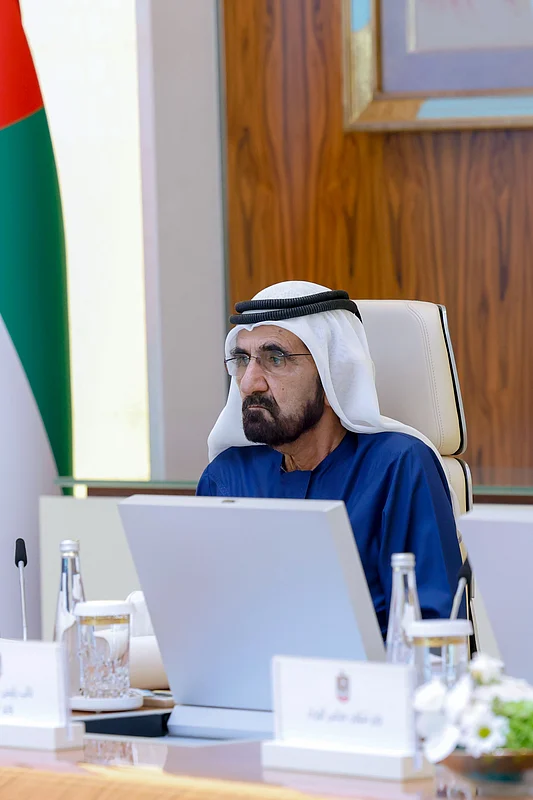
“We decided, 20 years ago, to aim for the first place… some doubted… However, today — thank God — the UAE has become a model of development that other countries are imitating,” Sheikh Mohammed said, as the UAE marked two decades of his leadership.
The remarks came during a Cabinet meeting on Monday (January 5), where ministers reviewed 20 years of reforms that have transformed how the country is governed, how services are delivered, and how the economy has grown.
The meeting was chaired by Sheikh Mohammed, Vice President and Prime Minister of the UAE and Ruler of Dubai, at Qasr Al Watan in Abu Dhabi, bringing together senior leaders to take stock of the federal government’s journey since he became Prime Minister in January 2006.
Stay up to date with the latest news. Follow KT on WhatsApp Channels.
UAE as the global benchmark
Under the leadership of President Sheikh Mohamed bin Zayed Al Nahyan, Sheikh Mohammed said the UAE has emerged as a global benchmark for development, ranking first in more than 280 international indicators covering quality of life, education, healthcare and housing.
He added that the country’s strength today is also reflected in its global standing in trade, artificial intelligence, space industries, sovereign investments and talent attraction — positioning the UAE as a key economic bridge between East and West.

Reflecting on the past 20 years, Sheikh Mohammed said the federal government issued more than 16,000 resolutions, worked through thousands of teams and managed budgets exceeding Dh1.1 trillion to fundamentally redesign government operations.
That transformation included streamlining services, updating legislation, modernising infrastructure and building advanced digital, legal and investment frameworks.
A new way of leadership
The Cabinet reviewed milestones that reshaped federal governance, beginning with the UAE’s first Comprehensive Strategy in 2007 and the launch of a the Government Performance System in 2008. These introduced data-driven planning and accountability across ministries.
Since then, six national strategic cycles have been implemented, each aligned with federal budgets to ensure policy and spending move in step.
Long-term planning became a defining feature of government work. In 2011, the UAE Vision 2021 was launched, aiming to make the UAE one of the best countries in the world by its Golden Jubilee. This was followed in 2014 by the launch of the National Agenda for the UAE Vision 2021, which served as a roadmap for achieving this vision. In 2016, the National Agenda’s executive teams were launched, and in 2017, the government launched the UAE Centennial 2071 plan, a long-term vision for sustainable development and enhancing the readiness of future generations.
The vision spans 100 years and focuses on investing in advanced education, a sustainable economy, and national identity to ensure the UAE’s global leadership by its centennial.
This was reinforced in 2020 with the “Preparing for the Next 50 Years” initiative, and in 2021, a new government methodology that prioritised speed, flexibility and short-term impact projects guided by the “Principles of the 50”.
In 2022, the “We the UAE 2031” agenda was launched as the first decade-long phase of Centennial 2071, focusing on social, economic and investment growth.
Initiatives during the last 20 years
Innovation became a core pillar of governance, with initiatives ranging from the World Governments Summit to regulatory labs and government accelerators.
The Federal Government launched several other initiatives during the last 20 years, It launched the Sheikh Khalifa Government Excellence Programme in 2006, the first UAE Government comprehensive strategy in 2007, the UAE Government Leaders Programme and hosted the Global Agenda Councils in 2008. In 2009, the UAE established the Emirates Competitiveness Council, launched the Mohammed bin Rashid Government Excellence Award and the Government Experience Exchange Programme.
The Emirates Government Service Excellence Programme was launched in 2011. The year 2012 saw the launch of the Mohammed bin Rashid Smart Learning Initiative, followed by the inception of the World Governments Summit. The UAE Government Annual Meetings was launched in 2017. In 2018, the UAE launched the Regulations Lab, and 2019 saw the launch of the Arab Government Excellence Award.
Artificial Intelligence has been a key focus of the UAE Government, established as a foundational pillar through several initiatives. The UAE appointed the world’s first AI minister in 2017 and launched a national strategy to accelerate its adoption across all sectors.
The government also launched the UAE legislation platform, which is the first unified digital platform for all federal and local legislation. The platform contains over 2,500 laws and regulations, and attracts an average of one million visits per month. During this period, the government also adopted more than 350 national policies, strategies and programmes in various sectors.
Spending, growth, and jobs
Ranking first globally on the Efficiency of Government Spending index, the UAE government spending exceeded Dh1.1 trillion in the last two decades. During this time, the government budget has grown by 167 per cent, from less than Dh27 billion in 2006 to Dh90 billion in 2026, with education receiving the largest share at more than Dh170 billion.
Healthcare and prevention received over Dh60 billion, social development programmes more than Dh100 billion, and citizen housing over Dh55 billion.
The economic impact has been equally striking. Real GDP rose 94 per cent to more than Dh1.77 trillion in 2024. Non-oil foreign trade surged nearly sixfold to around Dh3 trillion, while non-oil exports jumped more than 18 times to Dh559 billion.
The labour market also expanded rapidly, with workforce numbers doubling over the past 20 years and women’s participation more than doubling.
The Cabinet noted the UAE now ranks first in 279 global indicators, sits in the top five in more than 500, and appears in the global top 10 across 738 measures — a rise driven by coordination across federal, local and private-sector institutions.
What else was discussed at the UAE Cabinet meeting?
Cultural preservation also featured on the agenda, with approval of a national plan to register more UAE heritage elements on UNESCO lists between 2026 and 2036.
Ministers reviewed progress under the UAE Tourism Strategy 2031, which saw hotel capacity grow to more than 1,250 establishments and 217,000 rooms by 2024.
Updates were also discussed on the Circular Economy Policy 2031, alongside approval of a new healthcare policy aimed at delivering personalised, lifelong care for People of Determination.
The Cabinet approved the formation of a high-level committee to oversee the national strategy against money laundering and terrorism financing, as well as the restructuring of the UAE Circular Economy Council and new guidelines for sustainable digital government services.
On the international front, agreements with Tajikistan and Slovakia were ratified, while negotiations were approved for 21 additional international agreements and memoranda of understanding.

www.khaleejtimes.com (Article Sourced Website)
#aimed #place #Sheikh #Mohammed #marked #years #change #UAE #governance