
On the intervening night of November 18 and 19, at around 2.30 a.m., as the air-raid sirens went off in Kyiv, situated in the central part of the country, I hurriedly grabbed my jacket from my hotel room and ran to the shelter of the hotel premises where I was staying. I was one of the first ones to reach the shelter or basement for the third-day in a row. Perhaps years of working in conflict zones, and the loss of a few colleagues has given me the instinct to move quickly and instilled in me a deeper sense of caution. Others from Ukraine staying in the same hotel trickled in a few minutes later, explaining that such alarms had become routine for the last three-years. The neighbourhood around the hotel, where I was staying, had not been attacked so far, and several Ukrainian nationals, who were staying in the same hotel, appeared unfazed.
The next day, as we caught up with the developments with the locals, it emerged that at least 25 people had been killed, including three children, and nearly 100 injured in a barrage of Russian drone and missile attacks across Ukraine. The strikes on Ternopil, on the country’s western fringe, were the deadliest in weeks and the worst the region had seen despite being far from the frontline. The Russian missiles had travelled nearly 900 kilometers to reach their target. That same night, while being in the shelter, I was shown by Ukrainians on a live map on the mobile where the missiles were landing, each marker a reminder of how no corner of the country is beyond reach in the modern-day warfare. The radars alert the mobile apps as soon the missiles turn towards the Ukraine’s air space.
I spent nearly eight-days in Ukraine, gaining access to a country that has become one of the most closely watched conflict zones since February 2022. My focus was on understanding how the war is reshaping Ukrainian society and transforming daily life. Travelling there is far from easy; no region has been spared the impact of the conflict. Several family members and friends had advised me against visiting, their concern fueled by the grim reports of drone strikes and missile attacks that surface with unsettling regularity. Yet it was precisely this reality, lived every day by millions, that made witnessing it firsthand essential. With 20 percent of the territories no longer with Ukraine, many millions displaced internally or externally, and no recent nationwide census (the planned census was postponed because of the war) it is extremely difficult to produce a definitive “current population.” However, some of the estimates put the population has shrunk from 42 million in 2021 to 31-32 million in 2025 in the area that is still under Kyiv’s control.
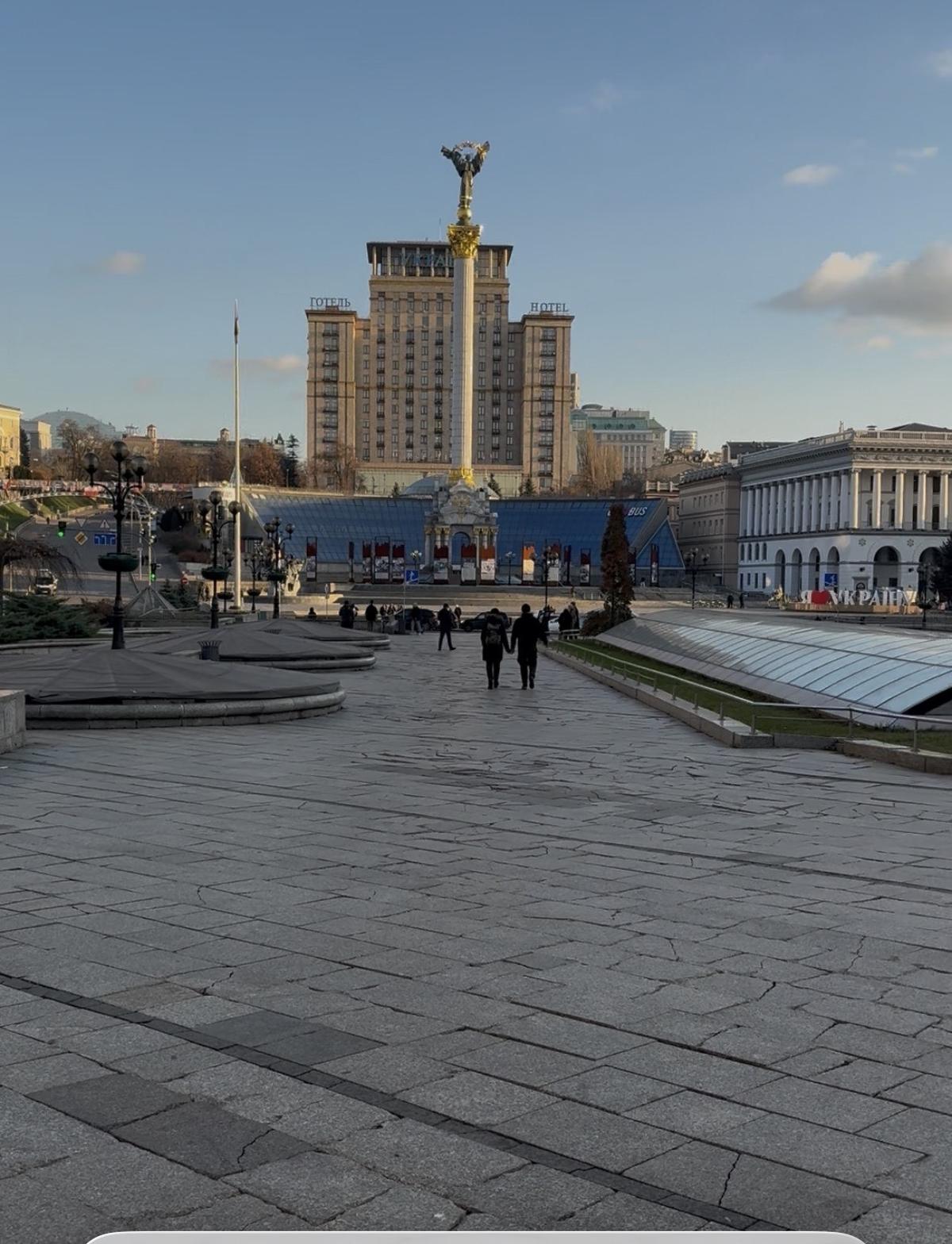
Kyiv, Maidan Nezalezhnosti, Independence Monument rising over Maidan Square in Kyiv, the symbolic heart of Ukraine’s modern political struggles. Photo: Special Arrangement
The journey from west to the eastern borders of Ukraine offered a rare opportunity to witness the country first hand, observe the lives of ordinary people, and listen to their perspectives on the conflict. There is hardly a night when one is not confronted with the realities of war. Almost every night I was in Ukraine I had to rush to a shelter, sometimes two or three times, and on the final night, I spent four to five uninterrupted hours underground.
The journey to Ukraine started through the Polish border as it is the only way to enter as all air routes are blocked due to the conflict. On the 14-hour train journey from Lviv to Kharkiv, I was struck by the warmth of the local co-passengers. Yet what stands out most is the atmosphere on board as there is an understated resilience and quiet camaraderie that reflect the country’s spirit in wartime. Seeing a foreigner my co-passengers were curious about my visit and immediately thanked that I was visiting their country during the conflict when there are hardly any foreign visitors.
The 14-hour train journey from Lviv to Kharkiv offered glimpses into both Ukraine’s resilience and its anxieties. The trains are well-maintained, cleaner than many I have used in Asia, the US or Europe, with spotless restrooms but relatively lesser space in the berth compartments. Yet beneath this quiet efficiency runs an undercurrent of fear shared by passengers and crew alike. As the train cuts across the breadth of a country at war, everyone knows that missiles have targeted rail infrastructure before. The hum of the carriage is therefore punctuated at times by tense glances at phones, the checking of alerts, and whispered conversations about recent strikes. Even in these moments of uncertainty, the passengers display a composed, almost habitual endurance as life must go on, despite the risks that accompany every mile.
For me, it was a rare opportunity to observe ground-level realities in Kharkiv, where the tension was palpable even before I arrived. As the train moved eastward, the cold deepened noticeably. Eastern Ukraine experiences harsher temperatures because it lies farther from the moderating influence of the Atlantic winds and sits firmly within a continental climatic zone, where winters are sharper and the air is drier. The open steppe offers little protection from icy fronts sweeping in from Russia. I was somewhat underprepared for this sudden drop in temperature and I realised, to my surprise, that it felt colder than New York, where I had lived for more than eleven-years and which had long been my reference point for tolerating winter.

Kharkiv, Memorial to Children Killed in the War, A small memorial for children lost in the war, with toys, flowers and candles placed there by local residents. Photo: Special Arrangement
Much of Ukraine’s industrial base and a large concentration of its engineering and medical institutes lies in the east. These regions have borne the brunt of the fighting over the past three years. Kharkiv, in particular, was long a major hub for international students from developing countries, including India, who came largely for STEM courses. Before February 2022, Kharkiv was a thriving region home to more than 900 large and medium enterprises, 715 schools, 745 kindergartens, over 800 healthcare facilities, and a dense network of cultural and educational institutions. With nearly 1.18 million people employed and an active entrepreneurial base of over 160,000 individuals, it was one of Ukraine’s most productive regions. From nearly 24,000 before the war, the number of Indian students in Ukraine has fallen to about 3,000, informs the energetic Kyiv based young surgeon Anurag Krishna, who hails from Bihar. He told me that as surgeon the past three-years, marked by a steady stream of war-related casualties and complex trauma cases, have given him an exposure and surgical experience he could never have imagined elsewhere.
The war has transformed the landscape in frontline areas dramatically. Since early 2024, according to Ukrainian estimates, settlements in Kharkiv have been shelled more than 21,000 times, with over 900 additional attacks recorded in the first months of 2025 alone. Guided aerial bombs, missiles, UAVs, artillery and multiple rocket launchers (MLRS) strikes have left a wide arc of destruction. As a result, more than 80,000 infrastructure objects, including nearly 38,000 residential buildings, thousands of non-residential premises, hospitals, schools, transport hubs, and industrial facilities, have been damaged. Large swathes of liberated territory remain dangerous, with 1.25 million hectares potentially contaminated by mines and unexploded ordnance. Despite new demining machines and coordination centres, rebuilding remains an immense challenge in a region still under constant attack. The destruction is most stark in Kharkiv, the eastern region bordering Russia. Scores of buildings lie damaged, entire neighbourhoods bearing the scars of relentless shelling.

Lviv, Rows of flags marking the graves of fallen Ukrainian soldiers, a stark reminder of the scale of the losses. Photo: Special Arrangement
Ukraine has endured a multi-dimensional crisis which has military, economic, humanitarian, and psychological components. Families have been torn apart. One illustrative case is Tetiana’s. Her father in his early 50s is currently on the frontlines, while the women in her family have been scattered across Europe. Each day she waits for a given code from her father on WhatsApp family group to indicate that he is safe. Stories like hers reflect a broader reality: families torn apart and dispersed by a war that shows no sign of ending. In Warsaw, a week later, I saw apartment blocks converted into shelters for Ukrainian women and children, many of whom have since moved further west in search of stability.
Irrespective of where one stands on the Russian invasion, it is impossible not to be moved by the resilience of ordinary Ukrainians. For instance, in some areas of Kharkiv, for instance, communities have set up modern underground schools to ensure that children’s education continues despite relentless shelling. “We cannot allow our future generations to grow up uneducated,” a local community leader told me. The school is extraordinary as classes run in a hybrid format, combining offline and online teaching, and the children remain steadfast learners even amid circumstances that would overwhelm most adults.
Kharkiv, what Serhii Plokhy, author of The Gates of Europe, calls the city a birthplace of Ukrainian romanticism. Once a bustling industrial hub shaped by Ukrainians, Russians, Jews, Poles, and others, the city reflected as the mosaic character of Ukraine’s eastern lands. Today, under relentless bombardment, Kharkiv remains a symbol of endurance. In this gateway city, long defined by “the coexistence and contestation of cultures,” residents now defend not only their homes but the plural identity that has always animated it. In one devastated residential block, I approached three elderly women for a conversation; they declined, saying they were too traumatized by the war.

Kharkiv, Missile-Damaged Building, The remains of a building in Kharkiv gutted by a missile strike, its entire façade ripped open and floors exposed to the street. Photo: Special Arrangement
There is a bigger challenge facing Ukrainian society today: many regions that were part of Ukraine are now under Russian control, leaving countless families divided across political lines. I met several people whose relatives are split between these territories. One of them was a young woman of Crimean Tatar origin, an ordinary citizen carrying an extraordinary burden of displacement. Now a political artist with exhibitions in Berlin, she embodies the quiet resilience of a community uprooted by force, living with the ache of separation and the memory of a homeland altered beyond recognition. She is now separated from her parents who live in Crimea, which Russia annexed in 2014. She communicates with her parents through VPN. In this equation, the story of the Crimean Tatars is even more complex. The present conflict unfolds against the backdrop of their mass deportation to Central Asia in 1944 and their eventual return to Crimea decades later after the break-up of Soviet Union.
There are granularities of evolution of identity that can only be understood on the ground. I asked some residents about the widely circulated claim that these are “Russian-speaking areas” towards the east. Several people explained that the reality is far more layered: during the Soviet Union, Russian functioned as the dominant administrative and social language, which meant that generations grew up speaking it irrespective of ethnicity. But younger members of many families have consciously moved away from Russian in recent years, reclaiming Ukrainian as part of a broader search for cultural and political self-definition. There is no doubt that at times language becomes a political signal rather than a cultural one, revealing the shifting fault lines of a society navigating war, memory, and the struggle to remain whole.
At the same time, the lesson is that the idea of viewing political identity through the lens of linguistic identity can produce very different conclusions. This divergence underscores a crucial point: linguistic affinity does not automatically translate into geopolitical alignment. Instead, identity is shaped by lived experience, historical memory, and civic values, often outweighing the linguistic categories imposed from outside.
In Lviv, where I had started my journey in Ukraine and boarded the train to Kharkiv, the spirit of rebuilding and defending national identity was visible everywhere. Long a gateway between Ukraine and the rest of Europe, the city’s streets are lined with monuments that testify to its layered past, especially its deep connections to the Austro-Hungarian Empire. Being farther west, Lviv has also become a major centre for medical treatment and rehabilitation, with Ukraine establishing extensive facilities for trauma care and recovery. Thanks to support from European partners, cutting-edge services are available for both psychological and physical injuries.
If there is one place that embodies the pain of this war, it is the Lychakiv Cemetery in Lviv which is an expanse that grows larger by the week. Even a half-hour spent there reveals an unending procession of grief: family members arrive almost every hour, tending graves, wiping the marble, placing flowers, maintaining a connection that war has violently severed. When I spoke to the person overseeing the cemetery, a former army personnel and medic, he pointed to the range of ages buried there as “from an eighteen-year-old to a seventy-year-old,” he said quietly. Conscription applies only to those above twenty-one, but many younger and elderly Ukrainians, both men and woman, driven by conviction or circumstance, volunteered. The rows of fresh graves stand as a ledger of that sacrifice, each one a reminder that the war’s burden is borne across generations.
Finally, it is Kyiv, the country’s capital, located in the center, which is at the heart of national planning. Like anywhere in the country, a nightly curfew from midnight to 5 a.m. reminds residents and visitors alike that the conflict is never far from daily life. Yet, as in cities across the world, the youth have adapted: new cafés have opened, cultural spaces continue to emerge, and the rhythms of urban life persist with quiet defiance. The city’s architecture, layered with medieval, imperial, Soviet, and modern influences, is a living archive of Eastern Europe’s turbulent history. Beyond the immediate danger to human lives, one cannot help but fear the colossal loss to human civilization itself if this architectural heritage were to be damaged. Kyiv, after all, is not just a capital under siege but it is a repository of memory, identity, and centuries of cultural evolution. Mindful of the vulnerabilities created by the ongoing conflict, one can spot that the city administration has moved to protect its key monuments, encasing them in protective coverings and barriers designed to withstand potential missile or drone attacks. Even amid the uncertainties of war, art installations appear in unexpected corners, and the city’s legendary parks remain alive with families, students, and elderly couples who refuse to surrender public life to fear.
One of the lesser-discussed impacts of the war is how it is hollowing out Ukraine’s cultural ecosystem. Poets, public intellectuals, and artists have volunteered in large numbers for the frontlines, leaving studios and lecture halls for the trenches. At an evening gathering in Kyiv honouring the lives of fallen artists, poets and writers, I found myself in a room heavy with memory and quiet grief. What moved me most was the testimony of the wife of the slain painter David Chychhan, 39. With composure, she recalled how David could easily have travelled to Europe and escaped conscription. Yet he refused to seek a privilege denied to others. He believed that his life should not be worth more than that of any other Ukrainian called to defend the country. Listening to her, the weight of his choice, and the cost paid by those left behind, settled over the gathering like a second silence. His paintings reveal a striking blend of anarchism, social justice, and anti-authoritarian themes which are now frozen in time by his death. He is not alone; several younger artists, too, have been taken by the war before their promise could fully unfold as the tearful parents share their memories of their lost sons and daughters.
On the last day, Eugene, a local travel guide in his late 20s, took me for a tour of Khreshchatyk street in Kyiv, which means crossed in Ukrainian. The street reveals the deep architectural imprint of the Soviet era. The buildings themselves narrate history: each successive ruler in Moscow, from Stalin to Khrushchev, left a distinctive mark on the street’s design. The heavy monumentalism of Stalinist architecture gives way, block by block, to the austere functionalism of the Khrushchev period, turning the street into a quiet archive of shifting ideologies imposed from afar. He informs that while the war has undoubtedly reshaped daily life, summer still brings a small trickle of foreign visitors.
As I prepared to leave Ukraine after a week-long stay, the memory of sudden wail of the sirens, the instinctive rush to the basement or shelter, the quiet composure of those who followed, returned to me with renewed clarity. Political and historical contestations will continue to crowd discussions about this region as debates over borders, identity, and the many conspiratorial narratives that surround this conflict across global capitals. But what must not be lost in these abstractions is the suffering of ordinary Ukrainians whose lives have been irrevocably transformed: families shattered, loved ones buried, homes abandoned, and identities reforged under fire. Even for a visitor staying only for a few days, the country’s existential crisis is inescapable; for Ukrainians, it is a daily reality they confront with resilience, dignity, and a determination that endures long after the sirens fall silent.
www.thehindu.com (Article Sourced Website)
#Ukraine #fights #journey #nation #living #relentless #war