
THE LATEST:
- Residents of much of coastal B.C. have been asked to avoid beaches and shorelines after a tsunami advisory was issued on Tuesday.
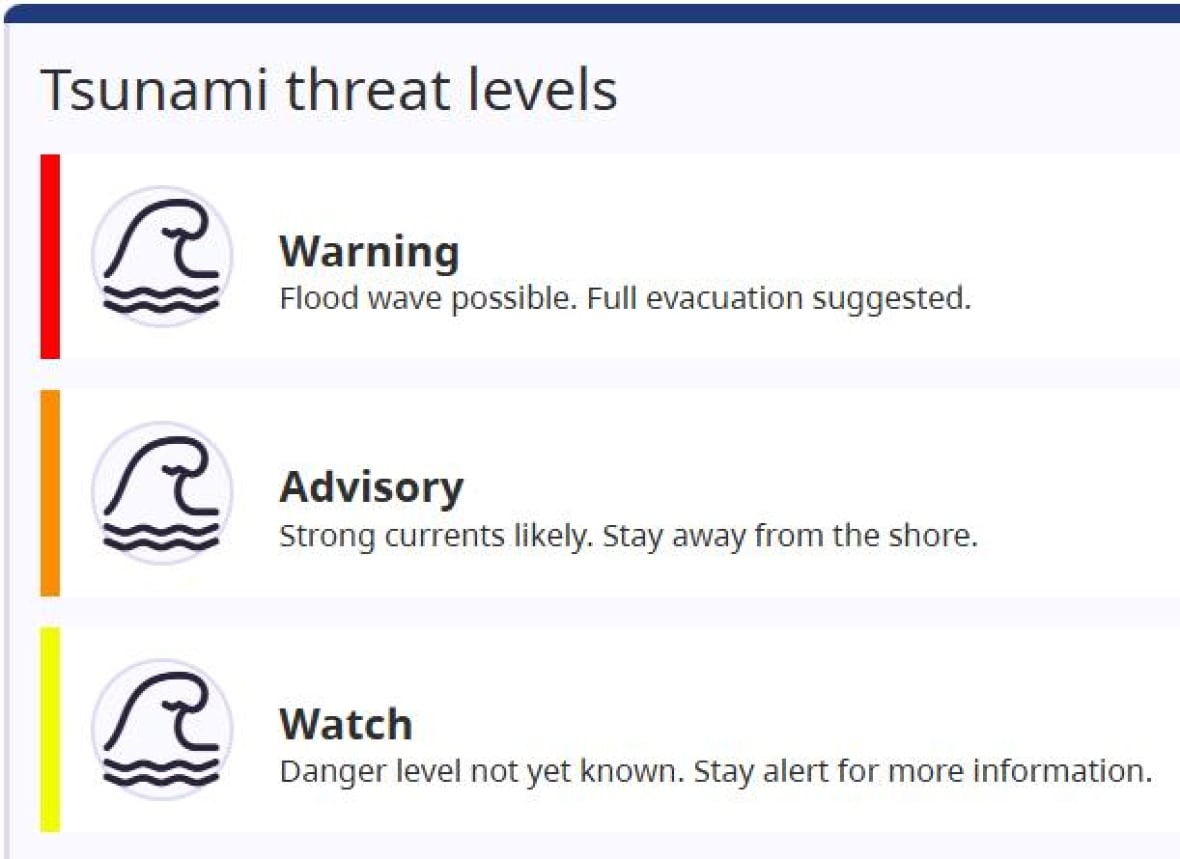
- An advisory is the second step in a three-tiered warning system, and it means strong currents are likely.
- Officials say an advisory means significant flooding isn’t expected, but strong currents could be dangerous for those near the water.
- The advisory covers B.C.’s central and north coasts, Haida Gwaii and the west and northeast coasts of Vancouver Island.
- It also spans Juan de Fuca Strait and Greater Victoria, including the Saanich Peninsula.
- The District of Tofino on Vancouver Island says that tsunami activity may reach the community around 11:30 p.m. PT, with a wave height of around one foot (0.3 metres).
Residents have been asked to avoid shorelines and beaches after a tsunami advisory was issued for multiple parts of the B.C. coast following a large earthquake in the Pacific basin near Kamchatka, Russia, on Tuesday afternoon.
Tsunami activity is expected to cause strong currents and waves in some regions of coastal B.C. late Tuesday night, with emergency officials saying that tsunami waves arrive in a series and the first of them may not be the biggest.
The U.S.-based National Tsunami Warning Centre says there was a magnitude 8.8 earthquake, with B.C. officials saying it occurred around 135 kilometres southeast of the Russian city of Petropavlovsk around 4:25 p.m. PT.
A tsunami advisory, upgraded from an earlier watch, was issued for B.C.’s north and central coasts, including Kitimat and Bella Coola, Haida Gwaii and the west and northeast coasts of Vancouver Island.
It also spanned the Juan de Fuca Strait from Jordan River to Greater Victoria, including the Saanich Peninsula.
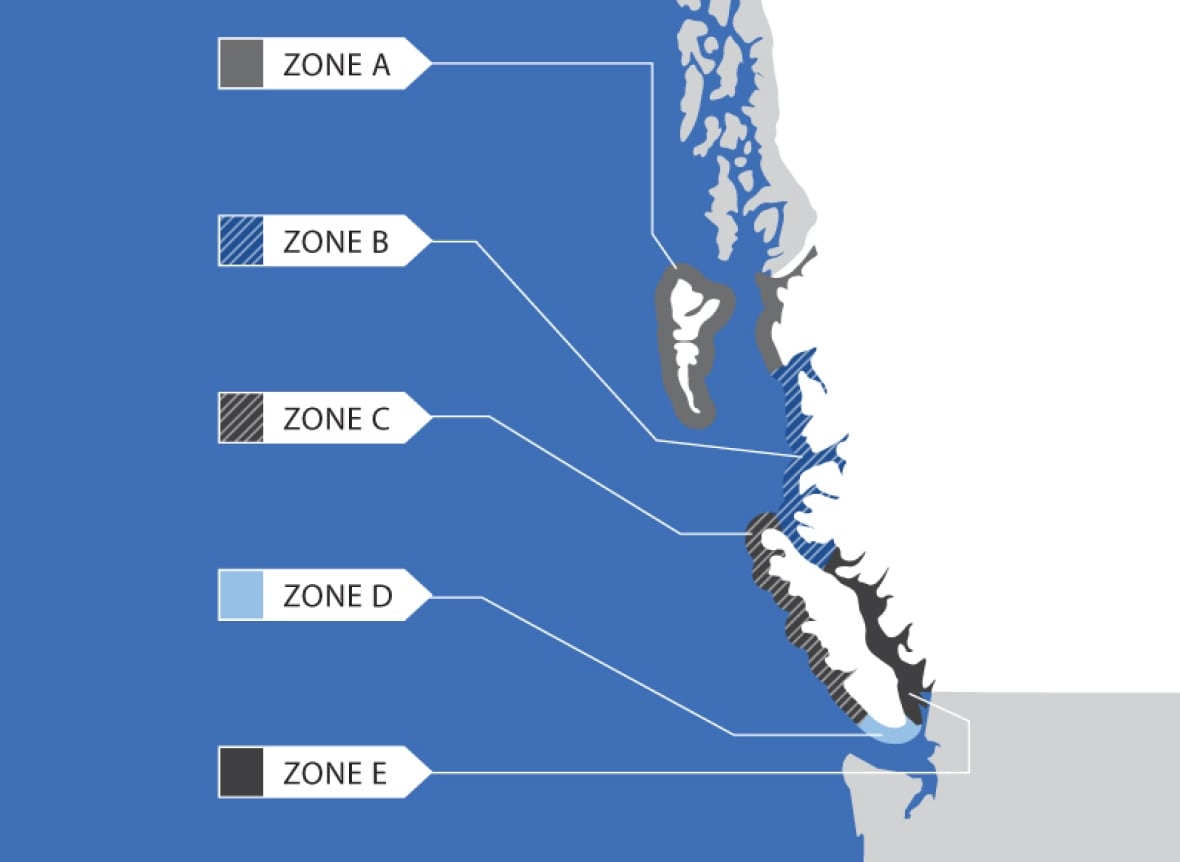
A tsunami advisory means residents should move away from the ocean and stay alert for more instructions from officials. They say the advisory means strong currents are likely in coastal regions.
“Significant inundation is not expected for areas under an advisory, but coastal zones may be at risk due to strong currents,” reads an Emergency Info B.C. advisory.
For Tsunami Notification Zones A, B, C, & D currently under Tsunami Advisory: <br>• Stay out of the water. DO NOT go to the shore to observe currents or waves<br>• Avoid low-lying coastal areas, harbors, marinas & beaches until emergency officials say it is safe<br>• Monitor for… <a href=”https://t.co/rMo16swgLj”>https://t.co/rMo16swgLj</a> <a href=”https://t.co/9siotR5snt”>pic.twitter.com/9siotR5snt</a>
—@EmergencyInfoBC
The advisory adds strong waves and currents could drown or injure people who are in the water, and currents at beaches, harbours, marinas or bays could be especially dangerous.
It had earlier advised boat operators in areas under a tsunami watch to move their boats out to sea to a depth of at least 180 feet (55 metres) if time and conditions permit, and avoid shallow water and inlets if they are already at sea.
A tsunami warning, which is the highest level, means that residents should move away from the water immediately.
Taimi Mulder, an earthquake seismologist with Natural Resources Canada, said that even if forecasted tsunami wave heights were small, people should heed the warnings to stay away from the water.
“One still wants to be away from the water, and the water’s edge, at that time,” she told CBC News late Tuesday night.
“Because unpredictable things could happen, and the currents will be much stronger than normal, and the water will be more confused-looking than normal.”
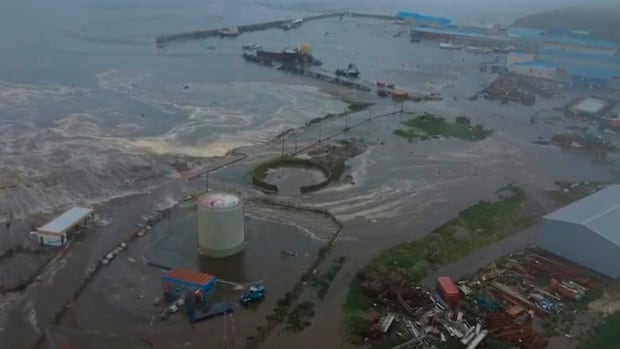
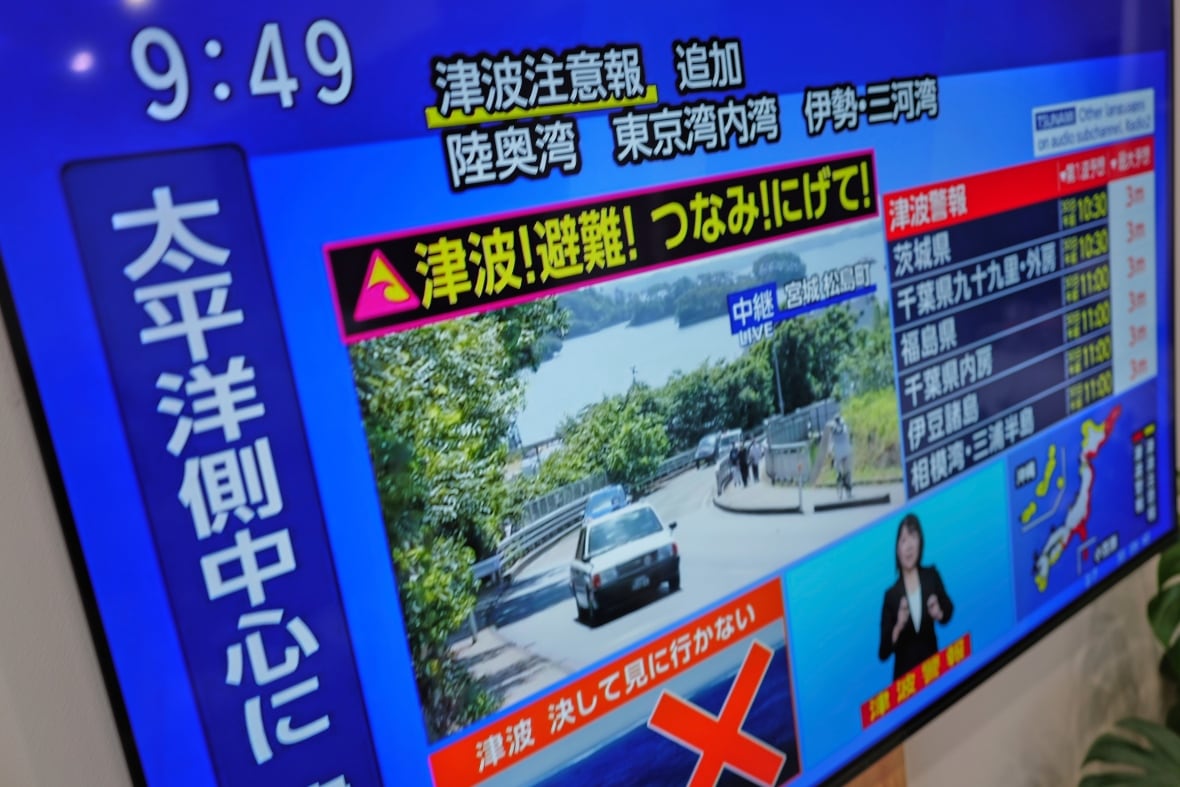
An 8.8 magnitude earthquake in eastern Russia caused widespread tsunami warnings as far away as Japan, Hawaii and the B.C. coast.
Tofino beaches closed
The District of Tofino on the west coast of Vancouver Island said in an emergency notification around 7 p.m. PT that people shouldn’t go to the shore to observe the waves, and later told CBC News in an email that it had closed all beaches until further notice.
It says the National Tsunami Warning Center has indicated tsunami activity would reach Tofino around 11:30 p.m. PT on Tuesday, with a wave height of around one foot (0.3 metres).
Emergency Info B.C. says Langara Island, off the coast of Haida Gwaii, saw tsunami waves around 10:05 p.m. PT, but the wave height was forecast to be less than 0.3 metres.

John Cassidy, another seismologist with Natural Resources Canada, said Tuesday’s earthquake was the type of seismic movement that was most likely to generate a tsunami.
“Those waves can travel across the Pacific…. They can travel a long way when they’re out in the open ocean,” he told Jason D’Souza, host of CBC’s All Points West, just before 6 p.m. PT on Tuesday.
“The tsunami waves travel at about the same speed as a jet,” he added.
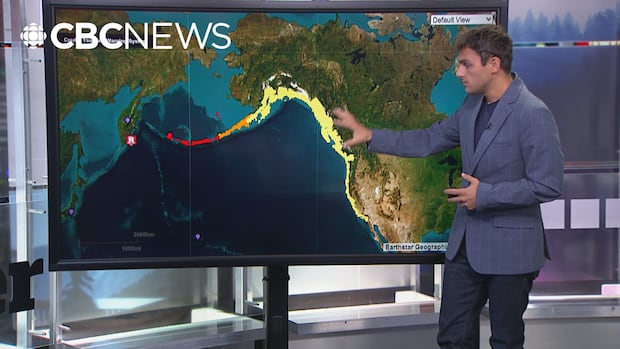
CBC’s Darius Mahdavi reports on a massive earthquake in the Pacific Ocean which has led to a tsunami watch in parts of B.C.
If the magnitude of 8.8 is confirmed, the earthquake would be among the top 10 strongest earthquakes recorded since 1900, according to the U.S. Geological Survey.
It would be the strongest earthquake since the devastating 2011 earthquake that struck near the Tōhoku region of Japan, which had a magnitude of 9.0 and triggered a tsunami wave more than 40 metres high.
“It’s a larger earthquake than we’ve seen,… in my lifetime anyway, that’s that close [and] could potentially affect our B.C. coast,” said Elmer Frank, chief councillor of the Tla-o-qui-aht First Nation, whose traditional territories encompass Tofino and Ucluelet on Vancouver Island.
Frank said Tuesday’s earthquake and tsunami scare is a reminder for his community to keep up on emergency drills and preparedness.

Warning issued for Hawaii
The U.S. Geological Survey, in an updated measurement on Tuesday evening, said the quake hit at a depth of 20.7 kilometres.
A tsunami warning was issued for the U.S. state of Hawaii, with the National Weather Service’s Pacific Tsunami Warning Center saying a tsunami from the quake had been generated that could cause damage along the coastlines of all the Hawaiian islands.
“Urgent action should be taken to protect lives and property,” the warning stated.
A tsunami warning is also in place for parts of the Alaska Aleutian Islands, and damage was reported near the quake’s epicentre on the Kamchatka Peninsula.
Japan’s meteorological agency issued a tsunami alert for Japan’s Pacific coast, upgrading an earlier advisory that warned of a tsunami of up to three metres across the Pacific coast of Japan.
www.cbc.ca (Article Sourced Website)
#Tsunami #watch #upgraded #advisory #B.C #coast #major #earthquake #Russia #CBC #News