

For five millennia, human civilization has progressed on the back of a simple yet rigid idea: the gear. From the chariot wheels crossing the Gobi Desert in 3,000 BCE to the intricate bronze clockwork of the Antikythera mechanism in ancient Greece, we have relied on interlocking teeth to transfer power. No matter the design, the rule has always been strict: mesh the gears perfectly or fail.
But now the solid gear is finally facing some much-needed competition thanks to innovation sparked out of the labs of New York University (NYU).
The NYU researchers essentially developed a gear system that has no teeth and never touches its partner. Instead of grinding metal or wood, these new “fluid gears” use liquid to transmit rotational force. While such power transfer will never replace the solid gears in your car’s gearbox, fluid gears could prove instrumental in robotics, allowing us to build machines that are softer, safer, and virtually unbreakable.
The End of the Grind
The problem with traditional gears is that they are inherently fragile. Whether they are made of Bronze Age wood or modern industrial steel, they share a fatal flaw: friction. If the teeth don’t line up exactly, the machine jams. In some sensitive cases, if a single grain of sand gets into the works, the system can grind to a halt.
“Regular gears have to be carefully designed so their teeth mesh just right, and any defect, incorrect spacing, or bit of grit causes them to jam,” explains Leif Ristroph, an associate professor of mathematics at NYU’s Courant Institute.
Ristroph, along with colleague Jun Zhang and doctoral candidate Jesse Etan Smith, wanted to see if they could decouple the machine from the material. They wondered if the laws of fluid dynamics could replace physical contact entirely.
“We invented new types of gears that engage by spinning up fluid rather than interlocking teeth — and we discovered new capabilities for controlling the rotation speed and even direction,” says Zhang, a professor of mathematics and physics at NYU and NYU Shanghai.
Their research, published January 13 in Physical Review Letters, details a system that looks less like a clock and more like a chemistry experiment. But the innovation could spark a wave of applications, the most interesting of which read like pure cyberpunk: machines that can heal themselves, ignore damage, and change their function on the fly.
How to Build a Liquid Machine
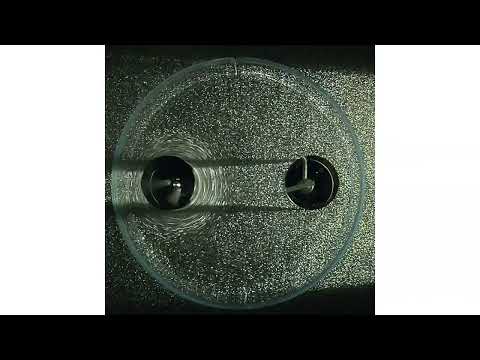
To create this frictionless transmission, the team submerged two cylinders, called rotors, into a tank filled with a thick mixture of water and glycerol. They added tiny air bubbles to the goop, allowing them to visualize the invisible currents swirling through the tank.
The setup was deceptively simple. One cylinder was hooked up to a motor (the active rotor), while the other was left free to spin (the passive rotor). In a standard mechanical setup, if these two didn’t touch, nothing would happen. But in the fluid world, the space between objects is alive with energy.
The researchers found that when they spun the active rotor, it dragged the fluid along with it. This created a hydrodynamic link between the two cylinders. Depending on how they tweaked the system — changing the speed of the spin or the distance between the rotors — the liquid morphed into different mechanical tools.
At close range, the fluid between the cylinders acted like invisible, interlocking teeth. The swirling eddies gripped the passive rotor, forcing it to spin in the opposite direction. It was a perfect recreation of a standard gear train, but without a single solid point of contact.

Magic Pulleys and Invisible Belts
Things got weirder when the researchers pulled the cylinders further apart or cranked up the speed.
In traditional mechanics, if you want to switch from a gear system (where wheels spin in opposite directions) to a pulley system (where they spin in the same direction), you have to rebuild the machine. For instance, you need to swap out parts or add a physical belt.
The fluid gears, however, are mutable. When the researchers increased the distance or speed, the fluid flow stopped acting like teeth. Instead, the current looped around the outside of the passive cylinder, acting like a phantom fan belt. Suddenly, the passive rotor started spinning in the same direction as the active one.
“Closer analysis showed why these flips happen,” Zhang told The Brighter Side of News. “Fluid sliding along the inner side of the passive rotor tends to push it one way. Fluid sweeping around the outer side pushes it the opposite way. The rotor’s motion depends on which effect is stronger.”
This means engineers can change the gear ratio or reverse the direction of a machine simply by speeding up the motor or moving the parts slightly. It offers a level of programmable flexibility that solid steel can never match.
Soft Robots in a Harsh World
Solid gears aren’t going away. They remain the gold standard for high-power, rigid, heavy-load transmission. Fluid gears are for low-load, high-flexibility, and delicate environments where preventing breakage is more important than raw strength.
As such, the potential applications for this technology are limited relative to the ubiquity of solid gears, but fluid gears are particularly appealing in the growing field of soft robotics. We are moving toward a future where robots need to be flexible and squishy to interact safely with humans or navigate unpredictable environments. Putting a rigid, jam-prone gearbox inside a soft robot is a recipe for failure.
Fluid gears may solve this. They are non-contact, meaning they don’t wear down over time. “Fluid gears are free of all these problems, and the speed and even direction can be changed in ways not possible with mechanical gears,” Ristroph notes.
Crucially, they are immune to the grit that destroys traditional machinery. If a piece of sand or debris enters a fluid gear, the liquid simply flows around it. This makes them ideal for rovers exploring dusty planets, submersibles in silty oceans, or medical devices operating inside the human body, where reliability is a matter of life and death.
www.zmescience.com (Article Sourced Website)
#Touchless #Gear #System #Fluid #Dynamics #Transfer #Power #Rotation #Teeth