
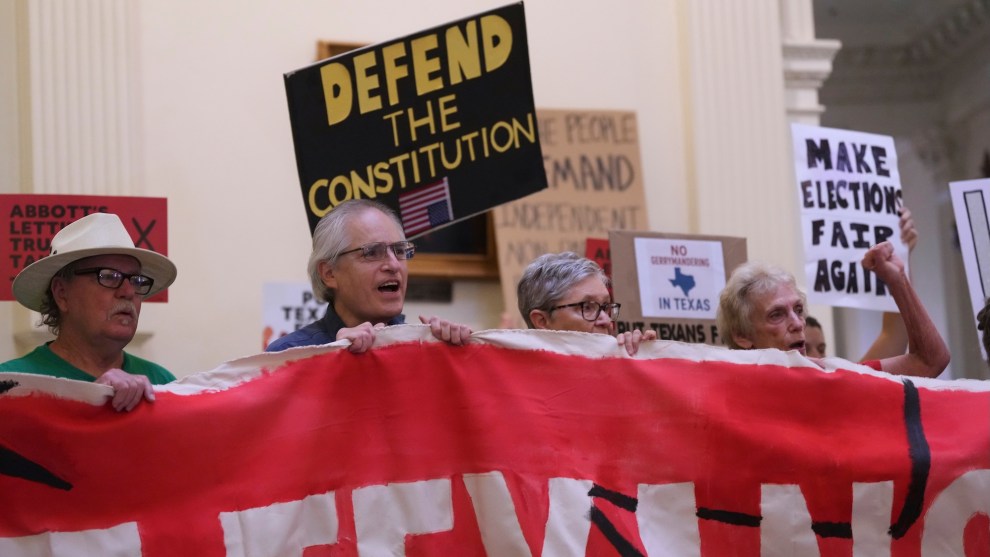
Protesters gather in the rotunda of the Texas Capitol as lawmakers debate a redrawn U.S. congressional map in Texas during a special session, Aug. 20, 2025, in Austin, Texas.Eric Gay/AP
The Supreme Court on Thursday reinstated the Trump-inspired gerrymandered congressional map in Texas after it was blocked by a lower court, with the Roberts court once again putting its thumb on the scale to weaken protections for minority voters and entrench GOP political power.
The conservative justices approved the Texas map, they wrote in an unsigned order, because “the District Court failed to honor the presumption of legislative good faith” and “improperly inserted itself into an active primary campaign, causing much confusion and upsetting the delicate federal-state balance in elections.”
Justice Elena Kagan dissented, joined by Justices Sonia Sotomayor and Ketanji Brown Jackson. “Today’s order disserves the millions of Texans whom the District Court found were assigned to their new districts based on their race,” she wrote. “Race provided the excuse for the partisan effort. And yet more critically, race provided the key means of implementing it.”
“Today’s order disserves the millions of Texans whom the District Court found were assigned to their new districts based on their race.”
Texas passed its mid-decade redistricting plan over the summer, when Trump said his party was “entitled to five more seats.” That launched a redistricting arms race ahead of the midterms. But the map was struck down earlier this month by a Trump-appointed federal judge, Jeffrey Brown, who wrote for the majority on a three-judge panel that “substantial evidence shows that Texas racially gerrymandered the 2025 Map.”
As I wrote at the time:
The panel’s two-judge majority pointed specifically to a Justice Department letter from early July that claimed that four congressional districts where Black and Latino voters comprised a combined majority were “unconstitutional racial gerrymanders.” Texas Gov. Greg Abbott cited that letter as the rationale when calling a special legislative session that month to redraw its congressional map. “The Governor explicitly directed the Legislature to redistrict based on race,” Judge Brown wrote.
Texas Republicans claimed the redistricting effort was motivated by partisan politics, a practice which the Supreme Court has said cannot be reviewed in federal court. But Brown concluded that “the letter instead commands Texas to change four districts for one reason and one reason alone: the racial demographics of the voters who live there.” The judge was unsparing in his criticism of the Justice Department, writing that the letter was “challenging to unpack” given its “many factual, legal, and typographical errors.”
The court concluded that the legislature “dramatically dismantled and left unrecognizable all four districts” targeted by the DOJ. The state ultimately eliminated seven “coalition districts” where two or more minority groups had joined forces to elect their preferred candidates, and turned them into districts where a single race predominated instead.
“It wasn’t enough for the map to merely improve Republican performance,” Brown wrote. “It also needed to convert as many coalition districts to single-race-majority districts as possible. That best explains the House bill’s authors’ comments during the legislative process and the map’s stark racial characteristics. The bill’s main proponents purposefully manipulated the districts’ racial numbers to make the map more palatable. That’s racial gerrymandering.”
In response, Judge Jerry Smith, a Reagan appointee, wrote a scathing dissent that personally attacked Brown for not giving him enough time to respond to the majority opinion and mentioned George Soros or his children 17 times.
The Trump administration responded to the decision by claiming, “Texas was not doing DOJ’s supposed bidding—much less in a race-conscious way—but instead was engaged in a race-blind partisan gerrymander that happened to affect the districts DOJ identified.”
The Roberts court laid the groundwork for Trump’s Texas gerrymander by holding in 2019 that partisan gerrymandering claims cannot be challenged in federal court. And it let Texas off the hook by allowing Republicans to claim that their racially gerrymandered map was simply done for partisan purposes, much like it did in a South Carolina gerrymandering case in 2024.
The Texas decision is yet another example of how the Roberts court has greenlit the many undemocratic schemes of Trump and his party, which my colleague Pema Levy and I documented in a new cover story for Mother Jones. That includes repeatedly gutting the Voting Rights Act and refusing to constrain excessive gerrymandering. The Roberts court has also repeatedly ruled in favor of Trump on the shadow docket, siding with his administration in roughly 90 percent of emergency orders.
And the conservative justices may not be done. The Supreme Court is currently considering whether to kill the last remaining protections of the VRA by holding that districts drawn to give representation to voters of color are unconstitutional. That could shift up to 19 US House seats in the GOP’s favor.
But the Supreme Court’s intervention on Trump’s behalf still may not be enough to save the president’s gerrymandering war. California voters last month passed Prop. 50, approving a new congressional map designed to give Democrats five new seats to offset Texas. (The Trump administration is now challenging the California map in court.) And though the GOP will likely pick up new seats in Missouri, North Carolina, and Ohio through new legislative maps, Democrats gained a seat through a court-order in Utah and could redraw maps in other Democratic states including Virginia. Meanwhile, Republicans have thus far been unable to muster enough support within their own ranks to draw new maps in Indiana, Kansas, New Hampshire, and Nebraska. That means the parties could more or less break even in a redistricting war.
Despite the best efforts of the Roberts court, what once appeared to be a decisive win for Trump’s party is now looking much more like a stalemate.
www.motherjones.com (Article Sourced Website)
#Roberts #court #helped #Trump #rig #midterms