
Invite Sicily into your home kitchen with these irresistible soft Italian pistachio cookies: chewy, nutty, naturally gluten-free cookies that stay tender for days and disappear fast from any cookie tray.

This post contains affiliate links. Full disclosure is at the bottom of the article.
Italian pistachio cookies were one of the first treats that made me understand just how serious Italians are about their sweets. Back in 2012, I went on a press trip to Sicily—it was my first visit to an island that would completely enthrall me. One of the stops on our tour was I Dolci di Nonna Vincenza, a legendary Sicilian pastry shop.
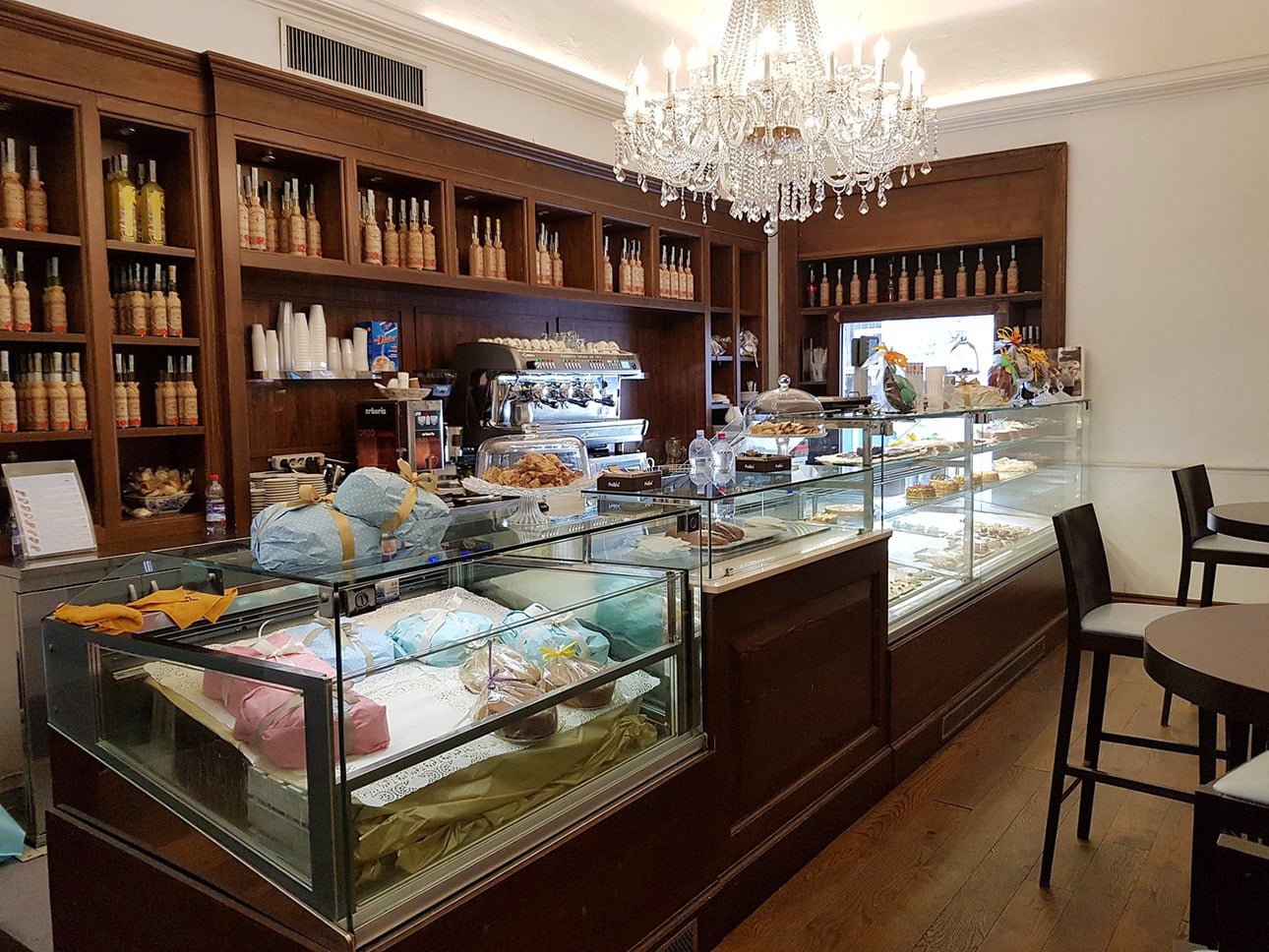
Photo by Ktylam, via TripAdvisor.
This pastry shop is famous for its cannoli, and although I do remember they were indeed very good, the souvenir that really stayed with me from that visit was the bag of paste di pistacchio I picked up on a whim. The cookies didn’t look like much—just sugar-coated pistachio chunks of “something”—but I was on a mission to taste every pistachio treat I could find on that trip. In Sicily, just about everything is made or topped with pistachios, from pasta, salads, and risotto, to sweets like gelato, semifreddo, and of course, cookies.
I wasn’t familiar with these particular classic cookies and assumed they’d be hard and crunchy, which is probably why I still remember my first bite of this Italian cookie to this day. These are not hard, crunchy cookies; they’re soft, chewy, a little sticky, incredibly nutty, and bright green inside thanks to precious Bronte pistachios grown in Sicily.
Needless to say, that first bag didn’t last long. I bought many more over the course of the trip to bring back home and gifted these Italian pistachio cookies to everyone I loved. The reaction was always as enthusiastic as mine had been—and there were never enough cookies to go around.
On every trip I took to Italy after that, I hunted down paste di pistacchio to bring back. Of course, I started looking for a recipe right away, but I couldn’t find one in any of my many Sicilian or Italian cookbooks. It took years before I finally struck gold: I found a recipe I could build on in the cookbook published by a small Italian restaurant in Montreal, Elena. I’ve been tweaking and baking those cookies ever since, and I don’t plan on stopping anytime soon.
My Italian pistachio cookie recipe is my way of bringing a bit of that warm Sicilian sun into my home kitchen. The cookies are small, crinkly, and just slightly chewy in the middle, with a gentle crunch on the outside. They’re fragrant with pistachio and lemon, naturally gluten-free, and just sweet enough. They also keep beautifully for days, which makes them perfect for gifting—if you can resist eating the whole batch yourself.
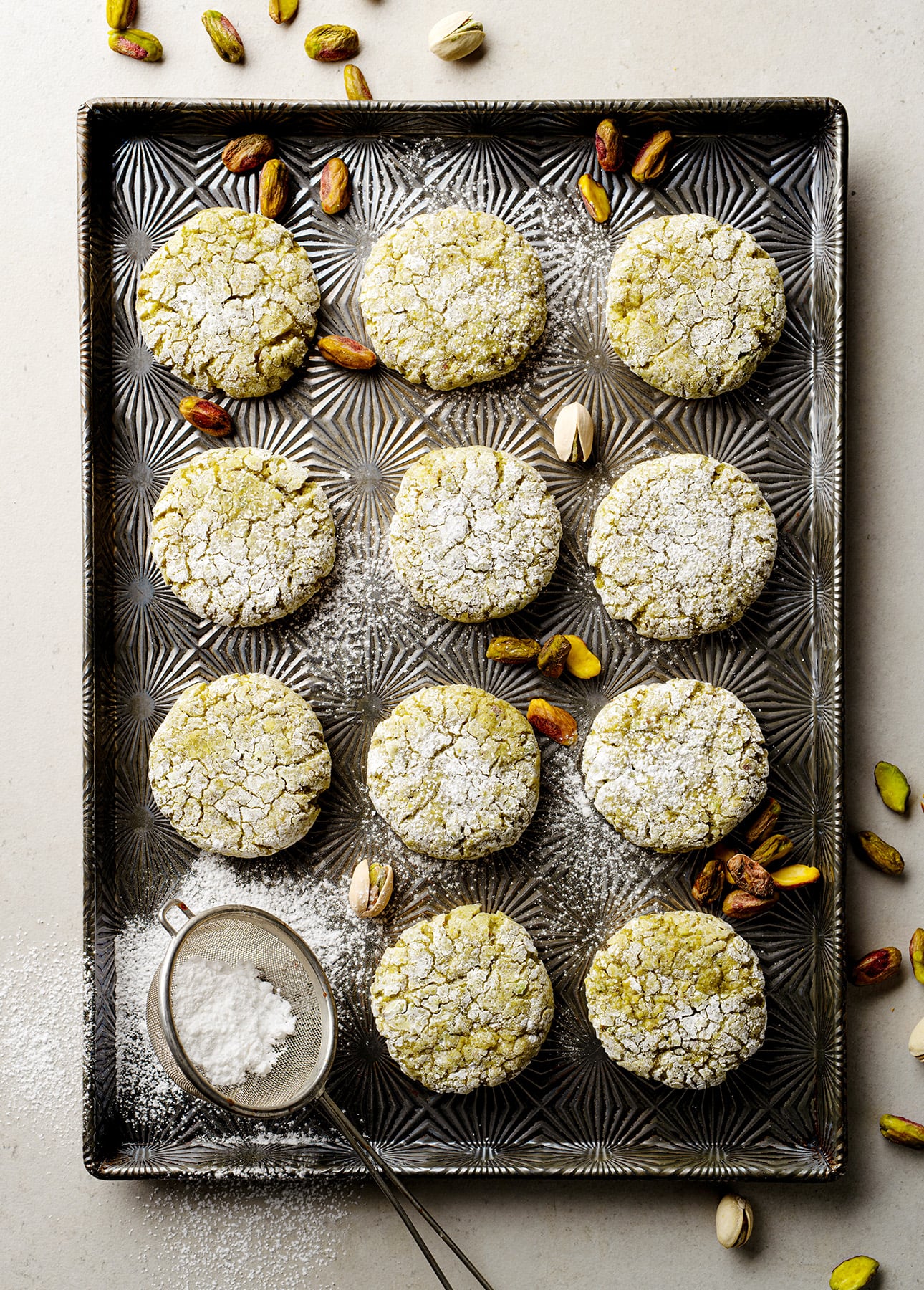
Italian pistachio cookies belong to the same extended family as soft amaretti: simple cookies made from nuts, sugar, and egg whites that do not contain any flour. In these cookies, pistachios take center stage, yielding a deeper, more distinctive flavor than classic almond amaretti—and, or course, that iconic soft green color.
You’ll often see them called paste di pistacchio, especially in Sicily. In pastry shops, such as I Dolci di Nonna Vincenza, almond cookies and candied citrus are usually displayed next to one another on large trays. The cookies take on different shapes: sometimes they’re irregular mounds, sometimes crescent-shaped, and other times rolled into balls or simple round cookies. The idea is always the same: a soft, almost marzipan-like interior wrapped in a delicate crust.
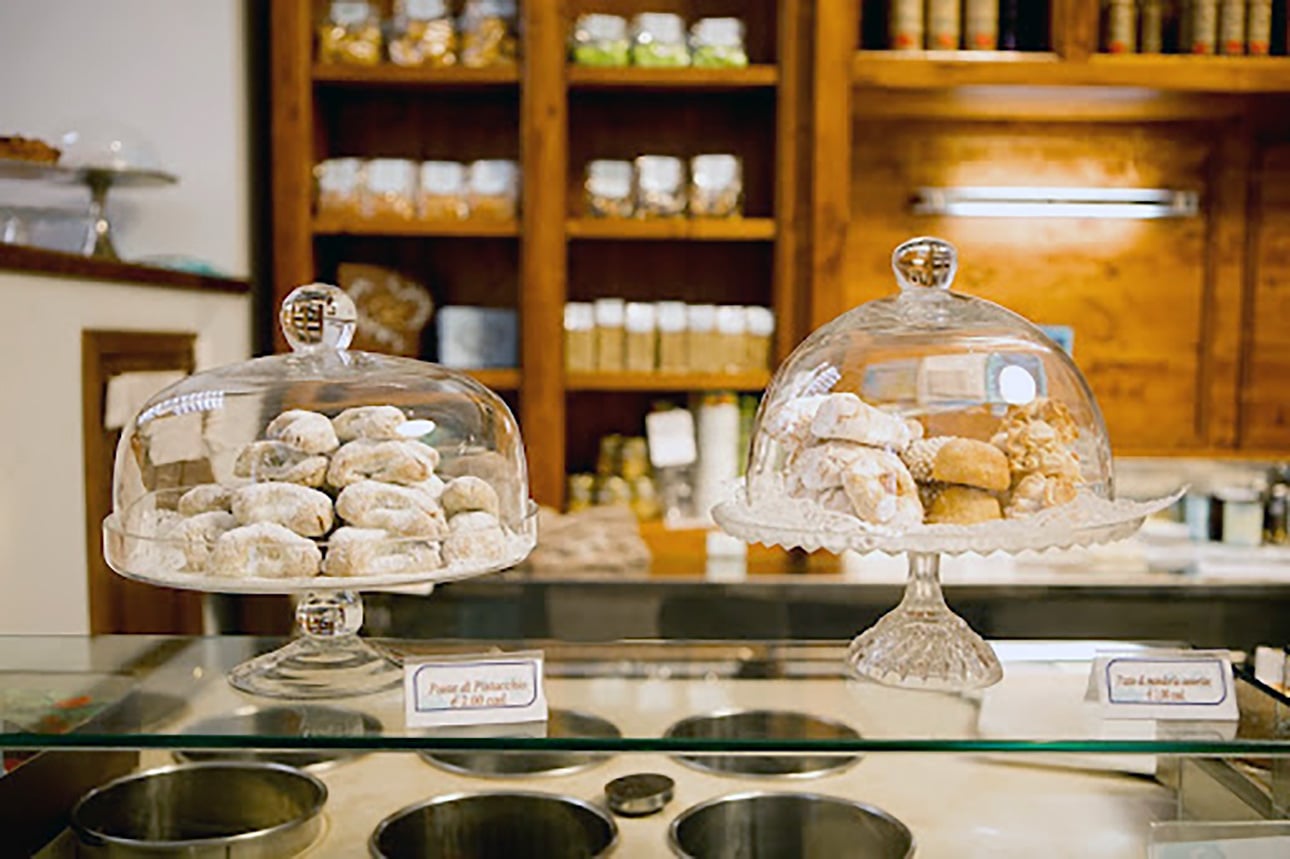
Photo by The Golden Bun.
It’s hard to overstate how addictive and satisfying these soft Italian pistachio cookies are. They really do earn their spot in a regular rotation!
- They bake up soft, with a chewy center that doesn’t dry out the next day.
- The recipe is naturally gluten-free and dairy-free, but still feels indulgent.
- A good hit of lemon zest and vanilla keeps the pistachio flavor bright, not heavy.
- They’re the ideal make-ahead cookies: the flavor actually improves as they rest.
Italian pistachio cookies are also friendly to busy schedules: you can make them in one bowl, on one baking sheet, and with no mixer or other cumbersome kitchen equipment. The most “technical” part is grinding the nuts without turning them into pistachio butter, but no worries: I’ll walk you through exactly how to prevent that.
VIDEO: How to Make Italian Pistachio Cookies
Watch how these Soft Italian Pistachio Cookies come together from start to finish in this step-by-step video. I’ll show you exactly how finely to grind the pistachios, how sticky the dough should be, and how to bake the cookies so they stay soft and chewy inside with that signature crinkly powdered-sugar crust. Hit play to see the texture you’re aiming for before you start baking!
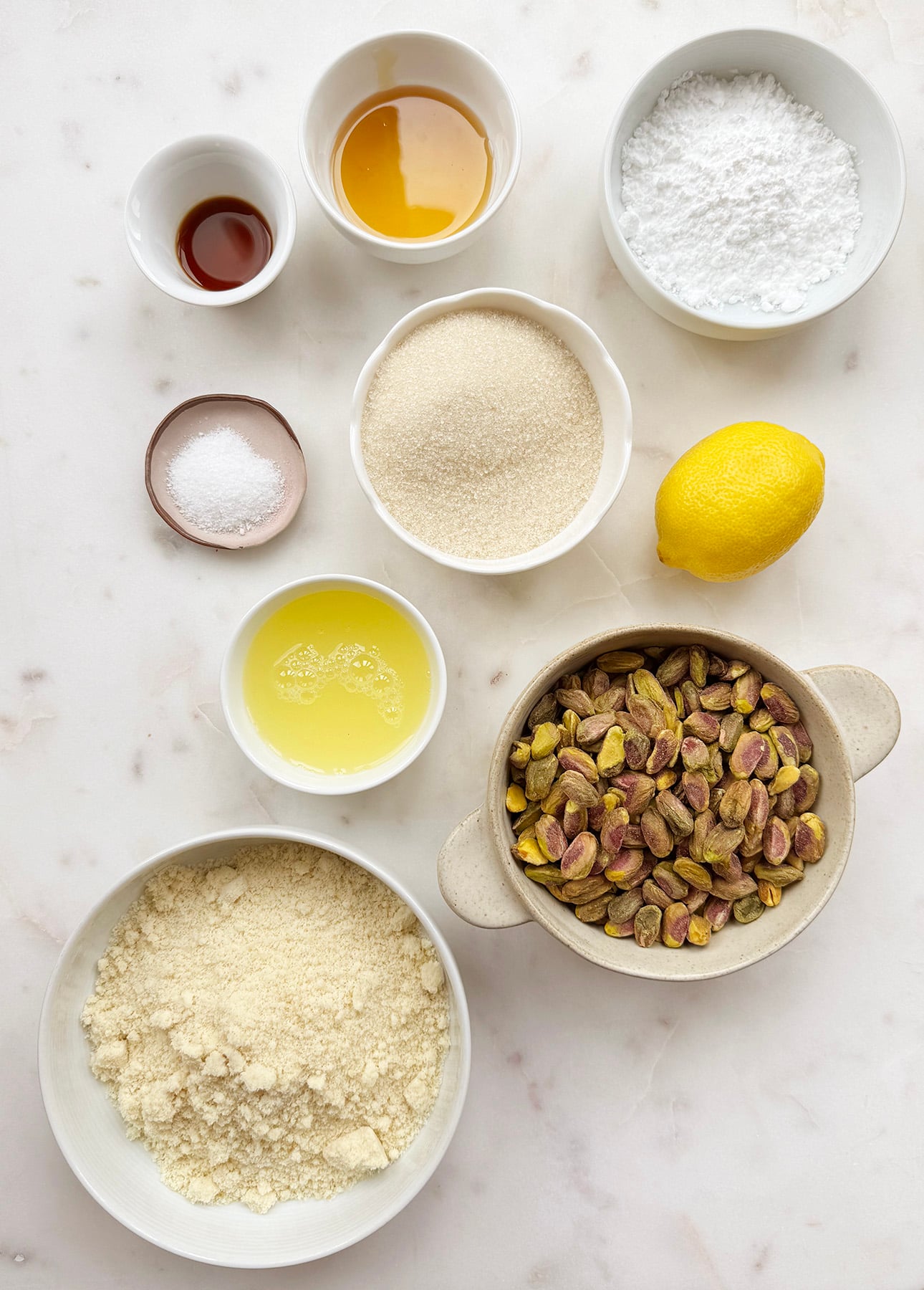
Pistachios and almond flour
At the heart of this recipe are pistachios. You’ll grind them together with sugar and a pinch of salt in the food processor, then fold in almond flour. The almond flour isn’t there to mute the pistachio flavor; it simply softens the texture and keeps the cookies pleasantly tender instead of dense and gummy.
When you pulse the pistachios with the sugar, aim for a fine, sandy texture. You might call it a coarse pistachio flour. You shouldn’t see any big nut pieces, but the mixture should still look powdery and loose, not oily or clumpy. If it starts to smear on the sides of the bowl, you’ve gone a little too far toward nut butter territory. You can still use the nuts, but just don’t go any further.
The best tool for grinding nuts quickly and evenly is a food processor; I often use the mini food processor attachment that comes with my hand mixer. If you don’t have a food processor, no worries: you can chop up the nuts yourself with a sharp knife. You’ll need to use all your elbow grease to make sure the nuts are as finely and evenly chopped as possible.
The “glue”: egg whites, honey, and flavorings
In these cookies, egg whites hold everything together and give them a gentle lift in the oven. Honey brings a deeper, more rounded sweetness and helps the cookies stay moist for several days. A bit of finely grated lemon zest brightens the whole thing, and vanilla ties it all together, somehow underscoring the smooth, nutty flavor of pistachios.
The dough will feel sticky when everything comes together; that’s normal. To make my paste di pistacchio, you don’t need a rolling pin and cookie cutters: you simply scoop the dough, roll it in powdered sugar, and bake!
Why Sicilian pistachios are exceptional
To me, all pistachios are special. I see them as a luxury nut, and their price certainly reflects that. But Sicilian pistachios? They’re something else. The most famous, world-renowned ones come from Bronte, a town on the slopes of Mount Etna. The volcanic soil and climate give Bronte pistachios an unusually intense, almost fruity flavor and a naturally vibrant green color.
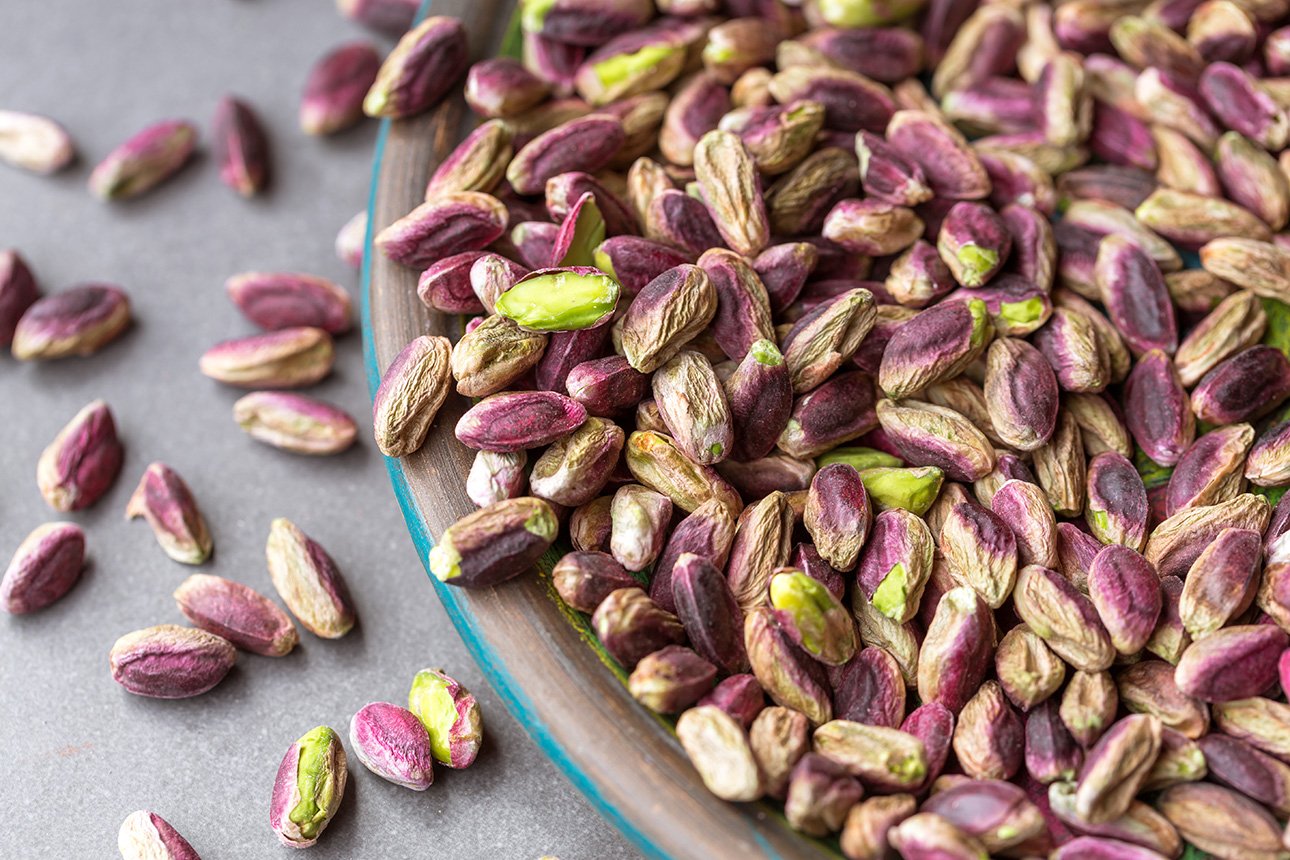
If you can find Sicilian pistachios, by all means use them to make these cookies. This Italian cookie recipe is probably the best showcase for them! But you don’t have to search high and low to find them, especially the Bronte variety; they tend to be expensive, even by pistachio standards. Just look for fresh-tasting pistachios that smell nutty, not oily or stale, and keep them in the refrigerator so they stay that way. I don’t recommend storing nuts in the freezer; the harsh temperature can cause freezer burn on your expensive nuts.
JUMP TO RECIPE
Step 1: Grind the nuts (but not too much)
Add the pistachios, sugar, and a pinch of salt to a food processor and pulse in short bursts. Stop and scrape down the sides once or twice; this keeps everything moving and prevents hot spots. You’re aiming for finely ground nuts—think coarse sand, not flour.
If the mixture starts to look damp or clumpy and coats the sides of the bowl, you might have gone a bit too far. You can still use the nuts; the cookies will still bake, but they may be denser and a bit greasy.
Better to stop a little early than a little late. This is also why I recommend using a food processor rather than a high-powered blender like a Vitamix. The latter are so powerful that it only takes seconds to go from ground nuts to nut butter.
Step 2: Mix the dough
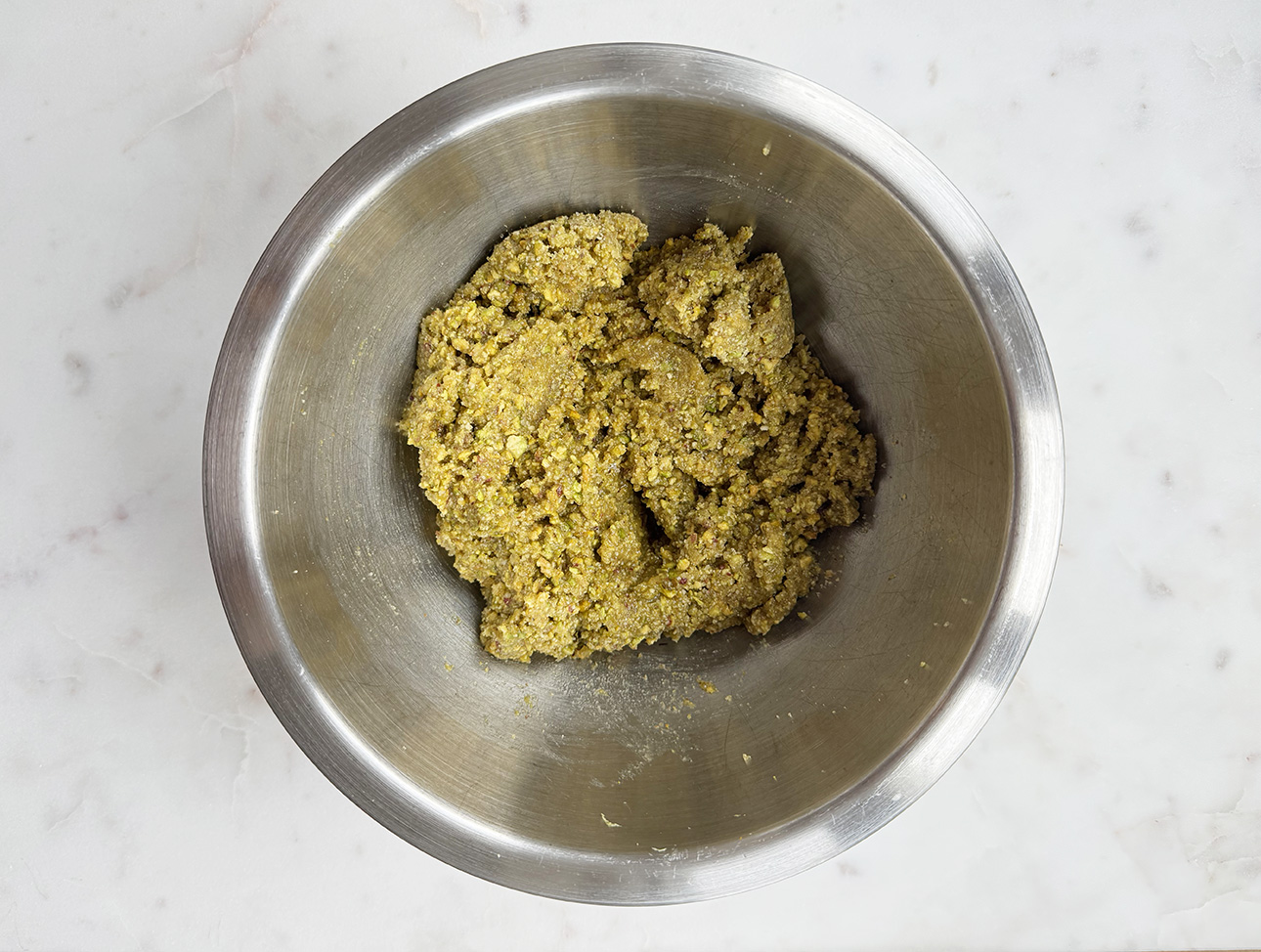
In a separate small bowl, whisk the egg whites with the honey, lemon zest, and vanilla. Pour the mixture over the ground nuts and almond flour, then use a fork to combine. After a short while, the mixture will come together. You can finish by lightly kneading with your hands, which will create a soft dough that holds together when pressed.
The dough will be sticky, and that’s exactly what you want. If you try to “fix” the stickiness by adding more almond flour, the cookies will end up dry.
Step 3: Shape and coat
To portion the dough precisely, I recommend using a medium (1 ½-tbsp) cookie scoop. If you don’t have one, you can use a measuring spoon or a regular spoon. Roll each portion briefly between your palms to form a smooth ball. Drop the balls into a bowl of powdered sugar and roll them around until they’re lightly coated. Since the dough is very sticky, a lot of sugar will stick at first. Rolling the sugared ball between your hands again will easily brush off any excess sugar.
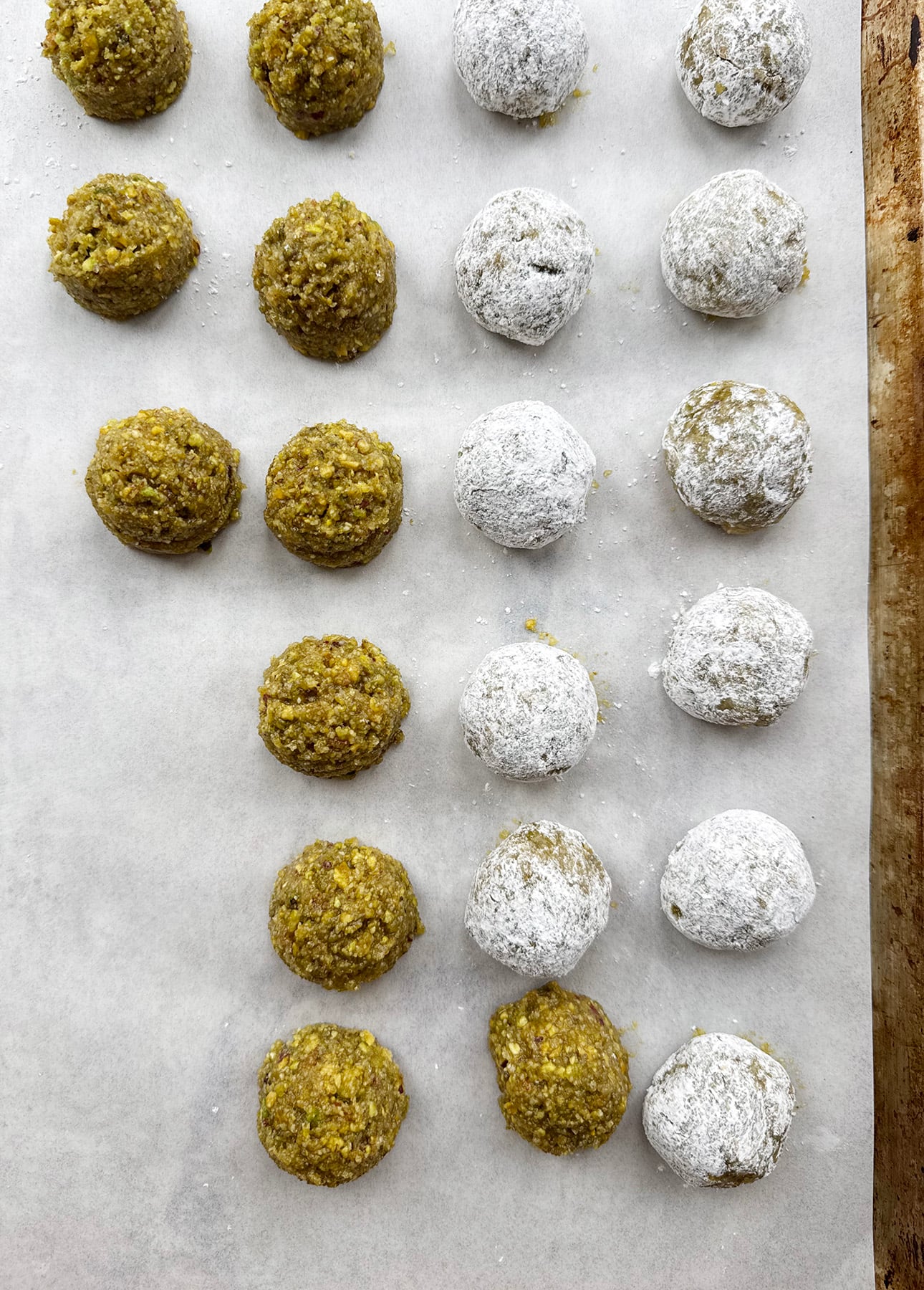
As you place them on the parchment paper-covered baking sheet, space the cookies about 2-in (5 cm) apart. Use your fingers, the palm of your hand, or the bottom of a glass to gently flatten the cookies. They won’t spread a lot, but this helps them bake evenly and crack nicely on top.
Step 4 – Bake until just set
Slide the baking sheet into a 350°F (175°C) oven and bake until the cookies are puffed, the powdered sugar has cracked, and the bottom edge is just beginning to turn golden (the color change should be very subtle).
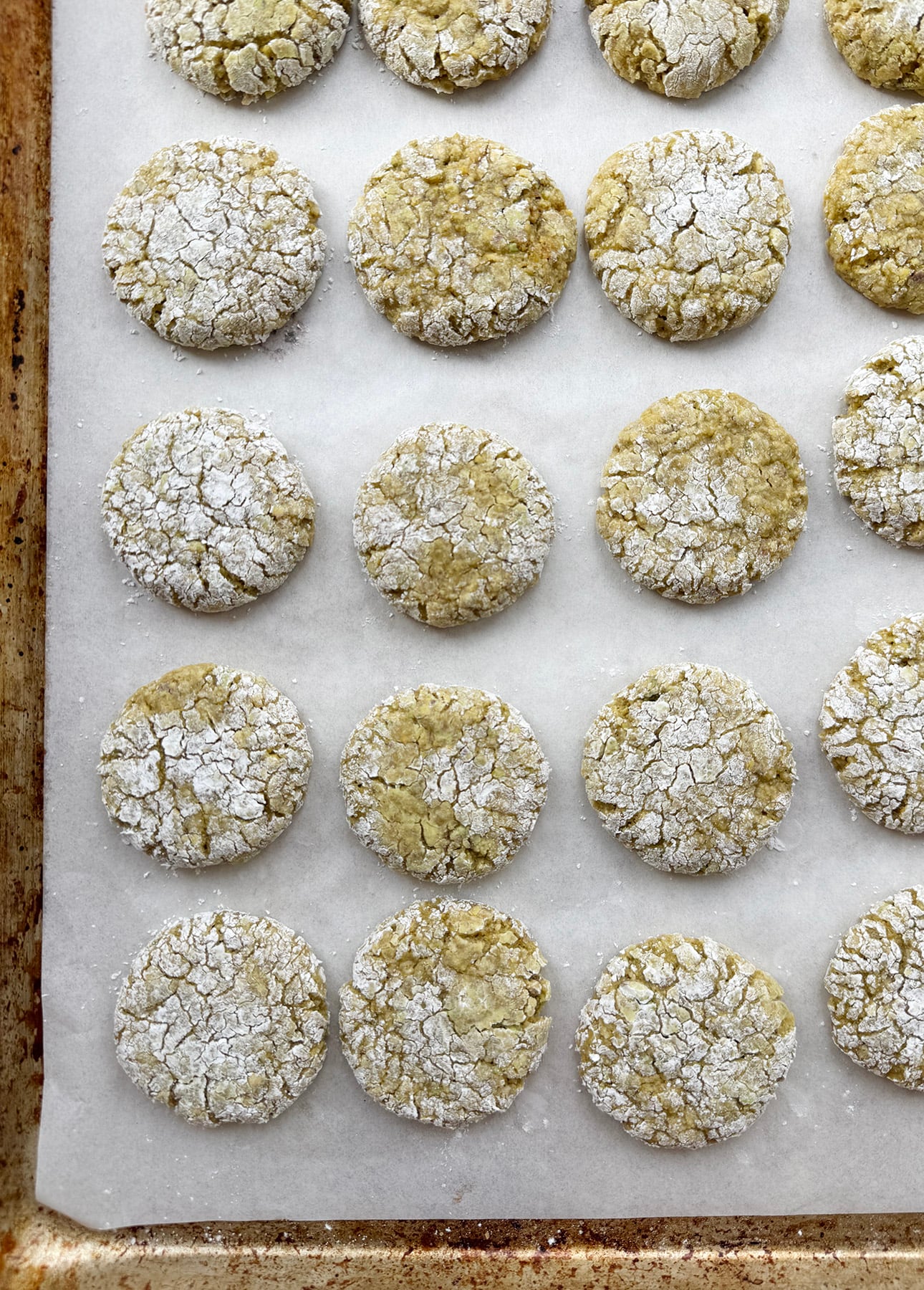
Because all ovens behave differently, this is one of those recipes in which you need to trust your eyes more than the timer. If the tops still look shiny and raw, give them another minute. If they’re browned all over, they’ve gone too far and will be hard and dry once cooled.
When they come out of the oven, they’ll feel very soft. Leave them on the baking sheet to cool for at least 15 minutes; they’ll firm up just enough while keeping that chewy center.
Natural Color vs. Neon Green
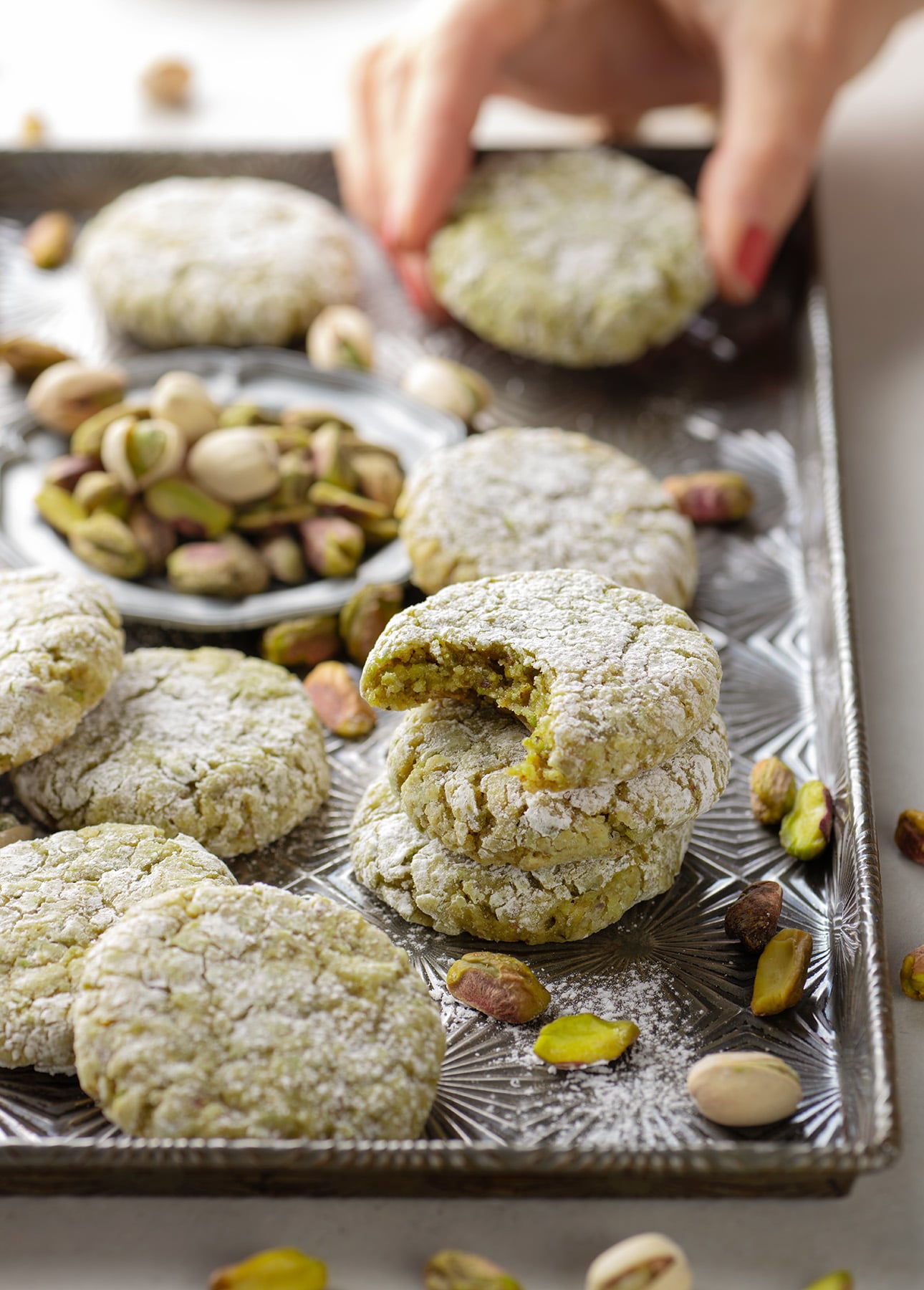
If you’re used to pistachio desserts made with pudding mix or food coloring, the soft, chartreuse green of these cookies might surprise you. That muted, speckled look is exactly what you see in Italian pastry shops and is a good sign you’re working with real pistachios, not flavoring.
Raw, Roasted, or Salted Pistachios?
I recommend using raw, unsalted pistachios. They give you the most control over the flavor and salt level. Lightly roasted pistachios can work too and will give the cookies a slightly toastier taste. If your pistachios are salted, omit the additional salt from the recipe. The cookies will have a slight savory edge, which is lovely when paired with the honey.
You can find raw, unsalted pistachios in bulk stores. Look for fresh-tasting pistachios that smell nutty, not oily or stale, and keep them in the refrigerator so they stay that way. You can also buy large bags of pistachios online; in Canada, my favorite supplier is Yupik. Their nuts are consistently fresh and they’re sold for a fraction of the price you’d pay in regular grocery stores.
How the Cookies Change Over a Few Days
Freshly baked, the cookies have a fragile shell and a very soft, almost gooey center. After a few hours, they develop the perfect chewy texture. By the next day, they taste even more pistachio-forward and almost fudgy, very much like soft amaretti.
If you’re baking for an event, you can easily make them a day or two in advance. Store them in an airtight container at room temperature and they’ll hold up beautifully.
Serving Ideas for Soft Italian Pistachio Cookies
These little cookies are surprisingly versatile. They’re lovely:
- with an afternoon espresso or strong tea,
- on an Italian-style cookie tray with amaretti, biscotti, and candied orange peel,
- as a light dessert when you want “just a bite” after a big meal.
I also like to sneak a couple onto dessert plates alongside gelato. The nutty, lemony notes make them a natural match for anything creamy or tart.
Perfect for Holiday Platters and Gift Boxes
Because they keep well and don’t crumble easily, these cookies are excellent travelers. They’re a yearly feature in the cookie boxes I make for family and friends! They’re always a hit. Make sure to bring them to holiday cookie exchanges, but be prepared to see your friends fight over every last one of them!
FAQ
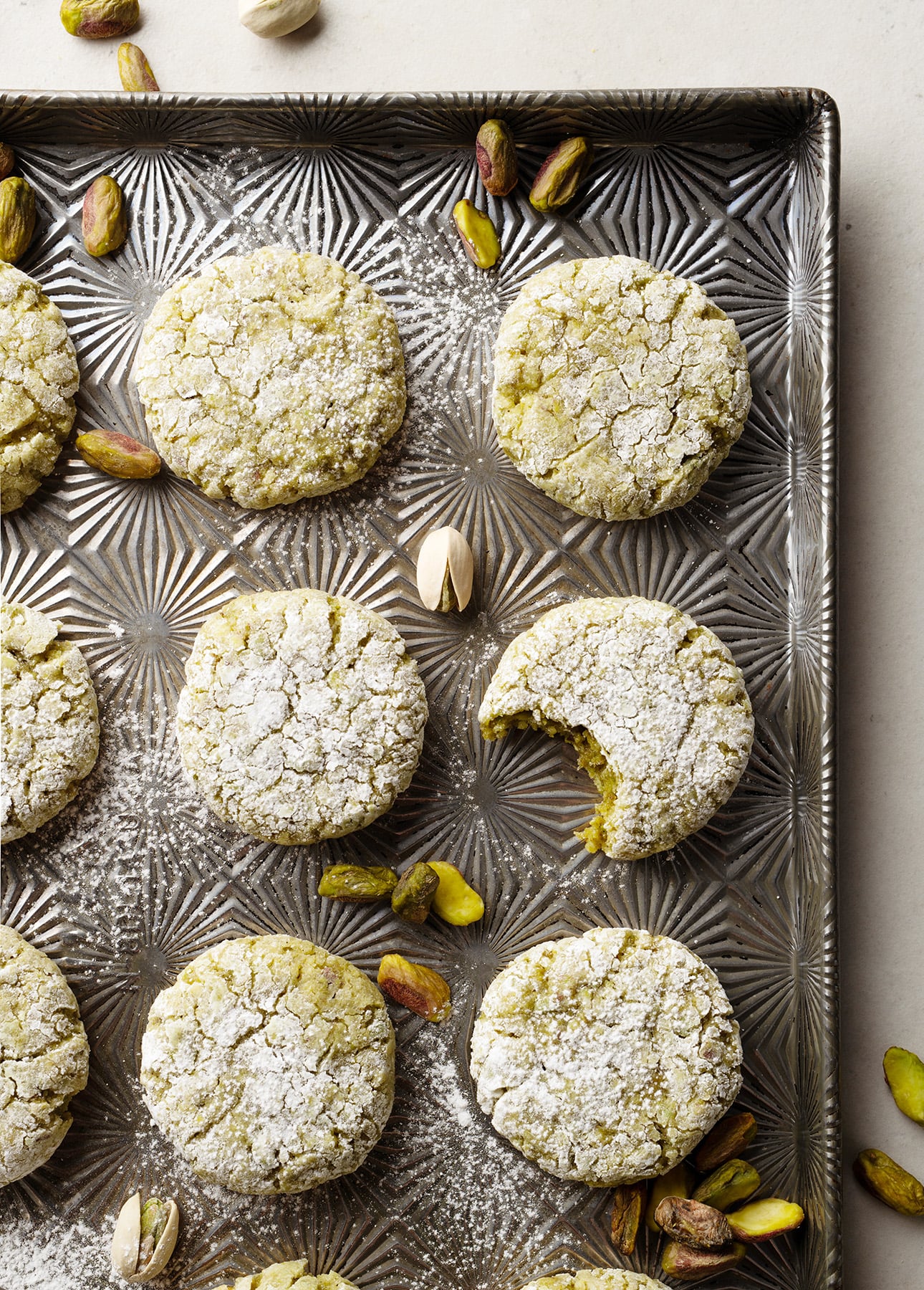
They should be soft and chewy in the center, not crisp all the way through. When you break one open, the interior should look moist and slightly dense—more like marzipan (almond paste) than a classic crunchy cookie.
PRO TIP: If a cookie snaps cleanly in half, it’s overbaked. If it bends a little before breaking, you’re right where you want to be.
After about 12 minutes, look for a few things:
- The tops have gone from shiny to matte;
- The powdered sugar has cracked into a nice pattern;
- The bottom edges of the cookies show just a whisper of golden color.
Gently nudge one cookie on the sheet; it should feel set on the outside but still a little soft. For 1 ½-tablespoon scoops, this usually happens around 14 minutes, but start checking earlier the first time you make them.
PRO TIP: If you’re hesitating between “one more minute” and “take them out,” take them out. Slightly underbaked is much better than dry.
They are. This recipe uses pistachios, almond flour, sugar, egg whites, honey, and flavorings—no wheat flour and no butter. If you’re baking for someone with celiac disease or serious allergies, just double-check your ingredient labels for potential cross-contamination.
You can freeze both, depending on what’s more convenient:
- Dough balls: Scoop out the dough, roll it into balls, then freeze them on a baking sheet. Once solid, transfer them to a freezer bag. Bake from frozen, rolling them in powdered sugar just before baking and adding a minute or two to the baking time.
- Baked cookies: Once completely cool, arrange them in a container with parchment between layers and freeze for up to 2 months. Thaw at room temperature and dust with a bit more powdered sugar if needed.
PRO TIP: If you know you’ll freeze the baked cookies, take them out of the oven while the centers are still a touch softer than you’d like. They’ll retain their chewy texture better after thawing.
- Preheat the oven to 350°F (175°C). Line a baking sheet with parchment paper. Place the powdered sugar in a small bowl and set aside.
- In a food processor, combine the pistachios, sugar, and a generous pinch of salt. Pulse until the nuts are finely but coarsely ground: no large chunks should remain, but you still want some texture. Transfer the mixture to a medium bowl, add the almond flour, and stir to combine.
- In a small bowl, whisk together the egg whites, lemon zest, honey, and vanilla. Pour this mixture over the pistachio–almond mixture and mix with your hands until the dough comes together in a moist, sticky mass, about 2 minutes.
- Using a medium cookie scoop (1½ tbsp/22 ml), portion the dough and roll each portion into a ball with your hands. Roll each ball in the bowl of powdered sugar to coat it generously, then arrange the balls on the prepared baking sheet, spacing them about 2-in (5 cm) apart. Using the palm of your hand or the bottom of a glass, press very lightly on each one to slightly flatten the top.
Bake for about 14 minutes, or until the cookies are just starting to turn lightly golden around the bottom edge and the tops look set but still soft. Remove from the oven and let cool on the baking sheet for at least 15 minutes—they will firm up as they cool while staying soft and chewy inside.
Once completely cool, transfer the cookies to an airtight container. They keep well at room temperature for up to 1 week and stay wonderfully soft, with the flavor improving after a day or two.
Did you make this?
Tell me how you liked it! Leave a comment or take a picture and tag it with @foodnouveau on Instagram.
Disclosure Notice: This site is a participant in the Amazon Associates Program, an affiliate advertising program designed to provide a means for the site to earn fees by linking to Amazon and affiliated sites.
If you click on an affiliate link, I may earn advertising or referral fees if you make a purchase through such links, at no extra cost to you. This helps me create new content for the blog–so thank you! Learn more about advertising on this site by reading my Disclosure Policy.
foodnouveau.com (Article Sourced Website)
#Soft #Italian #Pistachio #Cookies