
Grace Eliza GoodwinNew York
Jumping into the frigid waters of Coney Island in January for a pun on “I’m freezing… your rent”. Visiting food trucks to discuss how city permitting processes have led to “Halalflation”. Walking the length of Manhattan to show New Yorkers they “deserve a mayor that they can see, they can hear, they can even yell at”.
Those social media videos helped propel Zohran Mamdani and his left-wing policies to a surprise win in New York City’s mayoral primary, and then to victory in the November election.
The democratic socialist, 34, engaged New Yorkers – particularly young voters who spend much of their time “doom-scrolling” – by using social media to build an image of someone who is authentic and joyful, experts told the BBC.
Now, after he was sworn in as mayor on 1 January, his next challenge will be keeping those same supporters engaged and maintaining the momentum in office.
After becoming the first New York mayor to take the oath of office with his hand on a Quran, Mamdani told thousands gathered to watch his inauguration ceremony in freezing weather that he would represent everyone in the city.
“I do not stand alone. I stand alongside you,” he said, adding: “I promise you this: If you are a New Yorker, I am your mayor.”
About three-quarters of New York City voters under the age of 30 voted for Mamdani, according to an Associated Press voter poll.
Mamdani’s robust social media strategy engaged these voters by delivering an image of a political candidate that young people – frustrated with older, more established candidates – craved, said Jane Hall, a communications professor at American University who studies politics and the media.
A candidate does not have to be young to connect with young voters, Hall said, “but I think you have to be seen as being authentic and speaking to what people care about in a way that is hip and makes people want to be on the bandwagon”.
Jack Bratich, a journalism professor at Rutgers University who studies political culture and social media, said Mamdani has shown he is able to combine a lightheartedness with serious conversations.
That sense of fun stands in contrast to some of the negativity that President Donald Trump has leaned into on social media, Jennifer Stromer-Galley, who teaches communications, political science, and rhetorical studies at Syracuse University, told the BBC.

 Reuters
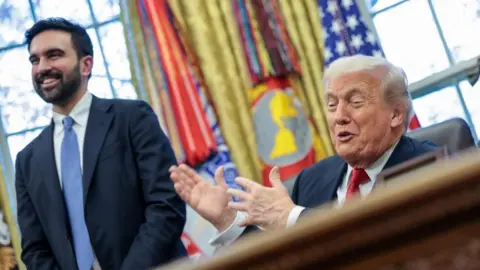
Despite an unexpectedly friendly first meeting in November between the two politicians, where they said they agreed on a number of issues facing New York City, such as the affordability crisis, the pair locked horns during the mayoral race.
Trump painted Mamdani as an extremist “lunatic”, threatened to withhold federal funding from the city if Mamdani won, and said he would have him arrested if he stood in the way of immigration enforcement operations.
On election night, Mamdani snapped back in his victory speech, telling the president “to get to any of us, you will have to get through all of us”.
That comment prompted a raucous cheer from his supporters at the time, but experts say the reality of governing may mean engaging with the Trump administration in a pragmatic way. That warm meeting in November may have been an early sign that Mamdani is willing to do so.
How he works with the White House – and the kind of relationship he cultivates with the president – could prove crucial for implementing his agenda.
While it may be easy to promise “fast, sweeping change” in campaign videos, things become much more difficult when it comes to actually “governing under a hostile administration”, said Ioana Literat, a Columbia University communications professor who studies youth online political socialisation.
“If his [social media] content doesn’t reckon honestly with those constraints, the same young people who made him go viral can just as quickly turn that energy into disillusionment or backlash,” she said.
To succeed in office Mamdani will need to keep his supporters engaged with day-to-day governing – and that is not as thrilling as a high-stakes political race, Jonathan Nagler, co-director of NYU’s Center for Social Media and Politics, told the BBC.
“It’s easy to mobilise people to oppose Trump. They already disagree with Trump on so many things, if we’re talking about New York City voters,” Nagler said.
“What’s much harder to do is to go on social media and say: “Hey, the New York City Council is in my way. I need you to get riled up about convincing the New York City Council to do something”.
Nagler added that it could be a challenge to educate some of those voters about how city government works.
“Like all election campaigns, the transition to governance via media is tricky,” Rutgers Prof Bratich said.
One strategy for keeping the momentum of his campaign could be to turn his captive social media followers into active grassroots organisers. After all, social media “was the front door into a huge field operation and youth volunteer corps” for the mayor-elect, Braitch said.
Mamdani’s posts during the campaign consistently directed followers toward protests, canvassing events, registration drives, and other forms of active participation – ultimately producing more than 100,000 volunteers.
“But if his administration stumbles and the feeds keep promising more than he can deliver, it could harden a sense among young voters that ‘even the internet’s mayor couldn’t change anything,'” Literat said.
“That broader reputational risk is part of what makes his governing-era social media so consequential,” she added.
Mamdani’s transition team did not respond to a request for comment from the BBC.
But there is at least one major sign that that the grassroots momentum surrounding Mamdani will continue.
In November, his allies announced a new advocacy group that aims to use his deep well of volunteers to raise funds for his agenda. The nonprofit, Our Time for an Affordable NYC, was founded by Mamdani volunteers and members of the Democratic Socialists of New York.
While Our Time is legally separate from Mamdani and his transition team, the group says it is focused on pushing forward the mayor-elect’s affordability agenda through “door-knocking, phone-banking, communicating, and organising at the neighbourhood, city, and state level”.
Mamdani’s swearing-in ceremony on Thursday took place inside the original City Hall subway station, which is now abandoned for regular transit.
“This is truly the honour and the privilege of a lifetime,” he said. “I cannot wait to see everyone tomorrow as we begin our term.”
www.bbc.com (Article Sourced Website)
#Social #media #fuelled #Mamdanis #rise #momentum #mayor