
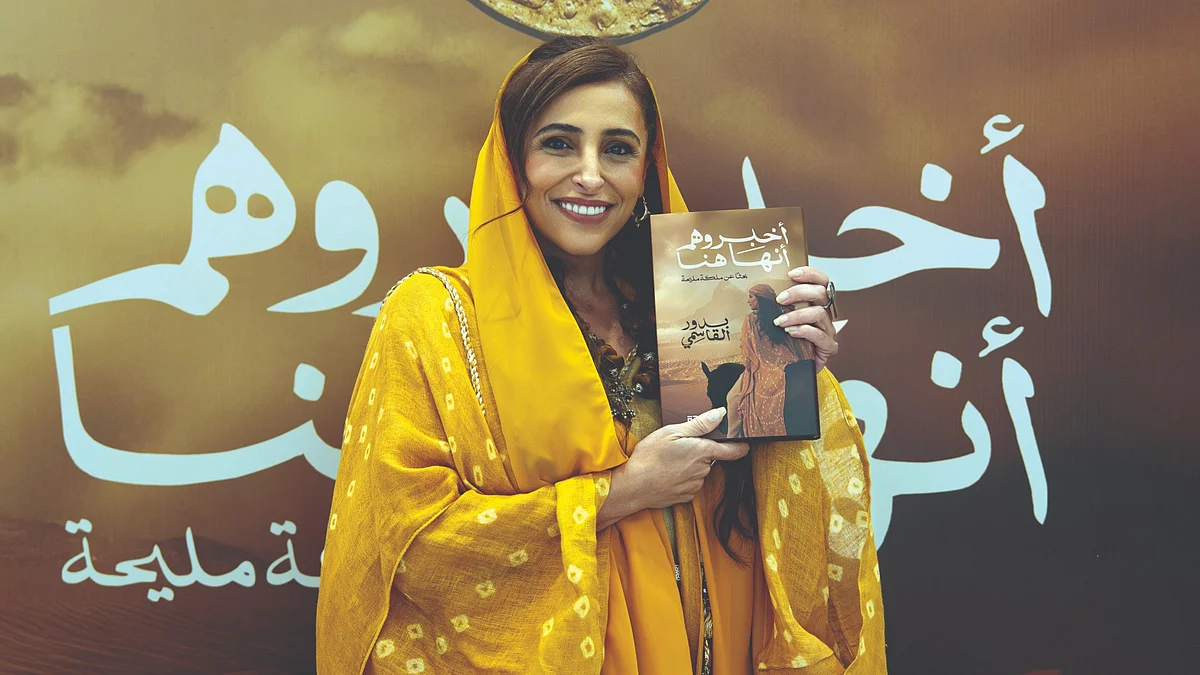
Sheikha Bodour bint Sultan Al Qasimi is a rare kind of multi-hyphenate whose work spans several, diverse fields. She is president of the American University of Sharjah, chairperson of Sharjah Book Authority, founder and CEO of Kalimat Group, author, an accomplished mountaineer, a UNESCO Goodwill Ambassador for Education and Book Culture and founder of Tanweer Festival among many other accomplishments in education, arts, culture and publishing.
Most recently, she collaborated with Jaipur Rugs to work on an exclusive collection of six handmade carpets, titled ‘Whispers of the Desert’, which debuted at Tanweer Festival in November 2025.
In an interview, Sheikha Bodour talks about her childhood, deep love for books, art and culture, and the future of publishing in the age of AI and fast-changing technology.

Edited excerpts from an interview:
In previous interviews, you spoke about the impact that books and stories had on you as a child. Could you tell me more about your childhood—the stories you loved and how they shaped your understanding of the world?
Books were woven into the rhythm of our days. My father’s belief that culture forms the foundation of society meant that stories, poetry, and history were present in our home the way conversation was: constant, necessary, shaping how we understood the world. Alongside books, many of the stories that stayed with me most were passed down orally, shared across generations, often around campfires, where listening became as important as reading.
I read widely with a deep sense of curiosity to understand the world through stories, in Arabic and in English. Historical fiction, poetry, folk tales, biographies. I was especially drawn to stories that carried mythology, elements of magical realism, and traditions woven into them. Those narratives taught me that people shaped by entirely different languages and histories are still asking the same essential questions.
That early relationship with books and storytelling, both written and oral, formed my instincts as a publisher. It shaped my understanding that stories build the infrastructure of how we see ourselves and each other. And like all infrastructure, they must be tended, protected, and ensured to reach everyone who needs them.
Who played the biggest role in cultivating your love for books and reading?
My father, His Highness Sheikh Dr Sultan bin Mohammed Al Qasimi, was central to my love for reading. Growing up around his writing desk and his vast personal library shaped my earliest understanding of what books can do. I remember him returning from research trips with manuscripts or rare volumes, then gathering us to share not just the content, but the questions that led him there and the connections he was tracing.
That environment shaped not only how I read, but how I learned to be with books. I was not like other children my age. I preferred to spend time alone, and books became my companions and friends as I was growing up. They offered me both refuge and curiosity, allowing me to explore worlds far beyond my own while also helping me make sense of it. Those quiet hours spent reading, alongside the example my father set, shaped my relationship with the written word in ways that have stayed with me until today.
You studied Medical Anthropology at UCL and completed a BA (Hons) at Cambridge. During those demanding academic years, how did you keep your love for art and culture alive?
Anthropology and culture are not separate pursuits. They are the same question asked in different ways: what does it mean to be human?
That understanding came early for me. When I was seventeen, I read Fatima Mernissi’s The Harem Within. As a Moroccan cultural anthropologist, her work opened a door I hadn’t known existed. She wrote about women, identity, power, and belonging with such clarity and intellectual courage that I felt something shift in me. What struck me most was how she illuminated lived experience, making visible what had long been rendered invisible, and giving language to realities that were rarely acknowledged. There was also a small, unexpected detail that stayed with me. One of the characters in her book was named ‘Bodour’. That coincidence felt like a quiet invitation. After finishing the book, I knew what I wanted to do with my life. I wanted to study anthropology. I wanted to ask the kind of questions she was asking.
During my years at Cambridge and UCL, I carried that early spark with me. I spent time in museums and galleries, bookshops and theatres. I read constantly. This was a habit I carried from home, where intellectual life and cultural engagement were never divided. What I learned was that studying how societies function and experiencing how they express themselves are inseparable. One illuminates the other.
You founded the Kalimat Group, an Arabic children’s publishing house, in 2007. What inspired you to start it, and what future goals do you envision for the group?
Kalimat Group began at a personal moment. When my daughter was young, I noticed that many of the Arabic children’s books available did not fully engage her imagination. I wanted her to grow up with Arabic stories that were imaginative and emotionally resonant.
But as I looked more closely, I realised the gap was deeper than I had first understood. So many published children and adult works about the Arab world were written from the perspective of the other, observed from outside, interpreted through distant lenses. I felt it was necessary for us to tell our own stories, to offer another texture, another perspective rooted in lived experience rather than assumption. That’s when Kalimat became more than a response to what was missing. It became a platform for Arab writers, and especially for women, to narrate their own stories from their own perspectives. Everyone deserves to see themselves represented in literature, not as objects of curiosity, but as full human beings. After all, stories are the bones of society. They hold us upright. They shape what we believe is possible.`
What began as a response to that gap became a larger mission: to reimagine what Arabic children’s publishing could be. Since then, Kalimat has grown into a group that publishes across age groups and genres, supports writers and illustrators from across the Arab world, and contributes to shaping a more confident, contemporary Arabic literary voice. We have published hundreds of titles and seen Arabic children’s books travel globally through translation, awards, and international partnerships.
Looking ahead, Kalimat’s future is about building lasting literary infrastructure. We want to continue opening pathways in both directions: bringing Arab stories to global readers, and world literature to Arab audiences in thoughtful, culturally rooted ways.
You were the first Arab woman to serve as president of the International Publishers Association. You are also the chairperson of Sharjah Book Authority. The publishing industry has been challenged by shrinking attention spans and AI. What do you think publishing leaders can do to navigate these pressures?
The industry is in transition, and what feels uncertain is not whether people want to read but how reading fits into their lives now. Attention spans have shifted because information itself has changed form. The question is not whether we can hold readers’ attention, but whether we are creating work worth their attention.
AI is a tool and a threat. It can improve how we discover books, manage rights, and reach new markets. But without strong copyright protections, it undermines the economic foundation that makes creative work possible. Publishing leaders must use AI strategically while protecting the framework that sustains writers and publishers.
Yet there is something AI cannot replicate, no matter how sophisticated it becomes: the experience of having lived. Technology can process information, patterns, and language at astonishing speed, but it does not live, remember, or belong. And it is from those human experiences that our stories are born. We need stories drawn from lived realities, shaped by authentic voices, rooted in original narratives that emerge from the complexity of being human. AI can mimic structure and style, but it cannot carry the weight of lived truth. It cannot offer the texture of memory, the specificity of place, or the insight that comes from a life actually lived. Stories built from genuine experience connect with readers in ways that generated content never will. They resonate because they are real, and that authenticity is not something technology can manufacture or replace.
This matters especially when we think about regional literature, where authentic voices have always existed but faced a different kind of barrier. The work has always been there. What was missing was infrastructure: translation pathways, distribution networks, rights management that functions across borders. Digital platforms are opening doors that were once closed. The task now is ensuring these voices are heard as essential contributions, not exotic additions.
Your book, Let Them Know She Is Here: Searching for the Queen of Mleiha, has been described in the media as “exploring scientific research on the matriarchal kingdoms of the Arabian Peninsula, especially Mleiha”. Tanweer Festival is held in the Mleiha desert, and ‘Whispers of the Desert’, your collaboration with Jaipur Rugs, reflects the landscapes of Mleiha and Faya. Mleiha features prominently in your work—why is that, and what fascinates you about it?
Mleiha holds a story at the very centre of human civilisation and evolution, one that has not been told or shared enough. It is a landscape where human life settled, adapted, and endured over tens of thousands of years. The archaeological record reveals continuity, resilience, and early innovation, offering insight into how communities organised themselves, developed belief systems, and learned to live in balance with a demanding environment. What fascinates me about Mleiha is how it shows us that history is never finished; the land continues to reveal what we need to understand about who we were and who we are becoming.
For me, Mleiha is deeply personal. It forms part of the longer history of Sharjah, of my family, and of this region, and researching it awakened a powerful sense of continuity and a longing to learn the stories of our female ancestors. When I discovered that powerful women once ruled here, yet no clear records of them remained, something shifted inside me. A fire was lit, and with it a mission to learn more, to uncover what had been hidden, and to ensure that their stories were told and their voices heard.
But the research became something more than historical recovery. During the research for my book, I came face to face with my roots for the first time. In the Mleiha desert, I rediscovered who I was. I connected to the land that nurtured me, that nurtured my ancestors, and that will one day nurture my children and grandchildren. There is a profound truth in this: to know one’s land is to know oneself. To walk its contours with reverence is to reawaken the truths encoded in your bones.
And once I understood my connection to the land, I could feel the presence of those who walked it before me. I felt their presence not as abstraction, but as something embedded in the landscape itself, in what was built, remembered, and revered. It became clear to me that history is only complete when all voices are represented, when those who shaped the course of civilisation are acknowledged rather than erased. Mleiha holds lessons that extend far beyond Sharjah or this peninsula. It speaks to a shared human story. That is why Mleiha appears throughout my book and work, from Tanweer Festival to ‘Whispers of the Desert’, as an ongoing conversation between past and present, allowing contemporary creativity to engage with a land that is still listening, still holding, and still speaking.
Your book looks at the influence and importance of female figures like Queen Zenobia and the Queen of Sheba in history. During your research, what personal lessons did you take away? Did these iconic women teach you anything about life or leadership?
The journey of writing my book was full of surprises, twists, and unexpected discoveries. But the most significant insight came when I realised that the story I was uncovering did not exist in one place. There was no single archive, no clear record, no visible map of feminine influence in the ancient Arab world. Instead, that map had been forgotten, buried beneath layers of history, scattered across time and geography, as if it had been deliberately erased. And yet, the voices of these women refused to vanish. They remained embedded in land, memory, and fragments of story, waiting to be acknowledged.
From these women, I learned enduring lessons about life. They taught me that leadership begins with wisdom before power, and purpose before ambition. They were wise, fierce, and unapologetic because they understood what they were responsible for. They led with deep loyalty to their people, defended them when it was difficult, and stood their ground even when history tried to erase them. From them, I learned that strength does not need permission, and that conviction is something you embody, not something you ask for.
Tanweer Festival debuted in 2024 and was back in 2025. What prompted you to launch the festival and what are your future goals for it?
Tanweer was born from recognising that we are moving quickly but rarely deeply. I wanted to create a space where people could pause, not to escape but to reconnect with what sustains us: music that transcends borders, art rooted in heritage, nature that teaches patience, silence that allows thought.
Mleiha offers this naturally. The desert’s stillness and ancient horizons create the right conditions for genuine encounter. The festival brings together global artists, workshops, immersive installations, and the landscape itself as teacher. The theme, ‘What You Seek Is Seeking You’, drawn from Rumi’s wisdom, invited people to approach the festival as an inquiry rather than entertainment.
My hope is for Tanweer to grow with integrity, becoming a gathering where people from different cultures come to experience what connects us. Where the desert reminds us that human wisdom has always been about listening as much as speaking.
Could you tell us how your collaboration with Jaipur Rugs came about? What was your vision?
The collaboration with Jaipur Rugs came about very organically. I was drawn to their deep respect for craft, time, and the human hand, values that closely mirror my own relationship with Mleiha and Faya. But there was something more. Weaving has always held profound meaning for me.
With ‘Whispers of the Desert,’ my vision was not to replicate the landscape, but to translate its presence. I wanted the rugs to hold the quiet language of the desert: its shifting light, its carved forms, its sense of continuity across time. The Bedouin women who have woven in these deserts for generations carry stories in thread, holding dunes, grasses, palms, and silence within their work. I wanted this collection to honour that lineage, allowing contemporary craft to be in conversation with ancient practice.
Jaipur Rugs understood this instinctively. Together, we created a collection that honours place, artisanship, and cultural dialogue, allowing two geographies to meet through shared values rather than aesthetics alone. These rugs became vessels of meaning, carrying forward what weaving has always done: binding memory, story, and human experience into form.
Can you walk us through the process of creating this collection—the work behind it, the hours involved, and the people who contributed to bringing it to life?
The process was deliberately slow and deeply collaborative. It began in the desert, through repeated visits to Mleiha and Faya, observing how the land changes across light, season, and silence. Those impressions were then translated into sketches and visual language, always guided by one question: what emotion does the land carry?
From there, the work moved to Jaipur, where master weavers brought the designs to life through months of meticulous handwork. Each piece required patience, precision, and an extraordinary sensitivity to material and rhythm. The artisans were not simply executing designs; they were shaping the soul of the collection. What emerged was the result of many hands, many hours, and a shared respect for craft as a living tradition
Which piece from the collection is your favourite or speaks to you the loudest? And why?
Each piece in the collection speaks to me in a different way, as they reflect different moods and moments of the same landscape. If I were to point to one as an entry point into the collection, it would be ‘The Edge of the Plain’. It captures a moment I know well in Mleiha, where the softness of the desert meets the sudden rise of the Faya escarpment. It is a place of transition, where the land seems to pause before changing its form. That tension between openness and structure, between movement and stillness, is held within the piece.
One of your profiles mentions your love for mountaineering and archaeology. How do you keep these passions alive amid your hectic schedule?
I have climbed many mountains and remain open to climbing more whenever possible. What mountaineering teaches you is that the climb itself is not the achievement. The achievement is what happens inside you while you are up there.
My favourite place for mountain climbing is Kalba. Walking its mountains is not about conquest, but about moving slowly through history. The terrain refuses to be rushed. Its ancient Samar trees and thorny undergrowth, its rocky soil, steep slopes, and scarcity demand patience, attention, and humility.
Writing Let Them Know She Is Here felt like climbing a mountain. The research was difficult. Tracing the lives of queens whose names were lost to time meant confronting absence and silence. It meant asking why some stories survived while others disappeared. That question shapes much of my work now, and it lives in the landscapes themselves.
What are your hopes and goals for the region in terms of educational development?
Educational development in our region has the opportunity to draw from our intellectual heritage while preparing young people for a connected world. We come from a region with a profound legacy of scholarship, inquiry, and creativity, and education can carry that legacy forward in ways that are both rooted and contemporary. What I hope to see are learning environments that cultivate curiosity and critical thinking. Where Arabic is the language through which children learn to think, not simply a subject they study.
www.khaleejtimes.com (Article Sourced Website)
#Sheikha #Bodour #Qasimi #recalls #Sharjah #Ruler #shaped #love #reading