
One danger of nationalism, Friedrich Hayek warned in 1960, was the “bridge” it provides “from conservatism to collectivism.”
“To think in terms of ‘our’ industry or resource,” he wrote, “is only a short step away from demanding that these national assets be directed in the national interest.”
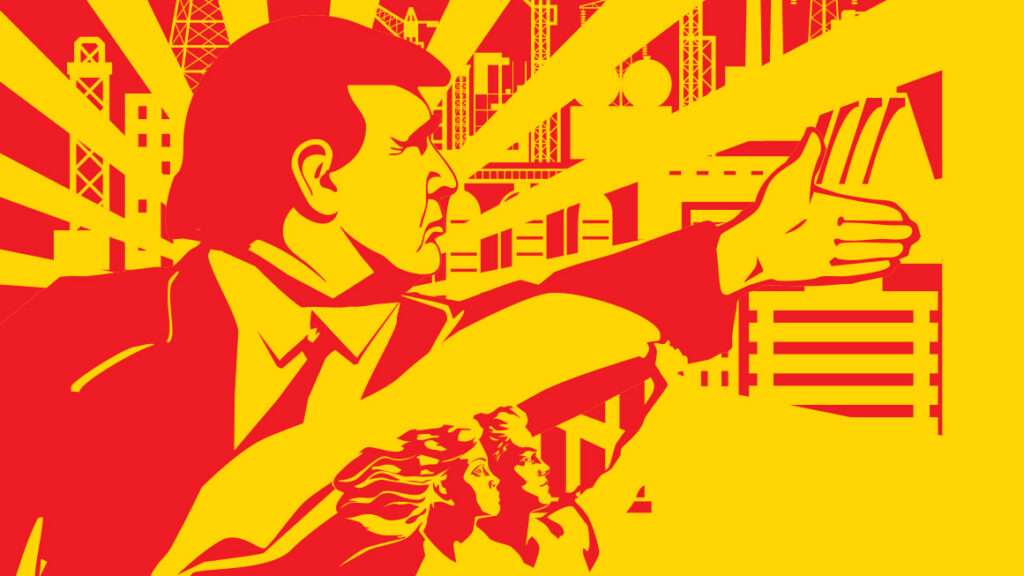
That’s a short step that President Donald Trump has eagerly taken. In the first nine months of his second term in office, the president has overseen a giant government leap into the boardrooms of strategically important businesses.
In June, Trump demanded (and the federal government received) a so-called golden share in U.S. Steel, which effectively gives the White House veto power over much of the company’s future. Two months later, the Trump administration purchased a 10 percent equity stake in Intel, the once-dominant and recently struggling American chipmaker. Similar stakes in at least four other companies followed, including ones that produce nuclear power or mine metals such as lithium and copper that are necessary for building high-tech chips and advanced batteries.
Even in light of the administration’s other intrusions into the free market—hiking tariffs on nearly all imports, applying ideological conditions on media companies’ proposed mergers, and the like—this has been a breathtaking turn of events. Trump and his top officials have signaled that they are only getting started. In August he told reporters “I want to try and get as much as I can.”
What makes these maneuvers stand out from other federal efforts at subsidizing, regulating, and controlling corporate decision making is the administration’s unmistakable nationalist tone and the lack of any major crisis as an inciting incident. Unlike, say, the auto bailouts during the Obama administration, the Trump White House is not framing these corporate invasions as temporary or unusual. The Intel deal is about “reinforcing our country’s dominance,” said Commerce Secretary Howard Lutnick in August. Acquiring a 10 percent stake in a small Alaskan mining company, the White House said in an official statement, would “prioritize economic growth and national security.”
Trump would not be the first leader to believe that greater state control of key industries and economic sectors would translate into better growth and stronger security. But from Soviet Russia to modern China, the best parallels come from authoritarian regimes rather than American presidencies. Resisting that temptation has historically worked out pretty well for the United States.
Following Trump’s lead, many conservatives are now gleefully crossing Hayek’s metaphorical bridge. On the other side is a risky experiment that involves more central planning, invites more corruption, and risks both taxpayer dollars and vital sectors of the economy.
And hey, what’s the word for this sort of thing?
“If socialism is government owning the means of production,” said Sen. Rand Paul (R–Ky.) not long after the Intel deal was announced, “wouldn’t the government owning part of Intel be a step toward socialism?”
Not too long ago, socialism was the ultimate insult one Republican could hurl at another. During the Obama administration, conservatives were especially attuned to any hint of “socialism,” particularly if it was emanating from one of their own who was insufficiently stringent in opposition to bailouts or Obamacare.
Times, clearly, have changed.
The Trump administration’s pivot toward socialism did not come without warning. One particular moment stands out: In an April interview with Time, the president declared that America was akin to “a department store.” He elaborated: “I meet with companies, and then I set a fair price.”
A few weeks later, while taking questions from reporters about the status of tariffs on Canadian imports, Trump returned to the same analogy. “I’m the shopkeeper and I keep the store,” he said. “I can set those terms, and they can go shopping, or they don’t have to.”
If the economy is a “department store” and the president is “the shopkeeper,” then the only meaningful distinction between the public and private sectors is that one is clearly subordinate to the wishes and commands of the other.
Discussing the Intel deal in the Oval Office on August 22, Trump offered a similar analogy from his time as a real estate developer, when he would use “restrictive covenants” to limit how certain parcels of land could be used.
“We have a restrictive covenant on certain industries,” Trump explained. “I will absolutely give somebody an opening to do a lot of business, which is good for us, as long as it doesn’t hurt us in a security or military way. And if I do that, I think the country should be paid.”
The president is not a shopkeeper and is not the nation’s appointed real estate developer. Those facts should not be in dispute, but the expansion of executive powers in recent years might help explain, though not excuse, why Trump feels this way.
Look at how then-President Joe Biden approached the proposed merger of U.S. Steel with the Japan-based Nippon Steel. That was a deal between two private companies owned by shareholders all around the world, and yet the Biden White House portrayed it as undermining a vital national security concern. Even after the Committee on Foreign Investment in the United States—a shadowy federal entity that has been empowered since the 1980s to assess and sometimes block such transactions—declined to label the deal a threat, Biden stepped in to block it on his own. In an executive order signed in January 2025, Biden claimed there was “credible evidence” that the deal would jeopardize American national security. He did not elaborate on what that evidence might be.
That gave Trump an opening. The incoming president had also opposed the merger on the campaign trail (and his running mate, J.D. Vance, was a particularly vocal critic of the proposal), but he was willing to make a deal. In June, Trump announced that he would allow Nippon’s purchase to go through, but with a rider attached: a “golden share” in U.S. Steel for the federal government to control.
Documents filed in June with the Securities and Exchange Commission spell out the specifics. Trump must provide “written consent” before U.S. Steel (which will continue to exist as a subsidiary of Nippon Steel) can change its name, relocate its headquarters, reduce or alter any planned capital investments, attempt to acquire any part of a competing business, or “close, idle, or sell” its existing plants.
In taking a stake in Intel, Trump again twisted one of Biden’s economic interventions toward more direct federal control of a previously private company.
The California-based chipmaker had long been a global leader in its field, but it recently fell well behind the likes of AMD and Nvidia, which are now producing smaller, faster, more advanced chips. Hoping to prop Intel up—and to establish a stronger domestic supply chain for key chips, many of which now come from the geopolitically charged island of Taiwan—the Biden administration made the company one of the prime beneficiaries of the CHIPS and Science Act of 2022, which set aside $52 billion to subsidize chip manufacturing. Last year, the White House authorized more than $9 billion in subsidies for Intel, tied to the company’s pledge to invest $100 billion in American-based semiconductor manufacturing.
Trump called that a bad deal for taxpayers—and on that point, it’s hard to argue with him. The subsidies also could not slow Intel’s decline—the company’s stock price fell 60 percent during 2024.
But Trump did not go on to separate Intel’s fate from the American taxpayers. He further entangled the two. In August, the administration announced that it would convert CHIPS and Science Act funding into shares of Intel stock, effectively giving the White House a 10 percent stake in the company.
In a press release announcing the acquisition, Lutnick said the deal showed “this administration remains committed to reinforcing our country’s dominance in artificial intelligence while strengthening our national security.”
After that, the dam broke. By the middle of October, the administration had claimed a 15 percent stake in MP Materials, a 10 percent stake in Lithium Americas Corporation, and a 10 percent stake in Trilogy Metals. All three are involved in key parts of the battery and semiconductor supply chains, from mining through manufacturing. In late October, the White House struck a deal with Westinghouse Electric, now a Canadian company that’s seeking to build more nuclear reactors in the United States. In exchange for financing and permitting those projects, Westinghouse will pay up to 20 percent of its future profits to the U.S. government, which also has the option of buying a 20 percent stake in the company if it goes public, Reuters reported.
It seems unlikely to stop there.
Treasury Secretary Scott Bessent “wouldn’t be surprised” if the U.S. takes equity stakes in more businesses, he said at a forum hosted by CNBC on October 15. Though he did not name them, Bessent added that the administration had identified seven industries where the government should seek equity stakes in key businesses. Military contractors are probably on that list—Lutnick has described them as being “basically an arm of the U.S. government.”
Then there are the firms working on advanced computing and artificial intelligence.
At least three companies working in advanced quantum computing “are in talks to give the Commerce Department equity stakes in exchange for federal funding, a signal that the Trump administration is expanding its interventions in what it sees as critical segments of the economy,” The Wall Street Journal reported on October 23.
Bessent has suggested that Washington’s top-down control of the economy could take other forms too, including setting “price floors” across “a range of industries.”
The risks of all this should be obvious, says Norbert Michel, a vice president at the Cato Institute. “It’s the federal government taking over and directing economic decisions that would have been made in the private sector.”
Generally, there are two ways this could go badly.
Most obviously: What if the feds make a bad bet on the taxpayers’ behalf? Recent American history is littered with Solyndras and Foxconns—government-subsidized corporate ventures that didn’t work out. With Washington sitting in the boardroom, that risk reaches new dimensions, no matter the administration’s intentions or rhetoric about national security.
In an October interview with Politico, businessman Kevin O’Leary (a.k.a. Shark Tank‘s “Mr. Wonderful”), a fan of Trump’s, called out the “bad investment” in Intel.
Intel is “where money goes to die for the last 10 years,” O’Leary said. “They’re a terrible company. Somebody has to tell the truth. I’m just telling you how it is: That dog don’t hunt.”
If the government views Intel’s success as “fundamental to the future of our nation,” as Trump has said, then it is more likely to pour greater sums of money into the company, even as the losses pile up. There is also an opportunity cost. What if a different mining or chipmaking company comes along with better or more efficient methods, but cannot succeed in a market where the government has already picked a “national champion”?
That leads directly into the second problem: when what happens in Washington becomes more important than what the company itself accomplishes.
Intel has already warned investors of possible “adverse reactions, immediately or over time,” that could be triggered by the federal government owning a stake in the company. Among those is the possibility that a changing political landscape in Washington alters or abolishes the company’s direct line to handouts.
With regard to the U.S. Steel deal, Sarah Bauerle Danzman of the Atlantic Council warns that “a golden share reduces the economic value of the company” because of the potential for politicians to meddle.
“The company’s governance documents will outline the areas of strategic and operational decision making over which the US president will now have veto authority,” she wrote in June. “US Steel may not be state-owned, but it is certainly now controlled by the US government.”
In the long run, this tends not to work out well for anyone involved. A World Bank study published in 2024 found that companies with at least a 10 percent government-owned stake were, on average, 32 percent less productive than other companies in the same industry. They were also 6 percent less profitable. State ownership “seems to curb operational and financial performance for firms operating in competitive markets,” the authors of that study concluded.
“Federal officials will be setting prices and making investments based on political decisions, rewarding the best-connected political allies. It promotes what’s good for them,” Michel says. “Once you start down that road, the pressure is always to do more, not less. At some point, you don’t really have a market economy.”
Noting that wide-ranging price floors are now on the table, he adds: “If we take Bessent at his word, we’re at that point.”
So what do we call what the Trump administration is doing?
“Socialism” and “fascism” probably do a poor job of describing it, since both are too general and too often used as political slurs. Officially, the Chinese Communist Party calls its system “socialism with Chinese characteristics.” Wall Street Journal economics writer Greg Ip has suggested a similar term for the U.S., writing in August that we were marching toward “state capitalism with American characteristics.”
This is not the sort of socialism that Karl Marx would have recommended. There is no uprising of the proletariat. There is certainlyno withering away of the state.
But certain historical comparisons seem inevitable. Government control of key economic sectors was one of the defining features of the major socialist states that emerged during the 20th century. They differed in style and substance, but both the Soviet Union and communist China sought a firm, centralized hand on any entity deemed essential for national security.
When Vladimir Lenin announced a “New Economic Policy” in 1921, he partially reversed some of the aggressive nationalization efforts that the Soviet government had pursued in the years after seizing power. “A free market and capitalism, both subject to state control, are now being permitted and are developing,” he promised.
But even then, the state would not relinquish power over what were seen as the most important sectors of the economy, including energy production, heavy manufacturing, mining, banking, and transportation. Effectively, anything that might be regarded as essential to national security or war planning would be subject to ongoing central control.
In socialist systems, this approach became known as the “commanding heights of the economy.” It is a deliberately militaristic metaphor that sees no meaningful distinction between the public and the private sectors in matters of national security—the definition of which is, naturally, open to interpretation. In China, a similar approach implemented during the 1990s emphasizes “grasping the large and letting the small go.” It is what it sounds like: allowing more markets to develop in spaces not seen as essential to policy goals, but imposing lavish subsidies and direct control in the areas that are.
In a less organized and deliberate way, that seems to be what the Trump administration is crawling toward. Bessent has described high-end computer chips as “a strategic necessity for us.” Trump has called Intel “fundamental to the future of our nation.” As it purchased a stake in Trilogy Mining in October, the White House said the deal was “vitally important to America’s national defense and economic prosperity.”
Top administration officials have described everything from shipbuilding to nuclear power as potential targets for partial government takeovers. Throw military contractors, AI computing firms, and rare-earth mining companies into the mix, and the “commanding heights” of the modern American economy start to come into view.
Want to avoid the intrusion of the federal government? Better do something that doesn’t seem to matter.
The most important question here isn’t what to call the administration’s industrial policy or how it compares to communist regimes. The most important question is: How will the White House know when to stop?
“We do have to be very careful not to overreach,” Bessent told CNBC in October. “And we need to go back and examine, OK, have we accomplished our goal? And then, you know, you can move on.”
How, one must wonder, does he expect to know when that point is reached? How many shares of how many corporations should be owned by the government to maximize the supposed national security benefits of these interventions?
Does this administration possess the wisdom to know the answer? Will the next?
Americans better hope the answer is “yes,” because there are no obvious ways to put a halt to this behavior.
The companies involved—Intel, Nippon, and so on—seem to be going along meekly, either eager for the infusion of cash or too cowed by the government to raise much of a fuss. Beyond them, it’s not clear how any other business or entity would have standing to sue over this. Congress is utterly useless right now, and even a Democratic takeover after the midterms is unlikely to change that—plenty of Democrats are just fine with Trump’s expansion of executive powers, and many others will already be salivating about how a future President Alexandria Ocasio-Cortez might use them.
Not that the Trump administration seems to care about that. Responding to a question about the possible misuse of political power, Vance said in late October: “We cannot be afraid to do something because the left might do it in the future. The left is already going to do it regardless of whether we do it.”
Trump’s decision to seize a chunk of Intel was lifted—maybe deliberately, maybe not—from the playbook of America’s most prominent democratic socialist, Sen. Bernie Sanders (I–Vt.). When the Senate was debating the CHIPS and Science Act in summer 2022, Sanders said he’d vote for it only if the subsidies came with serious strings attached. Among them: “Companies must agree to issue warrants or equity stakes to the federal government.”
Sure enough, after Trump announced his administration’s “equity stake” in the troubled chipmaker, Sanders cheered. “If microchip companies make a profit from the generous grants they receive from the federal government, the taxpayers of America have a right to a reasonable return on that investment,” he declared in a statement.
The Republicans who have dared to call out these risks—most prominently Paul and Rep. Thomas Massie (R–Ky.)—have now become targets of Trump’s ire. The president is backing a primary challenger against Massie and has called for his removal from Congress. On Truth Social, Trump has called Paul a “nasty liddle’ [sic] guy.”
There is a cognitive dissonance to all of this. Trump criticized the Biden administration’s misguided industrial policy, then used it as scaffolding for his own more aggressive intrusions on the private sector. Now, facing similar criticism, Trump has resorted to name calling while top administration officials push vague claims about national security rather than try to defend the merits of these maneuvers. Libertarians and conservatives are right to raise principled objections. If Trump succeeds at silencing the few critics who remain within his own camp, the American people will be left with a terrible choice: Do you want Sanders-style socialism or the MAGA-coded version?
“I think it’s a big mistake to have government ownership of things, and of course it is a step toward socialism,” Paul said on September 3, shortly after the Intel deal was announced. “When you see the people supporting the president just sort of saying ‘this is good’…I worry that the free market movement that was a big part of the Republican Party is being diminished over time.”
This article originally appeared in print under the headline “Republican Socialism.”
reason.com (Article Sourced Website)
#Republican #socialism #Trump #federal #stakes #private #companies