
Homemade pumpkin pasta dough (aka pumpkin pasta noodles) is easier than you think, and I’m going to show you exactly how to make it from scratch. With just a few ingredients and a rolling pin or pasta machine, you’ll have beautiful orange-tinted fresh pumpkin pasta ready in about an hour! It’s perfect for cozy fall pasta bowls or orange pasta for Halloween and Thanksgiving!
See recipe card for quantities.
Step 1. Make the dough. Combine flours and whisk well. Make a well in the center. Whisk eggs and pumpkin puree together, then add this and the olive oil into the well.
Step 2. Bring it together. Using a fork, start combining wet ingredients, gradually pulling in flour from the sides. When it’s too thick to mix with a fork, switch to using your hands to form a shaggy mass of dough. If it’s too sticky, dust it lightly with flour and incorporate it.
*Don’t add too much flour at this stage, though, because when you knead it, the more cohesive it becomes without sticking to your hands.
Step 3. Knead the dough. If too dry, wet your hands to add a little water slowly and continue kneading. If it’s too wet, sprinkle the minimum amount of flour on it to get it to stop sticking to your hands. Add the dough to a lightly floured work surface and knead for about 10 minutes, or until smooth.
Step 4. Rest the dough. Cover and rest at room temperature for 30 minutes. This is essential for workable dough!
Step 5. Divide. When your dough is well-rested, it will look hydrated, and when you poke a finger into it, the indentation will remain. Divide the dough into 4 equal pieces. Keep unused pieces covered to keep them from drying out.
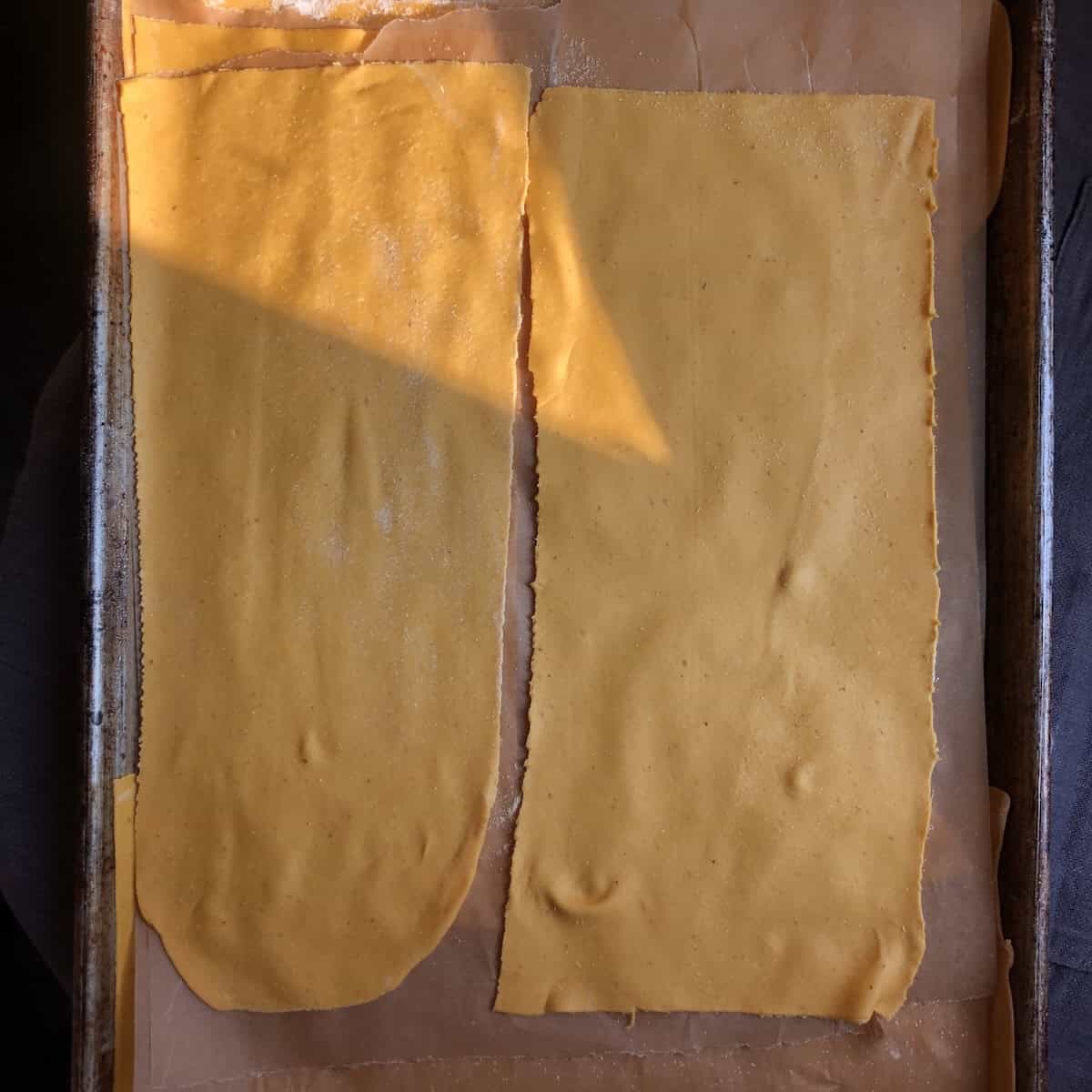
Step 6. Roll out the pasta dough. Working with one piece of dough at a time, flatten it using your hands.
Using a pasta machine: Feed it through the widest setting, fold it into thirds like a business letter, and feed it through again. Then progressively roll thinner through each setting to reach the desired thickness (#6 on my Marcato Pasta machine), dusting with flour occasionally to keep it from sticking to the rollers.
Using a rolling pin: Roll from the center outward until nearly see-through (about 1/16 inch), dusting with extra flour to keep the dough from sticking to the rolling pin or the countertop.
On my Atlast Marcato pasta machine, I most often use setting #6 for fettuccine, pappardelle, tagliatelle, tortellini, and lasagna sheets. For ravioli, I roll to #7 or #8, depending on the filling, and I like to use #5 and #6 for homemade chittara pasta, depending on the sauce pairing and how thick I want the spaghetti noodles.
Step 7. Cut your pasta. Cut into desired shape-fettuccine (¼ inch), pappardelle (¾ inch), or use for ravioli, chittara, tortellini, and lasagna. Transfer to a floured baking sheet to rest for at least 10 minutes and up to 30 minutes before cooking.
Step 8. Cook. Boil the pasta in salted water for 2 to 3 minutes until al dente. If frozen, add 1 extra minute. For soups, simply add the pumpkin noodles to your boiling vegetable or chicken broth and cook for 2-3 minutes.
Find detailed instructions in the recipe card.
No, you absolutely don’t need a pasta maker to roll out homemade pasta! A rolling pin works perfectly for making fresh pumpkin pasta. It requires a large work surface and is a bit more arm work than a pasta machine, but the results are just as delicious and authentic.
Roll the dough from the center outward, rotating it frequently to maintain even thickness. The key is rolling it thin enough-about 1/16 inch or nearly see-through. Many Italian nonnas and mammas still make pasta entirely by hand with just a rolling pin and have been doing so for generations.
Yes, you can use homemade pumpkin puree! I recommend Hokkaido, Sugar, or Delica pumpkin varieties for the best flavor and texture. The important thing to know is that fresh pumpkin contains 20-30% more moisture than canned pumpkin.
After roasting and pureeing your pumpkin, if it looks too wet compared to what my photos show, place it in cheesecloth or a paper towel-lined strainer to drain for 30 minutes or 1 hour to remove excess liquid before weighing out your 150g.
I have never had to do this when I use my homemade pumpkin purée recipe though:)
The best storage method for fresh homemade pumpkin pasta (or any pasta) is freezing! The method depends on the pasta shape, and here’s that breakdown:
For long pasta (fettuccine, tagliatelle, pappardelle): Shape into loose nests, dust with semolina or 00 flour, and place on a well-floured baking sheet without touching. Freeze uncovered for 1-2 hours until solid, then transfer nests to freezer bags or containers.
For pasta shapes (farfalle, orecchiette, cavatelli, etc.): Spread the shapes out in a single layer on a parchment-lined baking sheet, making sure pieces don’t touch. Freeze uncovered for 1-2 hours until solid, then transfer to freezer bags or containers.
For filled pasta (ravioli, tortellini, agnolotti): Use the same method as shapes-lay in a single layer without touching, freeze until solid (1-2 hours), then transfer to storage containers. Also, don’t over-fill the pasta because when you freeze it, the filling slightly expands and can break through the delicate pasta dough.
For lasagna sheets: Dust both sides generously with semolina or 00 flour, layer on a baking sheet with parchment paper between each sheet (making sure edges don’t touch), freeze for 1-2 hours, then store stacked with parchment between layers.
Properly frozen pasta keeps for up to 3 months (1 month for filled pasta). Cook directly from frozen-don’t thaw-by adding straight to boiling water with just 1-2 extra minutes of cooking time. For same-day use, keep cut pasta covered with a kitchen towel and cook within 2 hours. Freezing gives better results than refrigerating for longer storage.
Pumpkin pasta is incredibly versatile and pairs beautifully with both light and hearty sauces! The pumpkin flavor is subtle and delicate, not heavy or overpowering, which means you have lots of delicious options.
For a classic approach: Brown butter and sage sauce is a perfect pairing-the nutty brown butter and earthy sage complement the subtle pumpkin flavor perfectly. Add a few sautéed mushrooms to it and it’s eve better! Simple butter with Parmesan also works beautifully, letting the pasta’s delicate flavor shine through.
For creamy sauces: Light alfredo, pumpkin alfredo sauce, or a light cream sauce with nutmeg are all excellent choices. Tomato-alfredo sauce is another wonderful autumn option that complements tender pumpkin pasta.
For tomato-based sauces: Al pomodoro (classic tomato sauce), amatriciana, and alla gricia all work great with pumpkin pasta. The acidity of the tomatoes complements the sweetness of the pumpkin nicely.
For heartier options: Don’t shy away from richer sauces! Authentic Bolognese ragù works beautifully, as does sausage and mushroom sauce. A simple mushroom and garlic sauce is also delicious.
For pesto lovers: Both traditional basil pesto and pistachio pesto pair wonderfully with pumpkin pasta.
The key is this: if you want to really taste the pumpkin flavor in your pasta, go with lighter sauces like brown butter and sage or simple Parmesan cream sauce.
Or, if you just want a cozy bowl of delicious homemade pasta, feel free to pair it with heartier sauces and meat ragûs-the subtle pumpkin flavor works as a beautiful base for so many different preparations!
This particular recipe relies on eggs for structure and can’t be made vegan while maintaining the same texture and workability. However, you can make a simpler 2-ingredient vegan pumpkin pasta using just pumpkin puree and flour (no eggs).
Use about 150g pumpkin puree mixed with 250-300g flour, adjusting until you get a workable dough. The texture will be different-less rich, more tender, and less elastic-and it won’t have quite the same silky quality, but it’s still delicious. You may need to let it rest a little longer and/or roll it slightly thicker to prevent tearing.
Roll it much thinner than you think you need to-about 1/16 inch thick, which is thinner than pie crust and almost translucent. You should be able to almost see your hand through the dough when you hold it up to the light.
This is the single most common mistake people make with fresh pasta! Fresh pasta gets significantly thicker when it cooks-sometimes almost doubling in thickness-so what looks almost too thin when raw will be perfectly tender once boiled.
If you don’t roll it thin enough, your pasta will turn out thick and chewy instead of delicate and silky. And if you roll it too thin, it may not hold up for the sauce you’re pair with it.
Pro tip: When you make homemade pumpkin pasta, you get to choose the thickness, and everyone’s preferences vary! Before you roll and cut all your pasta, do a simple test with a couple of small pieces rolled at different thicknesses.
Boil them for 2 minutes to see how they cook up and which texture you prefer. This takes the guesswork out of getting the perfect thickness for you and your family-there’s nothing worse than rolling and cutting all your pasta just to find out it’s not what you wanted!
Some people love ultra-thin, delicate pasta, while others prefer a slightly thicker, more substantial bite. Testing first ensures you’ll be happy with your final result.
Absolutely! This dough works beautifully for ravioli, tortellini, tortelli, tortelloni, caramella (candy-shaped filled pasta), mezzelune (half-moon shaped filled pasta), and any other filled pasta shapes.
Roll the dough very thin (I roll all the way through setting #7 or #8 on my Atlas Marcato pasta machine), then cut into circles or squares for filling.
No, the pumpkin flavor is quite subtle and delicate-it’s more about the vibrant orange color, extra nutrition, and silky texture than a heavily pronounced pumpkin taste.
In fact, Luca isn’t a fan of “zucca” anything (pumpkin), but he loves this pasta! That should tell you all you need to know:)
The pasta has a gentle, slightly sweet, and earthy quality that pairs well with cream-based sauces, tomato-based sauces, and heartier ragûs.
Think of it as adding complexity and moisture to the dough rather than dominating the flavor. Your sauce choice will have the most impact on the overall flavor of the dish than the pumpkin pasta itself.
Using both creates the perfect balance of tenderness and structure. The 00 flour is super finely milled soft wheat Italian flour that gives you that silky, delicate texture authentic Italian pasta is known for.
The semolina flour (especially the finer semola rimacinata) adds structure and a slightly firm bite, helping the pasta hold its shape during cooking without becoming mushy.
Semolina flour also adds texture (roughness to the outside of the pasta), which helps sauces cling to the pasta noodles really well! It gives you that authentic texture where the pasta is tender but still has some tooth to it.
If you can’t find one or the other, simply use all 00 flour or all semolina rimacinata (finer grain semolina flour)-your pasta will still be delicious, just slightly different in texture and you may need to adjust the amount of flour you use.
Fresh pumpkin pasta cooks very quickly-usually just 2-3 minutes in boiling salted water. You’ll know it’s done when the pasta floats to the top and tastes tender with a slight bite (al dente). Start testing at 2 minutes.
If you’re cooking frozen pasta, add just 1 extra minute for a total of 3-4 minutes. *Don’t thaw frozen pasta before cooking it. Always cook it straight from frozen.
Fresh pasta cooks much faster than dried boxed pasta because it’s already hydrated. Watch it carefully-it can go from perfect to overcooked quickly!
I haven’t tested this recipe with gluten-free flour, but readers have reported success using a 1:1 gluten-free flour blend. You may need to adjust the liquid amounts, and the dough will be more delicate to work with.
Bob’s Red Mill 1-to-1 Gluten Free Baking Flour or King Arthur Gluten-Free All Purpose flour are both good options to try.
Start with less pumpkin puree (about 100g instead of 150g) and add more as needed to reach the right consistency.
bitingatthebits.com (Article Sourced Website)
#Pumpkin #Pasta #Recipe #Easy #Homemade #Pasta #Dough #Biting #Bits