
UAE drivers are spending more time in traffic than before, with delays reaching up to 45 hours in 2025. This increase from 35 hours in 2024 is due to more people and cars on the road, leading cities like Dubai and Abu Dhabi to invest billions of dirhams to reduce congestion.
The Federal government is working to improve transportation, and Dubai is making big changes too. These include smarter traffic systems and new ways to get around, all aimed at reducing congestion and building a more sustainable, connected city.
The UAE is advancing its goal of becoming a smart, future-ready country by setting new standards through its infrastructure projects. From aerial taxis to new highway networks, here’s how the UAE is revving transport projects and reshaping how people move across the city.
Stay up to date with the latest news. Follow KT on WhatsApp Channels.
UAE plans 4th national highway
The UAE has announced plans for a fourth national highway. The 120‑kilometre, 12‑lane road is meant to handle up to 360,000 trips per day, as part of a Dh170 billion national transport upgrade programme aimed at easing congestion across the Emirates.
The proposed road would become the UAE’s fourth pan-emirate highway, joining three existing major federal routes — the E11 (Al Ittihad), E311 (Sheikh Mohammed bin Zayed) and E611 (Emirates Road) — that together serve more than 850,000 vehicles commuting between Dubai and the Northern Emirates.
Aerial taxi project
Dubai’s electric air-taxi project is in full throttle and passenger services are expected to begin in 2026. The first crewed eVTOL flight was completed between Margham and Al Maktoum International Airport in November 2025. The aircraft, carrying four passengers plus a pilot, has a 160km range and top speed of 320 km/h.
Vertiport construction is underway, including a facility near Dubai International Airport now 60 per cent complete. Vertiports are also set to be established at Zabeel Dubai Mall, Atlantis The Royal on Palm Jumeirah, and Dubai Marina. Together, these four vertiports will form Dubai’s initial aerial taxi route network for 2026.

Abu Dhabi is also set to roll out its first electric air‑taxi service in 2026 after Joby Aviation struck deals with authorities to build an eVTOL system. This is expected to slash travel times dramatically, including cutting the journey between Abu Dhabi and Dubai from roughly two hours by car to around 30 minutes by air. Abu Dhabi Airports will build over 10 vertiports for air taxi and eVTOLs (electric vertical take-off and landing aircraft) operations to enhance connectivity within the Capital and other emirates.
Ras Al Khaimah will also join the aerial mobility push, with flying taxis expected to launch in 2027. Travel time between Dubai and Ras Al Khaimah will be reduced from more than an hour to less than 15 minutes.
Dubai Metro expansion
The Dubai Metro is expanding with the Blue Line project, adding 30km to the network by 2029. With the addition of 14 stations, the network will expand from 64 to 78 stations and grow the train fleet from 140 to 168 units. The project will improve access to residential, business, and leisure areas, easing road congestion and encouraging more residents to choose public transport.
The Dubai Metro Blue Line will link the Green and Red Lines, spanning two directions: a 21km route from Creek Interchange through Dubai Festival City, Dubai Creek Harbour, Ras Al Khor, International City, Dubai Silicon Oasis, to Dubai Academic City with 10 stations; and a 9km route from Centrepoint Interchange in Al Rashidiya through Mirdif and Al Warqa to International City (1) with four stations.
Etihad Rail
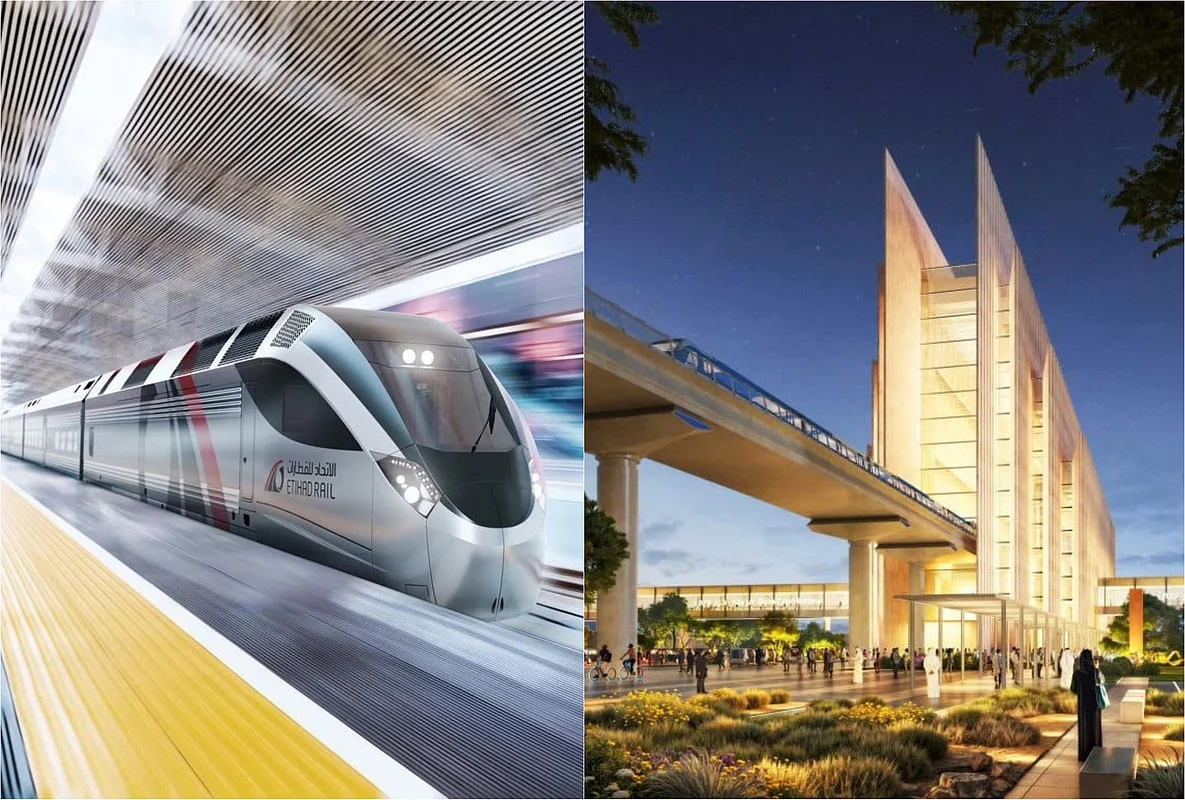
Etihad Rail, the UAE’s first passenger train network, is scheduled to launch in 2026, connecting major cities and economic hubs across all seven emirates. The network will cut travel times; instead of hours, it will take residents only 57 minutes to reach Dubai from Abu Dhabi. Each train will carry up to 400 passengers, travelling at speeds up to 200 km/h.
The 900-kilometre network, which will extend from Ghuweifat in Abu Dhabi to Fujairah, will take off hundreds of cars from the roads. By linking key urban and industrial areas, integrating with local metros and buses, and providing daily services, the passenger train will change inter-emirate travel, ease road congestion, reduce carbon emissions, and create a faster, more comfortable alternative to car travel across the country.
New high-speed train linking Abu Dhabi, Dubai
A new high-speed electrified line connecting Abu Dhabi to Dubai will feature six stations at Reem Island, Yas Island, Saadiyat Island, Zayed Airport, close to Al Maktoum Airport in Dubai and Jaddaf, near Dubai Creek. The project will enable seamless connectivity between the two emirates, significantly reducing travel times.
The high-speed train will transport commuters between Abu Dhabi and Dubai in just 30 minutes, reaching speeds of up to 350km/h. The route will pass through key strategic destinations and tourist attractions, ensuring seamless travel for passengers and visitors.
Etihad Rail will oversee the development and operation of this project.
Integrated road networks
Dubai’s Roads and Transport Authority (RTA) is executing 72 major projects by 2027, including 226km of new roads, 115 bridges and tunnels, and 11 main corridors. These upgrades are designed to streamline traffic flow, reduce travel times, and integrate new technology for smarter, more responsive traffic management.
Besides the proposed fourth highway, the federal government also plans major expansions of existing routes. Etihad Road will be widened by six new lanes (bringing the total to 12), Emirates Road will be expanded to 10 lanes, increasing capacity by 65 per cent, while Sheikh Mohammed Bin Zayed Road will also be widened to 10 lanes to improve flow by roughly 45 per cent. Work has already begun on the upgrade of Emirates Road, with an estimated cost of Dh750 million and scheduled for completion within two years.
Smart vehicles in Abu Dhabi
Abu Dhabi has launched the world’s first modular smart vehicles in the emirate in November 2025. These reconfigurable vehicles can adapt to operational demand and connect or detach as needed, improving traffic flow, reducing congestion, and minimising carbon emissions with exceptional efficiency.
Abu Dhabi is now the first city in the Middle East to launch driverless ‘robotaxi’ services. WeRide was granted operating permits for the first fully autonomous robotaxi service to operate commercially. These permits allow autonomous vehicles to carry passengers without a safety driver.
The first robotaxi rides started on Yas Island, and testing and expansion are ongoing in other major areas like Al Reem and Al Maryah. At the same time, the city plans to build a dedicated Abu Dhabi Autonomous Vehicle Test Hub to support testing, validation, and certification of autonomous vehicle technologies.
Dubai to turn into pedestrian city
The Dubai Walk Master plan aims to transform the emirate into a year-round pedestrian-friendly city. The master plan constitutes a 6,500km network of modern walkways covering 160 areas across Dubai. The plan also includes constructing 3,300km of new walkways and rehabilitating 2,300km of existing ones by 2040, in addition to more than 900km of walkways planned beyond 2040.
The Future Loop
The ‘Future Loop’ project, which will be implemented at the Museum of the Future area, is designed as an elevated, climate‑controlled walkway. It will connect 10 key locations, and have a 30,000-square-metre air-conditioned level that will allow year-round pedestrian use. The pathway will also feature 30,000 square metres of open spaces incorporating shaded structures and green areas designed to lower temperatures and help pedestrians.
Spanning 2km in length and varying in width from 6 to 15 metres, the bridge connects major economic and business landmarks, including the Dubai World Trade Centre, Museum of the Future, Emirates Towers, Dubai International Financial Centre (DIFC), and nearby Metro stations.
The Future Loop will be integrated into Dubai’s transport system, close to metro and tram stations, cycling tracks, and the future transportation network.

Ajanta Paul
Senior Editor


Ajanta Paul is a Senior Editor on the Digital team. A natural leader and newshound, she thrives in breaking news and high-pressure situations — and enjoys reporting on community issues that matter to UAE residents.
www.khaleejtimes.com (Article Sourced Website)
#highway #trains #metro #UAE #daily #commutes #change #residents