
Key Takeaways on the Planets Most Like Earth
- Although astronomers have directly imaged a few dozen gas giants on the scale of Jupiter, Earth-sized planets are too small and dim to be directly imaged.
- That’s not to say there’s a shortage of Earth-sized, rocky exoplanets. There are plenty — it’s just that most of them orbit M dwarf stars, also known as red dwarfs, which have a narrower habitable zone and emit more harmful radiation than G-type stars, like the sun, according to NASA.
- One notable exception is Kepler 452b, which lies in the habitable zone of a G-type star almost identical to ours.
Over the past 30 years, astronomers have identified more than 6,000 planets beyond our solar system, according to NASA.
With each new find, the central question is: Could it harbor extraterrestrial life? And because Earth is the only confirmed planet that does, scientists are especially keen to find rocky orbs resembling the one we call home.
But even as the rate of discovery accelerates, bringing more exoplanets to our attention every year, experts say there still aren’t many promising candidates. Stephen Kane, a planetary astrophysicist at the University of California, Riverside, counters the hype over potentially habitable worlds with a dose of sober realism:
If by “Earth-like” we mean a planet the size of our own orbiting a star like our sun, he says, then “to be honest, we really haven’t found anything like that at all.”
Read More: Weird Lemon-Shaped Exoplanet Discovered Orbiting a Bizarre Star
Are There Exoplanets Similar to Earth?
Part of the problem is that we have so little information about the exoplanets we’ve located thus far; our knowledge is mostly confined to measurements of size, mass, and orbit, with detailed atmospheric information conspicuously absent.
According to NASA, although astronomers have directly imaged a few dozen gas giants on the scale of Jupiter, Earth-sized planets are too small and dim to be directly imaged.
“We don’t know what they look like, even on a single pixel,” Kane says. “Everything we do know, we infer from indirect observations.”
Rocky Exoplanets That Orbit Red Dwarf Stars
That’s not to say there’s a shortage of Earth-sized, rocky exoplanets. There are plenty — it’s just that most of them orbit M dwarf stars, also known as red dwarfs, which have a narrower habitable zone and emit more harmful radiation than G-type stars, like the sun, according to NASA. From what scientists have gleaned so far, red dwarfs tend to strip the protective atmosphere off their planets.
For example, according to NASA, the TRAPPIST-1 system, which lies about 39 light-years away in the constellation Aquarius, is often cited as a strong contender for extraterrestrial life: seven planets in the habitable zone, all of them apparently rocky based on their mass. But the star is a volatile red dwarf, and observations from the James Webb Space Telescope suggest that at least some of the planets are likely devoid of atmosphere, according to a study in The Astrophysical Journal.
The same goes for a system of three exoplanets orbiting Teegarden’s star, 12 light-years away in the constellation Aries — they’re the perfect size and distance from their star, but the fact that it’s a red dwarf doesn’t bode well, according to the Infrared Processing and Analysis Center (IPAC) at Caltech. Unfortunately, red dwarfs are by far the most common type of star in the universe, meaning most exoplanets may exist under biologically inhospitable conditions.
What Planet Is Most Like Earth and Could Humans Live There?
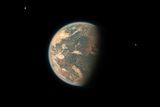
One notable exception is Kepler 452b, which lies in the habitable zone of a G-type star almost identical to ours.
There’s a catch, though: The planet itself is about 1.6 times the size of Earth, putting it just over the threshold where planets tend to switch from terrestrial to gaseous. Clearly, a lot of parameters must align for a world to truly resemble our own, Kane says, and “it’s very rare that we get everything.”
How Astronomers Spot Exoplanets
According to NASA, Most exoplanets are discovered via the transit method, which involves waiting for a planet to pass between its star and Earth. During that transit, a measurable amount of light is blocked from reaching Earth, allowing scientists to judge the planet’s size and orbital distance. But for this to work, the planet and its star must be aligned properly with Earth — otherwise, there will be no transit.
The Kepler space telescope, which has spotted more exoplanets than any other, according to NASA, stared at 170,000 stars for nine years, from 2009 to 2018. No doubt most, if not all, of those stars have planets, but Kepler tallied only about 2,700, simply because the vast majority of their orbits aren’t oriented correctly. Statistically speaking, Kane says, if there is a habitable exoplanet in our cosmic neighborhood, it almost certainly doesn’t transit.
He argues that the search for exoplanets needs to change tack. There are other ways to learn about distant worlds. For example, each one tugs just a bit on its host star, causing a change in the star’s “radial velocity” — that is, a slight wobble, according to the Planetary Society. By measuring a star’s wobble, we can determine how many planets it has, along with their mass and orbital distance.
Could We One Day Find a Liveable Exoplanet?
Then there’s the holy grail: direct imaging. Up to now, it’s been impossible to capture images of rocky exoplanets, in part because they’re too small and in part because the incandescent glow of their stars renders them functionally invisible. But a new generation of telescopes could soon overcome those challenges, providing our first real glimpse of an Earth-like exoplanet.
First up is NASA’s Nancy Grace Roman Space Telescope, slated for launch in 2027. It will be equipped with a coronograph, an instrument designed to block the overwhelming light from stars, bringing faint exoplanets into vision for the first time.
At the same time, NASA is planning well into the future. The Habitable Worlds Observatory, or HabWorlds — tentatively scheduled for launch in the late 2030s or early 2040s — would be the first telescope built specifically to survey the cosmos for alien biosignatures. Bearing the largest mirror ever sent into space, it would be capable of detecting molecules in exoplanet atmospheres that might signify the presence of life.
Of course, when HabWorlds finally comes online, it’s unlikely anyone will be talking about TRAPPIST, or Teegarden, or Kepler 452b. The design and execution of this ambitious mission will take well over a decade (if it ever comes to fruition), and by then, astronomers will have identified new targets — some of which we have yet to discover.
“We just need to be patient,” Kane says. “The last 20 years have been incredible. Let’s see where we are in another 20 years.”
Read More: JWST Helps Examine Atmosphere of Exoplanet 40 Light Years Away and in the Goldilocks Zone
Article Sources
Our writers at Discovermagazine.com use peer-reviewed studies and high-quality sources for our articles, and our editors review for scientific accuracy and editorial standards. Review the sources used below for this article:
www.discovermagazine.com (Article Sourced Website)
#Kepler #452b #Exoplanets #Similar #Earth #Exact #Twin