
Kate WhannelPolitical reporter

 BBC
BBCIt is a beautiful winter’s day in central London, with plenty of festive attractions open to tempt visitors and tourists.
Yet on this Thursday morning, around a dozen people have chosen to spend their free time watching MPs in the House of Commons public gallery instead.
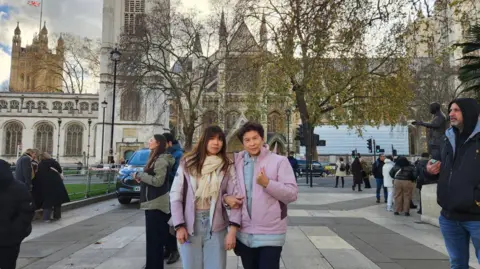
For Taiwanese student Yinwen Yeh and her mother Karen Fan, it is the result of a diary mix-up.
They had booked the full tour of Parliament but turned up on the wrong day so as a consolation prize are going to watch MPs in action.
Unlike the full parliamentary tours, the Visitors’ Gallery requires no booking and is free to enter after security checks.
Before the public are allowed to head to the viewing seats above the Commons chamber, they must wait for the Speaker’s Procession.
This ceremony, which marks the opening of the House of Commons, sees the Commons’ doorkeeper, the Serjeant at Arms (with mace in hand), the Speaker, the trainbearer, chaplain and secretary marching slowly through to the Commons chamber.
Police line their route and the inspector on duty shouts out “hats off, strangers” as they pass.
Yinwen says she was “shocked” by the spectacle. “I know it’s tradition but it suggests MPs are on some kind of aristocratic level,” she says.
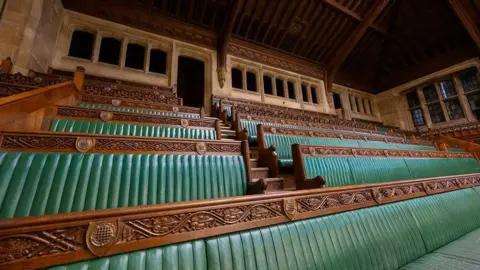
Once the procession is over, members of the public are allowed up the narrow staircase to the gallery, passing stern signs warning them not to clap.
The Visitors’ Gallery mirrors the chamber, with its wood panelling and green benches, although a glass security screen separates spectators from participants.
The first item of the day is questions to business and trade ministers. The subjects include Brexit, the hospitality industry and employment rights law, but the tone is fairly amicable.
Yinwen and Karen stay for about an hour before leaving. On their way out, they chat about the difference between politics in the UK and Taiwan.
Karen says it seems to be more peaceful in Westminster. She says in Taiwan, politicians sharply divide along pro and anti-China lines.
“There are two forces that keep struggling against each other – maybe in Britain you have more unanimity.”
That is a sentiment that might surprise some voters in the UK, but the Taiwanese Parliament has had a reputation for brawling, with punches – and on one occasion pig guts – being thrown.
 House of Commons
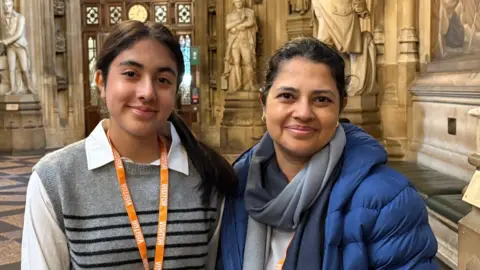
Later, another mother and daughter turn up. Alize Zobairi, and her mother, Zarmeen Noor, are Pakistani ex-pats living in Dubai.
Alize has been learning about UK politics at school and her teacher said she should visit Parliament while on holiday in London.
What fascinates them both is the connection they say MPs appear to have with their constituents.
They have been watching Business Questions, a session where MPs can raise any topic they wish, from vet fees to nuclear power to litter.
Alize and Zarmeen quote some of the cases raised – a 76-year-old man struggling to get a flu vaccine and a woman who had a stroke and was facing obstacles to renewing her visa.
Alize enthuses about MPs’ surgeries, where constituents can go to their local representatives for help with their problems. “It feels very personal,” she says.
So what happens in Dubai? Where do people go to when they have a problem?
There is a pause before Zarmeen says: “There aren’t too many problems.
“There is a customer helpline – things usually get fixed pretty quickly.”
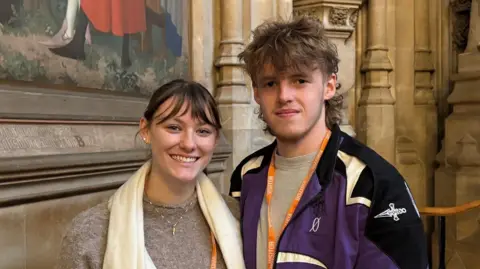
Dairy farm worker Renton Fewster and NHS apprentice Libby Robinson, from near Leeds, are in London for a few days but had no plans to visit Parliament.
“We were just walking and saw a sign. We followed the sign and ended up here,” says Renton.
“It feels like somewhere we’re not supposed to be,” Libby adds, looking around at the statues and stained glass.
They’ve been watching the Commons and the House of Lords and on balance think they would rather be peers than MPs.
“The Lords seems more casual and jokey,” Renton says.
The decor is a bit “OTT” he says, but adds: “It is what it is.”
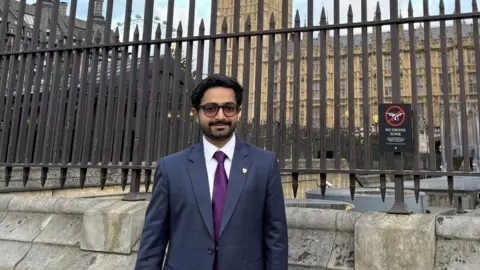
In the afternoon, MPs hold a debate marking St Andrew’s Day, which leads to a gentle exchange about whether a modern-day St Andrew would be happier or healthier under the SNP government in Scotland compared to St David living in Wales-run Labour.
Pruthvirajsinh Zala, an Indian lawyer studying at Cambridge, enjoys the discussion which is a world away from his last visit to Parliament in 2019 when the Brexit debates were at their most heated.
Leaving the gallery, he praises the building. “It is awe-inspiring, majestic, it has the X-factor,” he says.
One painting catches his eye. It portrays Sir Thomas Roe at the Court of Ajmir in 1614. According to the caption it depicts the beginning of British influence in India.
It gets him thinking about whether the painting is “celebrating colonialism” but even if it is, he doesn’t think it should be removed.
He launches a passionate defence of preserving remembrances of the past, even if that past is “problematic” as a way of “ensuring public memory of its injustice”.
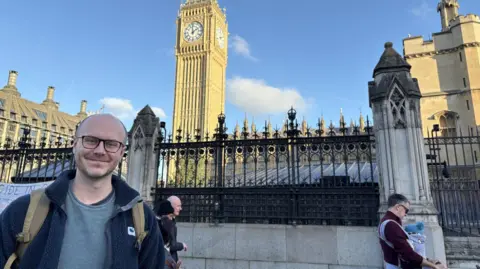
Tom Bell, an engineer from Southampton, also appreciates the paintings that line the route towards the House of Commons.
“You are experiencing a journey from 11th Century England, when power was invested in the sovereign and as you walk your way to the Commons you are tracing your way towards our parliamentary democracy.”
In a “stable, sophisticated, mature” country it is “so easy to forget the principles that people fight and died for”, he says.
He thinks it is good that MPs coming into work every day walk past paintings and statues that tell the story of the country.
An early work meeting in London has meant he had a few hours to kill, which he chose to spend watching a House of Commons debate.
He says it is important for people to come to Parliament to watch the House of Commons in person.
“Digital technology has the effect of distancing us from each other, friends and family and also ideas,” he says.
“It is difficult to feel you’re invested in what happens here at the emotive level without coming here in person.”
Back in the chamber, the final item of business for the day has started – a debate on the problems caused to the village of Pilning by a historic piece of planning law.
Lib Dem MP Claire Young acknowledges the subject matter may be “pretty dry” and many in the public gallery take that as their cue to leave.
It is dark outside and the gallery is empty, but throughout the day it will have seen around 400 to 600 visitors.
Even on a quiet parliamentary Thursday, and despite the lure of London’s attractions, the Commons offers its own, less glittery spectacle.
www.bbc.com (Article Sourced Website)
#Xfactor #view #Commons #public #gallery