
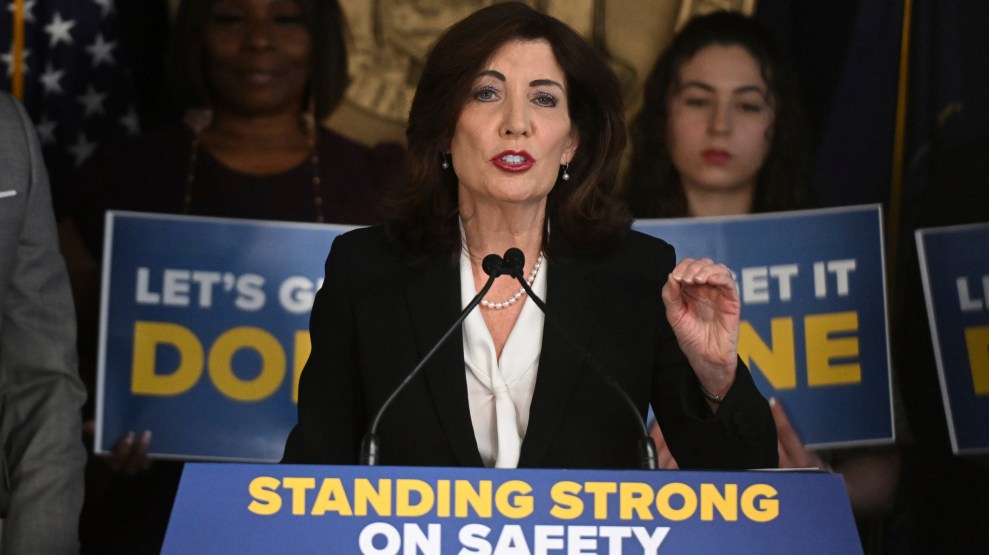
Governor Kathy Hochul joins domestic violence service providers to discuss New York’s discovery laws at the Office of the Governor on April 14, 2025 in New York City.NDZ/STAR MAX/IPx/AP
When Gina got a call that she owed money to a car financing company, it didn’t make sense. At the time, she did not have a driver’s license. In fact, she did not even know how to drive. But, the debt collector explained, her name was on the document.
Gina came to New York City from Haiti almost two decades ago. A few years after she arrived, she met a man, and they began a romantic relationship that quickly turned physically abusive. Within a month, he was sitting her down at a car dealership and telling her to sign her name. Gina didn’t understand that she’d be on the hook for his missed payments.
“When I found out about this debt issue, I couldn’t sleep. I was crying all the time. I lost a lot of hair. I was stressing,” Gina, who asked to use a different name due to safety concerns, told me through a translator. “It was the most terrible and horrible experience I’ve ever gone through in my life.”
Gina is a victim of coerced debt, a kind of financial abuse where bad actors either take out lines of credit in another person’s name without them knowing or pressure someone into accruing debt under threat. It’s an especially challenging legal hurdle when those experiencing financial abuse have to prove that the debt in their name wasn’t amassed consensually.
Across the country, forty-three percent of survivors report being pressured to take out credit in their own name when they did not want to, and 52 percent reported that an abusive partner put debt in their name through a fraudulent or forced transaction.
Right now, there’s a bill on New York Governor Kathy Hochul’s desk to provide a remedy for victims of coerced debt. The bill, which passed back in June, has been in the works for several years and would allow victims of coerced debt to petition creditors to have the debt in their name removed and transferred to their abuser—who debt collectors would then, in turn, be able to hold civilly liable for whatever money is still owed.
Hochul has until December 19, one more week, to sign the bill. But advocates worry it won’t get done, and fear the financial industry is stalling to alter the bill in the meantime. (In an email, Hochul’s office said, “The Governor will review the legislation.”)
“The debt collectors have exceptionally deep pockets. They are well connected in ways that our survivors simply are not,” Lauren Schuster, vice president of government affairs at Urban Resource Institute, the largest provider of domestic violence shelter services in the country, told me.
Months after the assembly passed Rosenthal’s bill in June, the American Financial Services Association wrote a letter to Hochul’s office, detailing their “grave concerns” about the legislation. While the association’s members are “highly sympathetic” to victims’ “extremely difficult” situations, Christian O’Connor, the AFSA’s State Legislative and Regulatory Counsel, wrote that the bill as it was passed is “open to exploitation by bad actors.”
In another document shared with the legislature showing notes on a 2024 version of the coerced debt bill, an industry trade group was more direct in a comment: “It is important to remember that there are two victims in a coerced debt scenario – first and foremost the consumer. But the creditor is also a victim who was taken advantage of by the abuser who caused the coerced debt.”
As the New York bill is currently written, in order to receive this relief, victims would need to acquire and submit official documentation that helps to prove the debt was coerced—like a police report, a Federal Trade Commission report, or a sworn certification from a qualified third party professional who has helped them, like a domestic violence counselor, a lawyer, or a social worker. The survivor would also need to submit a statement, sworn to be true, that the debts in their name were accrued through abuse or without their knowledge.
While coercing someone into debt is not currently illegal in New York, falsifying the kind of information survivors would need to submit is illegal—lying about this debt could amount to fraud or result in legal action, a reality that advocates say provides protection to creditors.
Currently, the executive office and both houses of the state legislature are going back and forth with negotiations to finalize the law over various proposed amendments. Some members of the credit industry, which did not make much noise during the voting process, are now petitioning Hochul’s office to change the legislation and introduce several provisions that advocates say would increase hurdles for victims of coerced debt.
“I understand the Governor has many, many bills,” Assemblymember Linda Rosenthal, who sponsored the legislation, said. “But I believe the way the bill was drafted, receiving input from all sides—from banks, from creditors, debt collectors, and of course from survivors of domestic violence and advocate groups—that the way we crafted it is the way it should be signed into law.”
Still, she continued, “well-heeled interests with deep pockets figure, ‘I don’t have to talk to the legislators, I will just go to the governor’s office.’” Rosenthal told me of the campaign to change the law. “I’ve gotten word to some of them, ‘You’re not skipping my office and my cosponsor in the senate’s office.’ So then they have to come back and say, ‘Oh we thought we called you, blah blah blah, we sent you an email,’ I’m like, ‘No you didn’t, but let’s talk now.’”
If Hochul signs the bill, New York will join a growing number of states that are introducing and passing coerced debt legislation. Texas, Maine, California, Minnesota, and Connecticut have all passed bills adding protections for victims of coerced debt—all to varying degrees. One thing that both the creditors and the advocates agree on is that this New York bill is more comprehensive than some of the other pieces of similar legislation that have been passed across the country. (Movement on the federal level to address this form of financial abuse has stalled in President Donald Trump’s administration.)
The advocates I spoke to called on Hochul’s past support and personal connection to those experiencing domestic violence and remained optimistic that she would sign the bill—and do so without introducing potentially burdensome concessions from debt collectors.
“I’m hoping that the voices of the survivors that we worked with, and all of the advocates and professionals who’ve been working on this, I hope that those voices matter in Albany,” Naomi Mo Chee Young, another lawyer who helps survivors, said.
The AFSA outlined several edits to the bill that they urged Governor Hochul to consider, including increasing penalties for false claims of coerced debt, removing physicians, religious leaders, attorneys, employee of a court of the state, and law enforcement officers from who is considered a “qualified third party” that can submit documentation for the victim, and excluding “secured debt” from monies that survivors can seek relief for, amongst other provisions.
The latter point on secured debt, if included, would make it so vehicle debts would be unavailable for relief. So victims like Gina would still be out of luck.
After several years and repeated threats from her abuser, Gina’s lawyers were able to get the creditors to dismiss the case based on a technicality, but not all victims are able to escape this kind of financial abuse. “She got lucky,” Divya Subrahmanyam, a lawyer with the Brooklyn-based nonprofit CAMBA who helped Gina, told me. “Most survivors are not getting lucky.”
www.motherjones.com (Article Sourced Website)
#minute #fight #legislation #victims #coerced #debt #York