
Polycystic ovarian syndrome (PCOS) affects all aspects of a Cyster’s life, but one of the biggest and best known areas of struggle is fertility. The hormonal imbalances of PCOS can make conceiving difficult and periods irregular. However, focusing on lifestyle changes to improve PCOS hormonal side effects and tracking your ovulation can be a big help!
Here’s more on that naturally reversing PCOS through lifestyle change thing, but today I’m dedicating this post to predicting ovulation! Ovulating is the only window of time in the menstrual cycle where a woman is can conceive, so figuring out when you’re ovulating can be the key to conceiving.
Here’s how to predict ovulation with PCOS:

How to Predict Ovulation With PCOS
Step 1: Learn about your cycle.
Before you start trying to predict when you ovulate, it’s a good idea to learn what a regular cycle actually looks like! And, I mean the entire cycle, not just your period. This is how a menstrual cycle works:
Menstruation
The first 3-7 days of your menstrual cycle is your period. This is when the thickened lining of the uterus sheds away through the vagina.
Follicular Phase
The second phase is about 10-14 days long and this is where your body prepares itself again for ovulation and the uterine wall that was just shed starts building up again. Also, in this phase, the follicle-stimulating hormone (FSH) prompts the ovaries to produce 5-20 follicles that are all immature eggs. Usually only one follicle will become an egg. Sometimes with PCOS, you have all the hormones to complete this phase, and you end up producing more than one follicle. But then, the body doesn’t have enough of the right hormones to get to ovulation so you end up with polycystic ovaries.
Ovulation
Here’s your fertility window! There’s about a 5 day window where you’ll be able to get pregnant as the mature egg moves down the fallopian tube to the uterus. Your cervical position rises and it becomes softer and moist to allow sperm to enter. Here, you either get pregnant or you move to the final phase.
Luteal Phase
This phase is about 8-10 days long and here unfertilized eggs change into the corpus luteum. This is where you get a lot of hormone shifts as the follicle holding the egg produces progesterone and estrogen to support a pregnancy.
Since the egg is not fertilized, the body breaks down the corpus luteum, hormone levels drop, and the menstruation phase begins again!
Step 2: Log what you can in cycle tracking apps.
Being generally aware of this cycle is a good start, but I don’t actually expect you to have it memorized and count your cycle days all the time. To help you track ovulation and the rest of the cycle, use a period tracking app.
However, these apps won’t be absolutely correct since predicting ovulation in women with PCOS is much harder! Irregular cycles make it hard for apps (and people) to track ovulation simple by counting days. But, this is a good start, and many of the apps get better at predicting your cycle the longer you use it.
Step 3: Pay attention to your cervical mucus.
Everything I’ve mentioned so far is great for a woman with regular cycles, but as mentioned, many women with PCOS have anything but a normal, predictable cycle due to hormonal imbalance. So, some of the best ways to track ovulation is using physical signs of each phase. Cervical mucus is usually a pretty good indicator of where you are in the menstrual cycle!
- After Menstruation: Tacky, usually white or yellow
- Follicular Phase: Creamy and cloudy (like yogurt)
- Ovulation: Consistency of egg whites, wet and slippery
- Luteal Phase: Dry and sticky
It may sound a little gross, but observing your mucus when you go to the bathroom can be a really effective way of determining where you are in your menstrual cycle.
Step 4: Take your basal body temperature.
Your basal body temperature rises and lowers throughout your cycle. Using a piece of graph paper and a basal body thermometer, you can track your body temperature. You simply check your temperature right away in the morning at the same time each day, and look for variations.
These variations will be very small! For example, if your temperature is normally 97 F, right before ovulation you will see your basal temperature drop by as little as 0.4 F, going to 96.6. After ovulation, it’ll rise by sometimes just as little, going from 96.6 past its usual 97 F to 97.4 F. However, it could rise or lower up to a degree.
To do this successfully, you’ll have to take your temperature every day for a few months to establish your baseline and norms. After that, though, it can be pretty accurate!
Step 5: Use ovulation prediction kits.
When you can start to gauge approximately when you may be ovulating using the other indicators above, ovulation test kits are the perfect way to know for sure! They measure your luteinizing hormone (LH) to tell you definitively if you’re in your fertile window of ovulation. I’ll break down how to use those below:
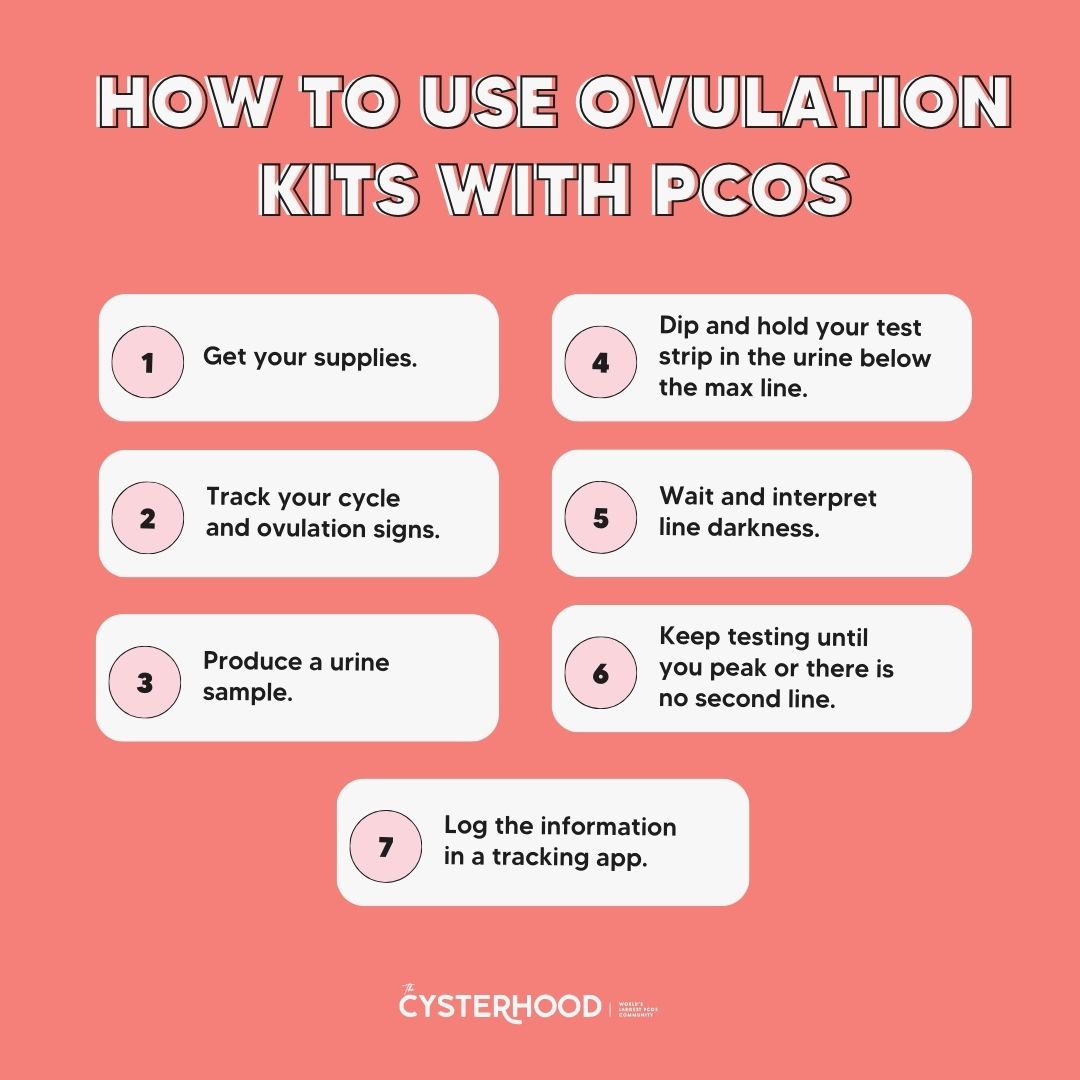
How To Use Ovulation Kits With PCOS
Step 1: Get your supplies.
First, you’ll need to gather supplies. You’ll need ovulation test strips, a reusable specimen cup, and a test strip results logging app like Premom.
Step 2: Track your cycle and ovulation signs.
Next, pay attention to your body and try to track your ovulation using the methods above. When you think you might be ovulating, take a test.
Step 3: Produce a urine sample.
Go ahead and produce a urine sample in the reusable specimen cup. You can also use disposable mouthwash cups if you prefer.
Step 4: Dip and hold your test strip in the urine below the max line.
Take out one test strip, and dip it into the urine, but don’t go past the max fill line printed on the strip. Hold it there for the directed time on the box.
Step 5: Wait and interpret line darkness.
Lay out the test strip, and wait for the lines to appear. Two lines will almost always appear, but they get darker within your fertile days. The darker that line appears (and the better it matches that control line) the closer you are to peak ovulation.
These test strips measure the amount of luteinizing hormone (LH) in your body, so it darkens as you get closer to ovulation.
Step 6: Keep testing until you peak or there is no second line.
Keep testing to figure out whether you’re heading toward ovulation or leaving it. As mentioned, once that second line is very dark, your chances of conceiving are the highest of your entire cycle!
Step 7: Log the information in a tracking app.
Log all of your test strip information in your app. That way, you can better understand and predict your cycle for the next go round.
It is possible to predict ovulation with PCOS!
Predicting ovulation with PCOS isn’t easy at all. We all know what PCOS periods are like, and they’re generally irregular, painful, and heavy. However, there are ways of getting it back on track! You can read more about it in the post How to Regulate Periods with PCOS and hear more about it in the episode of A Cyster and Her Mister called How to Master Your Cycle & Fertility. And, once your periods are managed, you can focus on improving ovulation and egg quality to finally put infertility behind you.
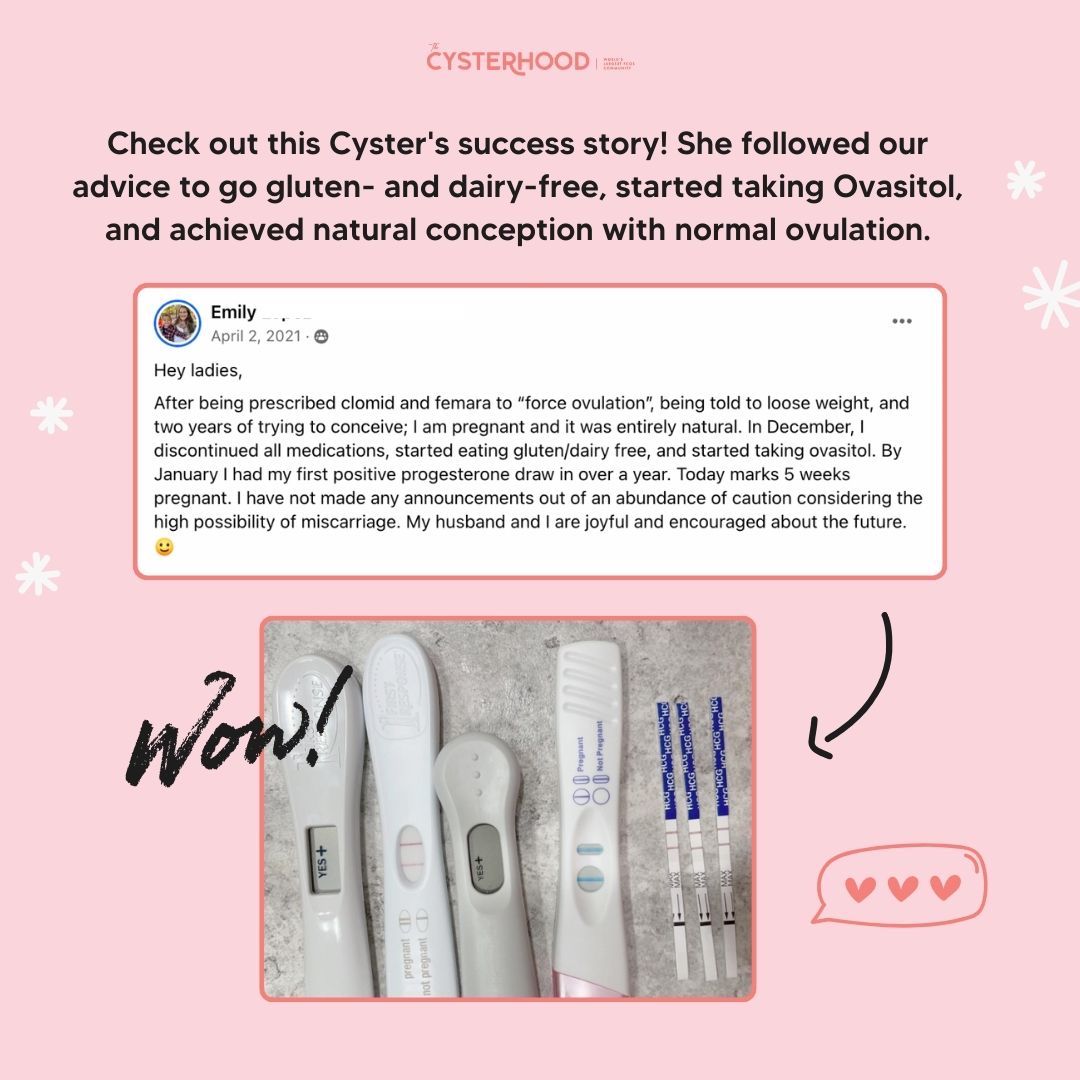
Just check out what happened to this Cyster! She took our recommendations to go gluten- and dairy-free and take Ovasitol to her doctor, and she finally experienced normal ovulation and conceived totally naturally. WOW!
Conceiving is one of the most difficult things a woman with PCOS goes through, with 70%-80% of Cysters experiencing infertility. There is so much wrapped up in it both physically and emotional, and the longing to be a mother is real. We’re here to help! Find more information about naturally reversing your PCOS on the blog, and join our amazing community by downloading The Cysterhood app where thousands of women like you are taking charge of their health to reach all of their life goals. We got this!
pcosweightloss.org (Article Sourced Website)
#Predict #Ovulation #PCOS