
By Xiao Xin
(CNS) — At the beginning of the New Year 2026, Beate Trankmann, the representative of the United Nations Development Programme(UNDP) in China, left Beijing and took up the position of UNDP Deputy Regional Director for Asia and the Pacific in Bangkok.
On the eve of her departure, CNS’s “W.E.Talk” conducted an exclusive interview with Beate Trankmann. Starting from the blue sky and the clear Liangma River outside the window, she shared her in-depth observations of China’s development story over more than 20 years.
Here are excerpts of the interview:
CNS: To begin, we’d like you to reflect on your time working and living in China. What has left the most profound impression on you about the country?
Beate Trankmann: If I compare the last 6 years of my current assignment with when I was here 25 years ago as a young officer, I think what has left the most profound impression is how far China has come in its environmental protection efforts, and how effective investments in environmental protection have truly improved people’s quality of daily life.
I’ll give you an example. 25 years ago, the Liangma River outside the office was very smelly. You couldn’t go near it. Nowadays, people run by the riverside and enjoy the natural beauty in the cafes along the riverbank. It’s not just the Liangma River; it’s a nationwide effort, and the data supports this. In the year 2000, just over 57% of China’s rivers had water of “good” quality. Today, over 90% do.
I have also witnessed air quality improve over recent years. 25 years ago, it was hard for people to realize that Beijing was a city surrounded by beautiful mountains. Now, the sky is clear and the mountains can often be seen. This is also supported by data. From 2013 to 2024, the city’s annual average PM2.5 concentration dropped by 66 percent.
From a development perspective, what is very important to me is that the environmental story is actually a very big part of China’s development story. Because China realized quite early on that it could only lift people out of poverty if it protected the environment and the ecosystem services that they depend on. Since the 1990s, China has begun to incorporate specific environmental goals into its Five-Year Plans, followed by continuous investment, action and monitoring. This is a highly valuable experience in how environmental protection and poverty reduction can go hand in hand.
CNS: Eradicating poverty in all its forms, the first UN Sustainable Development Goal, is a central mandate for UNDP. What do you consider to be the key factors behind China’s success in meeting the poverty reduction targets of the UN2030 Agenda a decade ahead of schedule? What implications does China’s achievement hold for global poverty reduction efforts?
Beate Trankmann: As you pointed out, China eradicated extreme rural poverty in 2020. Over the past 40-plus years, China has lifted 770 million people out of poverty, accounting for three-quarters of all people lifted out of poverty worldwide. It is the result of a long-term vision, continuous political commitment, as well as significant investment of funds and human resources. From 2012 to 2020, China invested a total of 1.6 trillion yuan in poverty reduction and dispatched over 3 million public servants to remote rural areas for poverty alleviation.
Obviously, you cannot simply compare China’s economic, planning and governance capabilities with those of smaller countries. But I think the valuable lesson that China’s experiences and successes in alleviating poverty offer to other countries is that policy continuity and long-term investments over time will yield results.
Preventing a return to poverty is an important task ahead. In the face of the current uncertain global economic environment, relatively poor people are the most vulnerable and most susceptible to shocks. Strengthening social security systems such as pensions, unemployment insurance and medical insurance is an important way to alleviate the impact on them. What is encouraging to see is that these reform priorities have been reflected in the upcoming 15th Five-Year Plan proposal, indicating that expanding and strengthening the social security system is a priority that the Chinese government fully recognizes and is promoting.
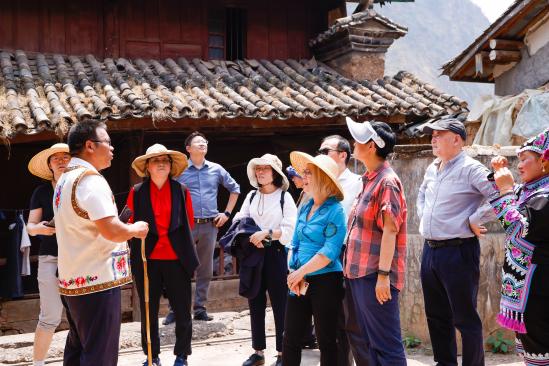
In April 2023, Beate Trankmann visited Waipula Village in Yunnan Province to experience the achievements of poverty reduction and rural revitalization achieved through sustainable means. Photo from UNDP
CNS: As a UN official stationed in China, your work has played the role of a “bridge”. In the context of a complex international landscape, what inspirations can the cooperation experience between UNDP and China offer for the globe?
Beate Trankmann: From a global, international perspective, international cooperation is vital. It’s not an option; it’s a must. Because environmental pollution, ecological challenges, and climate change transcend borders. You can’t solve them in isolation.
The important role played by UNDP is to bring countries, parties and people around the same table to work on common solutions and share what works and what doesn’t.
China has a lot to share in terms of “what works” and can also gain opportunities for mutual learning with other countries. That is how we understand our role as UNDP and the UN in China.
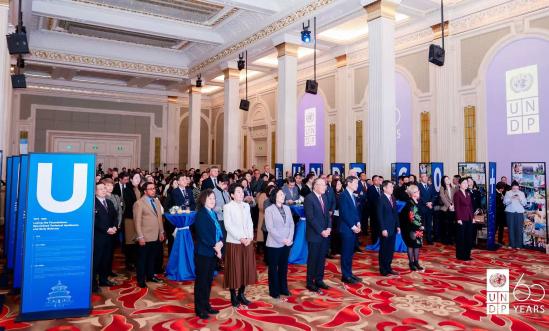
On November 13th 2025, UNDP in China hosted a high-level reception to commemorate UNDP’s 60th anniversary and 46 years of partnership in China. Beate Trankmann reiterated the importance of collaboration for the SDGs. Photo from UNDP
CNS: Looking ahead to the next five years of UNDP-China collaboration, what priority areas does the new Country Programme Document identify for accelerating achievement of the SDGs? How will it align with China’s development goals during the15th Five-Year Plan period?
Beate Trankmann: China plays a key role in helping the world reach the SDGs by 2030. So working with China on this “last mile” towards 2030 is a very important motivation of the new Country Programme. China has proposed that it will promote high-quality development during the15th Five-Year Plan period. UNDP supports China’s sustainable development efforts through the new Country Programme launched on January 1st, 2026.
It will focus on three key accelerators to achieve the Sustainable Development Goals:
The first is financing. Directing both public and private finance towards sustainability, making sure that the necessary investment is seen in areas such as biodiversity conservation, climate action, and green transformation. It will include domestic investment and overseas investment under the framework of South-South cooperation. For instance, the work is currently being carried out by the China International Development Cooperation Agency and the China Development Bank.
The second accelerator is innovation. China has established 11 National Sustainable Development Agenda Innovation Demonstration Areas. UNDP is establishing SDG Innovation Labs with local authorities to try out new approaches, new ways of doing things using innovation, technology, and digital solutions.
The third accelerator is integrated approaches. These are development approaches that can address inequality, biodiversity, and climate action all at the same time for shared benefits and to mutually reinforce each other.
People often ask, why do China and the UN need each other? The answer is that the commitments and investments China is making for its own development can play a “leverage role”, exerting a greater impact on the achievement of the SDGs both domestically and overseas.
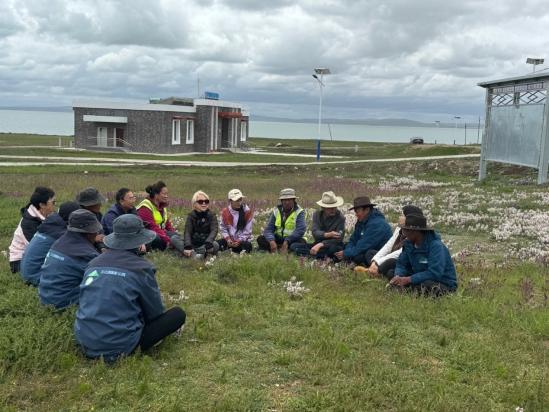
In July 2024, Beate Trankmann conducted an investigation in the Sanjiangyuan National Park in China. Her team had in-depth discussions with local villagers, learning about the state and achievements of local ecological protection. Photo from UNDP
CNS: UNDP has announced the establishment of the Global Center for Sustainable Development in Shanghai. What role will it play in this process?
Beate Trankmann: The Shanghai Center, the Shanghai Global Center for Sustainable Development, is a key element of the future partnership between UNDP and China, extending beyond the current country program. It recognizes China’s increasingly important role as a development cooperation actor, and it also demonstrates a shared belief in and commitment to collective action for the SDGs.
The idea behind the Shanghai Center is that it will support developing countries in their environmental protection, low-carbon economy, digital transformation, and so on, leveraging China’s experience in these frontier areas. We envisage it as a”Think and Do Tank”, meaning that it will combine policy research and analysis to develop practical solutions that respond to the specific needs and priorities of developing partner countries.
Shanghai is one of the top tech and science clusters in the world; it is also a major financial hub. It has a very vibrant entrepreneurial and innovation ecosystem. The idea really is to leverage Shanghai’s specific ecosystem to develop practical solutions for developing countries’ needs and share experiences.
A very new and exciting stage of the partnership with China is really beginning. This marks the continuation of the longstanding relationship that UNDP China has into the future.
CNS: Could you share your vision for strengthening collaboration with China in your new role as the UNDP Deputy Regional Director for Asia and the Pacific?
Beate Trankmann: I will leave China with one crying eye and one happy eye. Leaving China for me is leaving my second home. Including my first appointment and studies, I have spent 10 years in China, which is more than in any other country in the world outside Germany, my home country.
But it is indeed an exciting opportunity, especially with the perspective that I bring the China perspective. China is the largest economy in the Asia Pacific. China’s trajectory will shape development outcomes for the region. So strengthening regional cooperation between China and the Asia Pacific countries remains a key priority.
With my understanding of China’s journey and the experiences that China brings, I will share my professional experience in sustainable development, climate action, biodiversity conservation, and the digital economy. Under the framework of South-South cooperation, Chinese institutions will be introduced for cooperation and financial partnerships will be established to support sustainable development in the Asia-Pacific region. I will also assist the vast youth population in the Asia-Pacific region through an innovative learning platform, calling for and promoting the achievement of low-carbon development and climate change response goals.
As a long-term and very interested China watcher, I really hope to continue to accompany China from my new position in the next stage, to tell China’s development story and share its development transformation for mutual experience sharing.
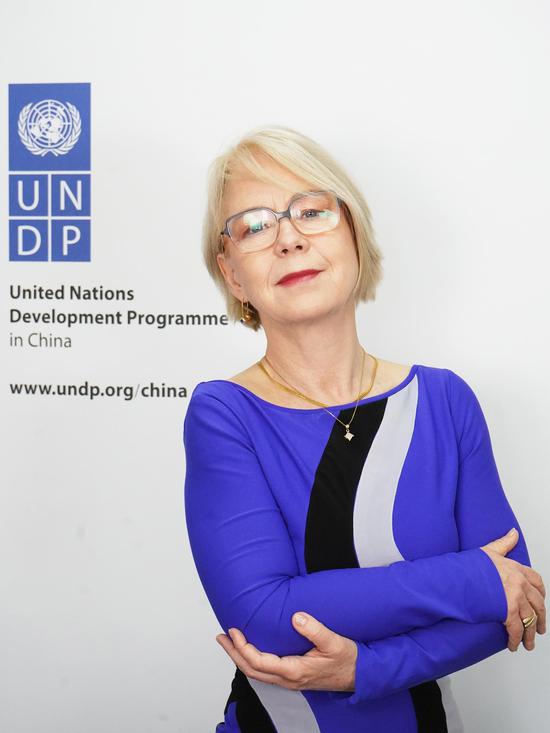
Beate Trankmann
Ms. Beate Trankmann is deputy regional director for Asia and the Pacific and director of UNDP Bangkok Regional Hub. She has been the UNDP Resident Representative in China since late 2019 and previously served as the United Nations Resident Coordinator and UNDP Resident Representative for Mongolia. She was also posted as the UNDP Country Director in Indonesia further to appointments with UNDP in Sri Lanka and Cambodia. Prior to joining UNDP, she worked with EU institutions in Brussels including with the European Parliament and as a research fellow at the European Institute for Asian Studies (EIAS), advising on EU-Asia relations. She holds a master’s degree in political science and a bachelor’s degree in China studies, both from University of Hamburg.


www.ecns.cn (Article Sourced Website)
#official #observe #understand #Chinas #development #story