
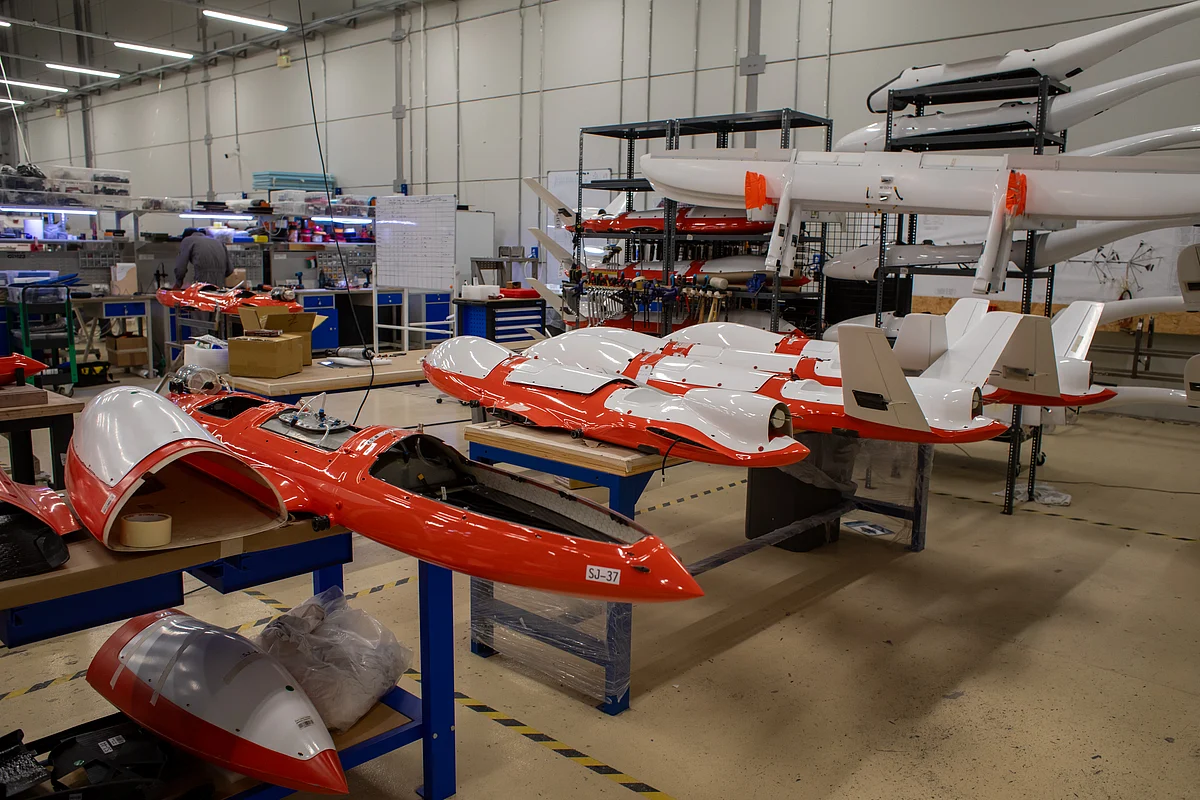
Inside a vast, warehouse-style production facility in Masdar City, aircraft fuselages sit in various stages of assembly — some stripped down to carbon-fibre frames, others freshly painted and ready for testing. Engineers move between CNC machines, composite moulds and long worktables, assembling aircraft that, until recently, existed only as digital models on computer screens.
This is where Air Q, an Abu Dhabi-based unmanned aerial vehicle (UAV) manufacturer, is preparing its platforms for real-world deployment — from long-range surveillance missions to transporting blood samples between hospitals.
During an exclusive behind-the-scenes tour, Khaleej Times was shown how the company’s flagship aircraft, the Harara, has progressed from early prototypes to a platform that has now completed more than 1,000 test flights.
Stay up to date with the latest news. Follow KT on WhatsApp Channels.
“Everything you see here started with a very small team,” said Dino Dedic, CEO of Air Q. “In 2022, we were just six people.” Today, that team has grown to around 100 engineers and technicians, working across design, production and testing — largely under one roof.
From design screen to flight-ready aircraft
Upstairs, designers worked at large computer screens displaying detailed 3D models of the Harara hybrid, with every component colour-coded to distinguish individual parts.
Dedic paused at one workstation and zoomed into the aircraft’s digital blueprint, rotating the model to reveal its internal structure. “We did it from scratch,” he said. “We know every single part of our plane.”

That depth of in-house design, he explained, gives Air Q a practical advantage once aircraft are deployed. Because the company designs and builds its own components, faults can be identified and addressed quickly, without relying on overseas suppliers. “If something goes wrong, we can prove it very quickly and very shortly,” he explained. “Our team is super hands-on. We exactly know what happened.”
He contrasted this approach with what he described as a wider trend in the UAV industry — visually striking designs that look impressive on paper but fail to deliver in reality. “You can make the most beautiful product in one week, but it doesn’t fly.”
The Harara is a fixed-wing aircraft with vertical take-off and landing (VTOL) capability, designed to operate without runways while maintaining long endurance. Available in electric and hybrid versions, the hybrid model can fly for more than six hours and cover up to 600km.
One of its early commercial applications in the UAE will be medical logistics — specifically, transporting blood samples between hospitals and laboratories. “Instead of using a van and sitting in traffic, it will directly travel from point A to point B,” Dedic explained. “It’s faster, cheaper, and you don’t need a runway.”
Standing beside the aircraft on the factory floor, he pointed to design decisions that shaped Harara — including the use of three tilt motors instead of five, reducing weight and improving efficiency. “The biggest enemy of performance is unnecessary weight.”
Engineering roots in performance aviation
A key figure behind Harara’s design is Igor Pongrac, an aerospace engineer who previously worked at Rimac, the Croatian electric hypercar manufacturer known for high-performance engineering. Pongrac was part of the engineering team shaping the aircraft’s aerodynamics and configuration.
That expertise, Dedic said, helped the company overcome one of the most complex challenges in VTOL aircraft: the transition from vertical take-off to fixed-wing flight — a phase where many UAV projects fail.
“Flying doesn’t mean just taking off for a second and landing,” he said. “It means flying six and a half hours.”
Why Air Q builds almost everything itself
Throughout the facility, engineers demonstrated composite manufacturing, CNC machining, wiring and final assembly — processes that many UAV startups outsource. Air Q chose to bring most of this work in-house after struggling with supplier delays early on.
“We realised very quickly that supplier lead times were killing us. Some parts would take months to arrive,” Dedic said. Instead, the company began designing and manufacturing most aircraft components internally — from moulds and composite structures to wiring harnesses — sourcing only engines externally.
“That decision changed everything. It shortened delivery times and gave us control.” The facility, he added, has the capacity to scale production significantly as demand grows.
Tested in UAE conditions
All aircraft are tested locally, a deliberate choice given the region’s extreme climate.
“The conditions here are much worse than anywhere else,” Dedic said, pointing to heat, humidity and prolonged sun exposure. “If it works here, it works anywhere.” In fact, Air Q’s first aircraft Harara – which translate to heat in Arabic, got its name from the heat its engineer felt after moving to the UAE.
Defence and training applications
Beyond commercial uses, Air Q is also targeting defence and security markets. Among the platforms shown during the tour was the StingJet, a jet-powered target aircraft designed for military training.
The aircraft can simulate high-speed manoeuvres and recover via parachute. Unlike disposable target drones, it is designed for repeated use.
Supporting this platform is what Air Q describes as the world’s first fully electric UAV launcher, developed entirely in-house and capable of performing up to 200 launches on a single charge.
Growing without rushing
As Air Q looks ahead, the company is developing larger cargo platforms capable of carrying payloads of 40kg and eventually 200kg. Despite growing interest from overseas markets, Dedic said the company deliberately avoided rushing into sales.
“A lot of companies highlight performances that are not correct,” he said. “We say we can fly six hours — and we fly seven.”
Walking through the factory, past aircraft in various stages of completion and engineers working across open production floors and offices built above storage areas, the company’s approach is clear. “We didn’t come here to try,” Dedic concluded. “We came here to build, prove ourselves, and grow.”

www.khaleejtimes.com (Article Sourced Website)
#military #blood #sample #transport #UAEbuilt #aircraft #prepare #realworld