
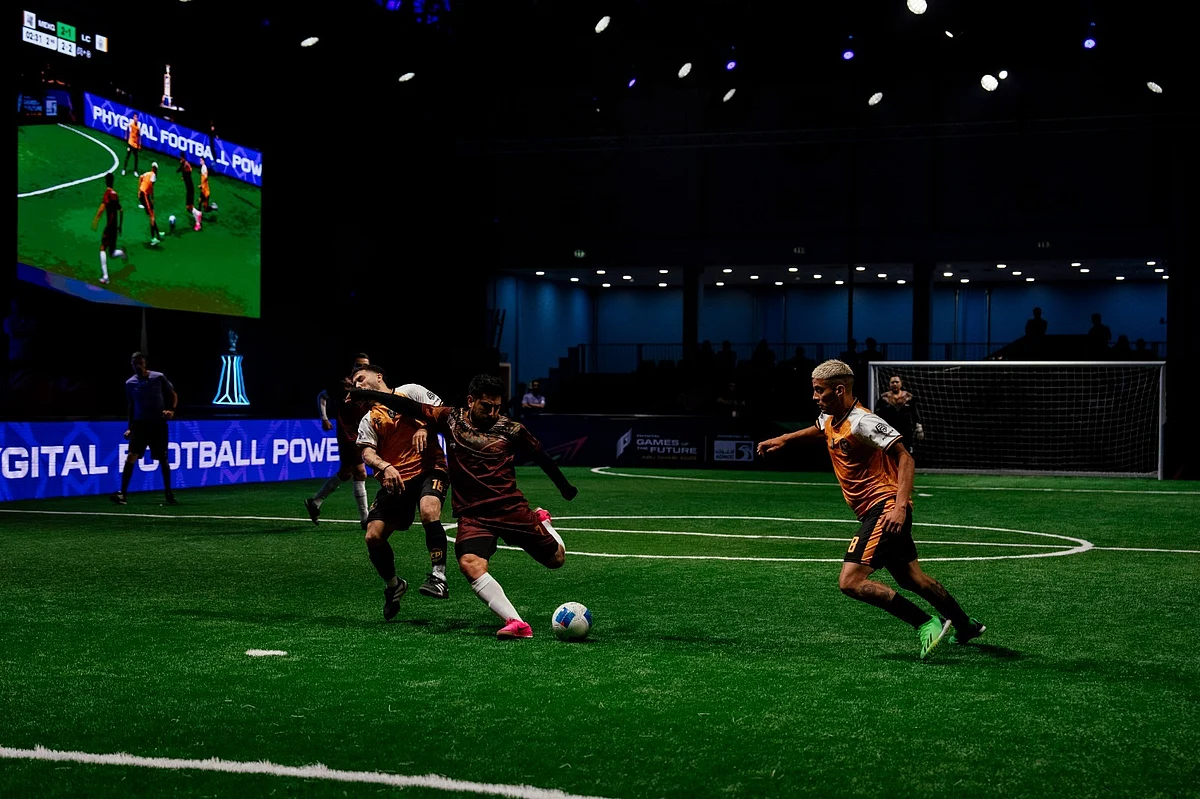
At the Games of the Future Abu Dhabi 2025, competitors moved between two very different arenas: one physical, the other digital. A match could begin on a football pitch, continue on a screen, and end with players visibly catching their breath as results flashed above them.
The six-day event, which concluded on December 23, brought together teams competing in what organisers describe as ‘phygital’ sports – formats that combine traditional athletic performance with esports, requiring participants to perform in both disciplines within a single competition.
Stay up to date with the latest news. Follow KT on WhatsApp Channels.
“This is a new sport concept where you mix the best of two worlds,” said Nis Hatt, CEO of Phygital International, the body behind the format, describing the format as a fusion of classical sports and esports “combined into pretty much one sport, where you have to do both”.
Held from December 18 to 23, the Abu Dhabi event marked the culmination of six days of competition across 11 phygital sports, with teams qualifying through international feeder tournaments to reach what organisers describe as the pinnacle event: the Games of the Future.
Not gamers versus athletes — but teams built to balance both
One of the defining features of the Games is that advantage does not sit clearly with either professional gamers or traditional athletes.
“It’s equal — and that’s the purity of the concept,” Hatt said. “You will literally see people who are very, very good at gaming and less good when they hit the football pitch, and vice versa. Even former professional football players were not that good in gaming.”
Success, he said, comes from team composition. “When they come together as one team, then all of us suddenly will see the magic happening.”
That balance was visible throughout the arenas, where teams were often made up of players with sharply different strengths and backgrounds. Teams are not bound by nationality, with mixed-gender and multinational line-ups encouraged.
“It does not necessarily have to be a male or female team, or one team from a certain area,” Hatt added. “It can really be mixed nationals.”

HADO: ‘Another world’ of sprinting, strategy and split-second decisions
Among the most physically demanding spectacles on the final day was HADO, an augmented-reality game where players wear headsets and sensors, sprinting across a court while launching and dodging digital energy blasts projected on screen.
Japan’s team — Takio Kurushima (Morozo), Tatuki Azuma (Zoomaa) and Koga Ishido (Choco) — secured third place, emerging visibly exhausted but grinning after their match.
“First of all, we need to figure out what this character can do,” Kurushima explained. “After that, we need to do physical training for how to use the character.”
Preparation involved far more than screen time. “The main exercise is for the lower part of the body — legs,” he said, adding abs and back training were also essential. “They really break a sweat.”
Kurushima, 24, who works as a driver outside competition, described the format as unpredictable. “We have been playing normal HADO for six years, but the HADO World is just a few hours,” he said. “They give you a surprise. You have little time to get used to the character and bring its power.”
Despite the challenge, he was clear about the appeal. “That’s a joy. Really a joy.”
From Counter-Strike to laser tag — and back again
Elsewhere, digital precision met physical pressure in the Counter-Strike/laser tag hybrid format, where teams first battled it out on screen before stepping into a live-action arena where movement, stamina and real-world tactics mattered.
During a tense semi-final, commentators pointed out how physical performance directly impacted digital outcomes, with mistakes in the laser tag stage costing points on screen.
Among the teams qualifying for the finals was Donstu, featuring Nikita Bulgyin (gaming name: Twiskar), a 27-year-old Russian player new to phygital competition.
“I like that it’s original,” he said. “You can win it in CS, and you can win it in another. Usually, for CS players, it’s only CS — and it’s maybe a little bit boring for viewers.”
Bulgyin, who has played Counter-Strike and League of Legends for more than a decade, said the toughest part of the competition was mental pressure. “Today, it was a little bit nervous for us.”
Preparation involved both screen time and physical training, with sessions typically running twice a week. While his main role was team captain in Counter-Strike, Bulgyin said he hopes to compete physically next time. “I’m probably going to play laser tag next.”
A format designed for a new generation
For organisers, the long-term ambition goes beyond spectacle. Hatt said phygital sport is designed to engage younger audiences who are already deeply immersed in gaming culture, while encouraging physical movement rather than replacing it.
“We want to embrace and make sure that you have the young generation participating,” he said. “If you only sit there gaming and do not take part in physical sports, over time you run the risk of lifestyle diseases.”
He pointed to games like HADO as examples of how fast, high-impact formats can motivate movement without feeling like traditional exercise. “You look at it and say, ‘What is going on?’ until you see the replay on the big screen,” he said. “It’s super short, super fast — a lot of action.”
What comes next?
The Abu Dhabi event was not a standalone experiment. According to Hatt, 15 national members worldwide currently run local competitions, feeding into the Games of the Future through a structured qualification system.
“This is the pinnacle,” he said. “It is a proper concept, very precisely laid out.”
Looking ahead, the next Games of the Future are set to take place in Astana, Kazakhstan, with organisers already working with authorities in the UAE to explore how phygital sport could be introduced at school and university levels.

www.khaleejtimes.com (Article Sourced Website)
#heard #phygital #sports #Step #Abu #Dhabis #Games #Future