
Click here to listen to the Audio verison of this story!
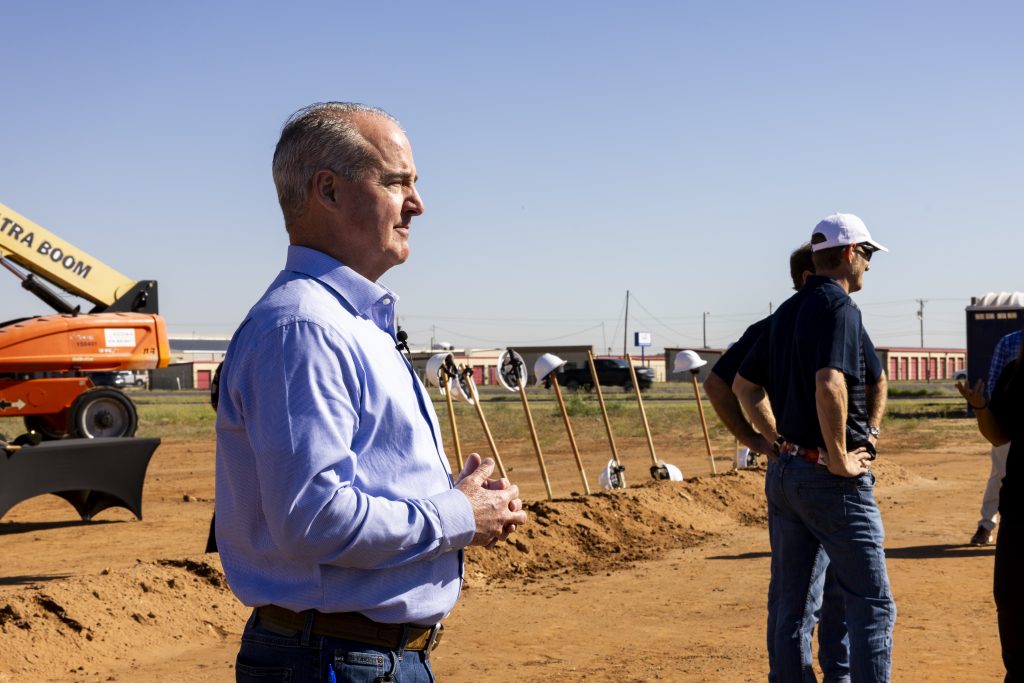
Travis Stice looks on as the groundbreaking ceremony of the Diamondback Energy Athletic Complex unfolds—Diamondback’s largest philanthropic donation then to date.
The person who founded what is now Diamondback Energy and took it from a tiny, private-equity-backed firm producing 3,700 barrels of oil equivalent per day (BOE/d) in 2012 to a publicly traded firm producing more than 900,000 BOE/d in 2025, deserves to be named the Permian Basin Petroleum Association’s (PBPA) Top Hand of 2025.
That person is Travis D. Stice, and he is indeed the PBPA’s 2025 Top Hand. On Jan. 29, the Petroleum Club of Midland will see the gathering of PBPA members, along with Stice’s friends, family, and well-wishers, as the Permian Basin oil and gas industry pays tribute to one of its finest.
Over the last 15 years Stice has been CEO (2012-2025), Director (2012-2022) and Chairman of the Board (2022-2025) of Diamondback. As of May 2025, he became the company’s Executive Chairman.
He has also been CEO of Viper Energy Partners, Inc., the publicly traded mineral subsidiary of Diamondback (2014-2025) where he remains a director. He was CEO and Director of the General Partners of Rattler Midstream LP, a midstream company acquired by Diamondback in August of 2022.
And Diamondback’s recent acquisition of Endeavor created the Permian’s third largest producer, with approximately 838,000 acres producing 815,000 barrels of oil equivalent per day (boe/d).
As impressive as that resume is, Stice is careful to credit others and teamwork, insisting that the people he surrounds himself with are “so much smarter than I am. I mean that sincerely. I recognize that when you put smart people around you, you really do generate better results.”
From Pre-Med to PE

A luncheon celebrating volunteers was the occasion for Stice and his team, and “Empower” was the word of the day.
Although Stice grew up in the oil business—his father was general counsel for a local independent—he first decided to go a different direction, choosing medicine. Partly because, in the high-school-age Travis’s eyes, “It seemed like the only thing that you could do coming out of Midland was fast food and the oil and gas industry.”
But the extreme “memorization and regurgitation form of learning” in early pre-med years at Texas A&M frustrated him. After a year of straining to memorize bones and muscles, he “came home” to a major in petroleum engineering.
His 1985 graduation dumped him into an oil patch reeling from low prices and layoffs. On the positive side, that made it easy to decide which job to take. After extensive resume sending and interviewing he got a job offer.
Exactly one. And that one was “really by the grace of God.”
Certainly, as he looks back now, he sees how that prepared him for the roller coaster ride that is ever the oil patch—a ride that he sees as character-building. “That’s what I think defines and develops the grit and determination that this industry is known for—being able to participate in a business where you don’t control the price of the product that you produce. I think that’s a unique attribute that all of us in the oil business have had.”
The Layoff that Altered History
That first job was with Burlington Resources. It was a great situation, one in which Stice flourished and advanced. After a few years, in the early days of merger and acquisition frenzy, ConocoPhillips bought Burlington. And while he stayed on board for a time, it wasn’t a good fit.
Stice then spent two years in a private equity venture called Laredo, but “it just wasn’t a satisfactory match,” either. He needed a new option.
Until then he’d never thought about starting anything himself. “This was never part of the calculus of my career,” he said. “In fact, had Burlington Resources still been in place today, I would have hoped I was still working for them.”
He left Laredo with “a fire in my belly. I think I was 50 years old when I left Laredo. I had a firm ability to prove that, yeah, I could do this.”
That fire found a vessel when another PE firm, Wexford Capital, had some assets that they wanted to grow. They were looking for someone to assemble a management team that would take the venture public with an initial public offering (IPO), thus providing the capital to expand.
Fifteen years later, as that company, now Diamondback, is one of the largest Permian producers, most analysts would say that plan worked pretty well.
Friends are Friends Forever
During any transition time it’s good to have friends to help talk things through. For Stice, a key confidant was Denzil West, who is now CEO of Admiral Permian Resources.
They met in high school, with West admitting to being “two or three years older.” Through the years they’d kept in touch, as their sons played baseball together on traveling teams. West recalled that Stice was a major-league-level statistician, feeding a lot of useful information to the coaches.
During the transition from ConocoPhillips to the next step, West recalls getting a phone call from Stice. They’d had regular get-togethers starting a few years before with Stice listening to West as the latter considered returning to the oil and gas industry. But around 2010 it was West’s turn to provide a listening ear.
“When Conoco bought Burlington, he had to stay on for a certain amount of time,” West said. “It was a different culture for him, and he was struggling through that cultural change. And we would talk through that.”

Stice greets families at the Annual Company Picnic at a Midland Rockhounds double-A affiliate baseball event.
Interestingly, Denzil West knew Steve West, who had approached Stice about coming to work for the startup that would become Diamondback. Steve West asked Denzil West for some input. “And I just told him what I knew about Travis. I said, ‘It’s not fair because we’re good friends.’”
Diamondback Rising
While the buyout made Stice look elsewhere, his Burlington years had prepared him for next steps. He said, “There were individuals there that poured into me things that I was able to take, learn from, take their guidance, and create the elements that, I think, have laid the groundwork for the success of Diamondback Energy.”
Steve West was also significant, hiring Stice for Diamondback’s predecessor in the first place. West was a principal at Wexford Capital, the private equity company accumulating leases around the Midland airport, Stice said.
He recalled that in the interview process, “He and I just hit it off. We saw the development of the business in the same way.” West taught Stice about capital markets and other business aspects, but he did much more than that.
“He was always a person I could talk to, no matter how complex the situation was. He was able to devolve that situation into very simple elements that we could then unpack and figure out a strategy to go forward,” Stice said.
Joining Wexford Capital in 2011, Stice made the company public in 2012—which was part of West’s plan. Funding from the public offering is one thing that catapulted Diamondback to where it is today.
Another factor was the pair’s shared vision, which included a production strategy that could withstand the storms of price volatility. “I’ve learned that if you’re going to be an ongoing entity in the Permian Basin, you have to be the lowest cost producer,” Stice said, citing a philosophy they still hold, and that has been especially fruitful in the industry’s volatility since 2020.
Low cost was one leg of the stool. The other legs were best-in-class execution, and transparency both internally and with investors.
On cost and execution, Stice compared today’s shale production to the manufacture of widgets. “In any manufacturing process, it’s the lowest cost manufacturer, of widgets in this case, or barrels in the Permian Basin, that ultimately is successful.”
The Fire Inside
Yes, the business model is important, but for Stice, making Diamondback successful has been much more than business. It’s personal.
“I really wanted to be the difference maker in the lives of the people that came to work for the organization.” This was particularly a challenge in Diamondback’s early days, which Stice recalls as “our survival stage.” During that time, before the IPO, capital was scarce and everything was done on a shoestring, he recalled.
“But I had a burning desire to see the individuals that put their trust in me. They came over recognizing that they were leaving something that they were already very successful at. They saw something in me that really emboldened me to see if I could make a difference in their lives, a trajectory-changing moment in their lives, that decision to come work for Diamondback.”
He continued, “To get up every day and to know that there’s now 1,750 employees that are leaning on our leadership to meet their hopes, wishes, dreams, and desires is something that really keeps me going because everyone came to work here thinking that whatever they want out of life is going to be met, at least professionally, through their choice to come to work for Diamondback.”
Dedication to employees was also in view during the COVID-19 shutdowns. Then, not only did they lay off no one, the executives took pay cuts to create budget space.

In Others’ Words
Stice’s declaration about being as good as the people around you rings true in light of Denzil West’s assessment. West declared that Stice is “a fierce competitor, fierce competitor but fair and but so humble in the way he handles things.” He used the word again later, saying Stice is “fiercely loyal.”
In fact, as West is on the PBPA board that picks Top Hands, he’s one reason Stice is this year’s winner. “When it [the Top Hand vote] came up this year, it’s like, he has to do it. There’s probably no better candidate for what he’s done for Diamondback, for his investors, but really for Midland and the Permian Basin than what Travis has done over the last 10 to 15 years and he’s so deserving of it.”
West also lauded the organization. “PBPA is one of the most influential voices in advocacy of the entire oil and gas industry and for the Permian Basin specifically. It is a tremendous steward of its assets to get the most effectiveness in influencing public and private policy in aid of the industry.”
Marc Dingler, now Diamondback’s executive vice president of government and public affairs, came to the company as a general counsel in 2014. Dingler had worked for Pioneer for 20 years (starting when they were Parker and Parsley), who had transferred him from Midland to their Dallas office.
A Diamondback recruiting call from someone Dingler had known from earlier days at Pioneer caught his attention. Initially, he didn’t want to move and when he decided to interview, he wasn’t what Diamondback was looking for.
But in the conversation, in which he met Stice, the company decided Dingler’s skills could indeed help them if they changed the job parameters. In that adjustment Dingler saw Stice’s humanity. “My first impression was that he was just a genuine person,” and that “attracted me to want to work for him.” Dingler came on board as deputy general counsel.
Treating everyone as humans is part and parcel of Diamondback’s fiber, said Dingler. He pointed out that in every acquisition of another company, they evaluate the incoming staff as people, to see what they can learn from them.
A case in point, Stice and Dingler both are pleased with the fact that no one was laid off in the Endeavor acquisition—a vast departure from most such deals, where a massive “duplication-reducing” bloodletting is the first order of business after the ink dries on the contract. Dingler noted that Endeavor employees were offered exit packages, and enough took those to reduce the total workforce by about 15 percent without forced layoffs. “It’s comforting to realize that you let people make that choice on their own,” instead of handing out pink slips, Dingler said.
Dingler’s favorite Stice quote originated at a quarterly earnings call, when he answered an investor question by saying, “I try to live my life by these guiding principles: Do your best, do the right thing, and treat others the way you want to be treated.”
What’s Next?
“There’s three things,” Stice said. “There’s faith, family, and friends,” he said. “I know that I wouldn’t be where I am today without my faith. My family would not be the family they are without our faith. And it remains the single most important thing in my life. I look forward in the future to diving even deeper into our faith and our foundation.”

Paul Wiseman
A longtime contributor to PB Oil and Gas Magazine, Paul Wiseman is an energy industry freelance writer.
The post Difference Maker appeared first on Permian Basin Oil and Gas Magazine.
pboilandgasmagazine.com (Article Sourced Website)
#Difference #Maker