
When Lisa Petersen had her first child, she knew she would be heading back to work before long. So when her daughter, Naia, was a few months old, the former B.C. educator logged onto an portal run by the city of Copenhagen and selected her ideal daycare.
Soon after, she was guaranteed Naia’s spot — full-time, subsidized care at a facility run by qualified educators.
“It was insanely easy,” she told CBC News. “I feel horrible talking to people back in Canada about it, because it was just so incredible.”
Petersen’s experience with Denmark’s world-renowned daycare system is vastly different than that of many parents in Canada, who still face lengthy waitlists and high fees, despite a 2021 Liberal target of bringing daycare fees down to $10 per day, on average, by 2026.
As of July, five provinces — Alberta, Ontario, B.C., Nova Scotia and New Brunswick — had yet to reach that goal.
“We’re nowhere near a universal system,” said Morna Ballantyne, executive director of Child Care Now, an advocacy group.
But as governments weigh extensions to the Liberal subsidy program, there is evidence from other countries that Canada’s market-based approach risks wasting public dollars — and worsening the quality of care.
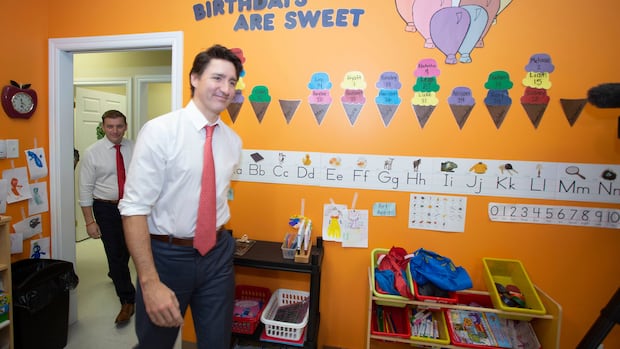
Despite its budget of $30 billion over five years, the federal $10-a-day daycare program has accomplished less than 40 per cent of its goal ahead of its 2026 deadline. However, Families Minister Jenna Sudds tells Power & Politics she is ‘not concerned’ about missing the deadline.
Australia’s cautionary tale
Fourteen years ago, Georgie Dent, like Petersen, was in search of child care for her two children.
Returning to her native Sydney from abroad, she found herself in a battle for spaces, facing long commutes and sky-high fees.
“We were spending more on child care than we were on rent,” said Dent. “We had two centres going, two dropoffs every day. It was crazy.”
Today, Dent runs an advocacy group called The Parenthood, representing parents and caregivers. She says that Australia’s efforts to subsidize care, which are similar to Canada’s, have proven “woefully inadequate.”

Australia has offered subsidies since the 1990s, paying a portion of the fee charged to parents, conditional on their work activity and income.
But similar to Canada — and unlike Denmark — Australia has largely left the development of its child-care centres to the private sector.
More than 70 per cent of Australian daycares operate on a for-profit basis; international conglomerates, including the Ontario Teacher’s Pension Fund, have invested heavily in the sector, seeking high returns.
“Child care has become big business in Australia,” said Matt Grudnoff, an economist with the Australia Institute, a think-tank. “There has been a lot of obvious price gouging.”
The subsidy, meanwhile, has been unable to make a dent, with fees rising alongside increases in public spending, according to Australia’s Centre for Policy Development.
Child-care deserts
And the subsidy has done little to address “child-care deserts,” areas where there is a shortage of care. To maximize profits, experts say, providers tend to put facilities where they can stretch parents’ budgets the furthest: wealthy, urban areas where care is already in abundant supply.
Worse, these experts say, the funding is not conditional on regular evaluations of quality. That has given for-profit operators little incentive not to maximize profits by lowering operating costs — and potentially compromise safety.

“We have a sector that is dominated by a casual, high-turnover, low-paid workforce,” said Lisa Bryant, an advocate for child care in Australia. In remote areas, as much as half of staff leave their positions after 12 months, attributing their decision to long working hours and poor wages.
In the past few years, the Australian government has tried to address these shortages with raises for child-care workers and bonuses to increase worker retention. But it hasn’t been enough.
At the same time, Australia’s government has been considering scrapping the child-care subsidy — reorganizing the system completely around universal public or non-profit care.
In just the last few months, the country has been rocked by scandals over neglect and abuse in care. One city asked more than 2,000 children to get tested for sexually transmitted infections after an alleged abuser worked at dozens of centres; he has since been charged with more than 70 offences, involving at least eight children.
“We’re in a period … where there is very little trust in our child-care centres,” said Bryant. “And it all trickles back to how we fund them.”
Denmark’s success story
Unlike Australia — and Canada — Denmark has long treated access to daycare as a basic right.
“By law, they have to find a spot for you,” said Erika Naud, a Canadian living in Denmark with two children under four.
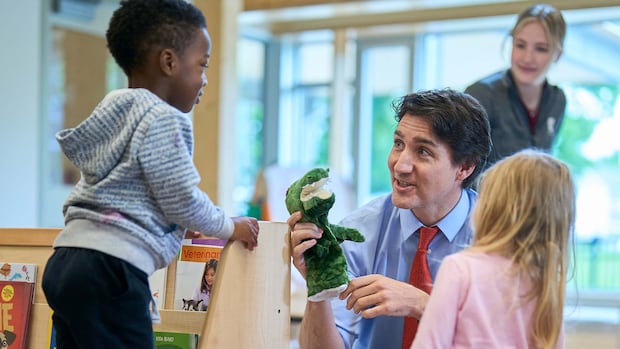
While many providers have signed up for $10-per-day childcare, waitlists are only getting longer — some years-long — and parents are getting frustrated. Meanwhile, some providers are threatening to pull out of the program because they can’t raise fees.
Nurseries like the one her children attend, where a few dozen kids are cared for by a team of educators, are run through the municipality as an extension of the public education system.
If spots in these aren’t available, Denmark also offers subsidized home-based care and modest payments to mothers who stay home with their own kids.
These subsidies are based on a family’s income, but parent fees never account for more than 25 per cent of the operating costs of a facility.
This system has delivered results. Today, more than 92 per cent of Danish children aged one to two years old are in some form of child care, with most kids starting daycare between nine and 11 months.
Research suggests that access to high-quality early childhood education can have enormous benefits for children’s social and emotional development, particularly for kids from marginalized backgrounds.
“We have really solid research in Denmark that when kids reach second grade in school, it’s over — their path is made,” said Birgit Stechmann, a consultant with FOA, the Danish union representing child-care professionals. “Early childhood … has such an impact.”

Could Canada go Danish?
A public system like Denmark’s is not cheap. Merete Villsen, manager of the early child-care department in Aalborg, a city of about 220,000 people, said the municipality spends more than $170 million Cdn each year on daycares.
Katherine Oborne, a child-care expert with Australia’s Centre for Policy Development, also cautions that once private providers establish a foothold in a sector, it is difficult to phase them out. “It would be very hard to unscramble that egg,” she said.
In countries like Australia, Canada, and the U.K., Oborne says, there is also less “social licence” for treating daycares like an extension of the public school system, as they do in Denmark.
She says that’s one reason why Australia’s government is leaning on the non-profit sector to expand availability, rather than running it themselves through public schools.

Canada’s system is not exactly like Australia’s. For one, it varies greatly from province to province, and in many provinces, subsidies are paid directly to providers as a percentage of their operating costs, not issued as vouchers that follow parents, as in Australia.
But advocates are still concerned that, as in Australia, the for-profit sector is taking too big a slice of an essential public service.
“The percentage of for-profit child care has been increasing dramatically,” Ballantyne said. Since 2013, the creation of for-profit centres has outpaced non-profits by nearly two-to-one. Governments, meanwhile, “are continuing to treat [daycares] very differently than public education,” she said.
She sees some hope in recent plans to revisit funding formulas to ensure that subsidies are actually lowering costs for parents and keeping quality daycares afloat.
But she cautions that some provinces, like Ontario, are actually cutting their contributions as the federal government increases theirs.
“This should be understood to be a nation-building project … [and] an economic initiative,” she said. “I’m optimistic, but I know it’s going to be a lot more hard work.”
www.cbc.ca (Article Sourced Website)
#Daycare #Denmark #basic #Canada #offer #CBC #News