
Sri Parthasarathy Swami Sabha (SPSS), celebrating its 125th anniversary, carries a legacy forged in music, dance and drama, and tempered by time. For a century-and-a-quarter, it has nourished generations of artistes.
The Sabha’s longevity is the visible manifestation of an organisation built upon vision, adaptability, community spirit and resilience.
Named after the presiding deity of the Parthasarathy Swami Temple in Triplicane, SPSS first took shape as the Sangeetha Vidwat Sabha in 1896 and was officially registered under its current name in 1900 and functioned on the banks of the ‘Kairavini Saras’, the temple’s sacred tank — it is one of India’s earliest performing arts organisations and the oldest music sabha in South India.

Manni Thirumalachar, founder of Sri Parthasarathy Swami Sabha.
| Photo Credit:
The Hindu Archives
The absence of a permanent home, however, has been a significant handicap. Its journey began with a decade-long stint (1896-1905) at ‘Gate House’, the residence of its founder Manni Thirumalachar. From there, the Sabha embarked on a series of sojourns across Triplicane, with venues shifting from Peyazhwar Koil Street (1905-1910) and Thulasinga Perumal Koil Street (1910-1920), to the Kalavala Kannan Chettiar Maaligai (1920-1935). Later homes included T.U.C.S. Jubilee Hall (1936-1938) and a dual arrangement with the Hindu High School for music and N.K.T. Kala Mandapam for dance and drama (1940-1959), before a 25-year tenure in a building on Venkatarangam Pillai Street (1959-1993) in Triplicane offered relative stability.
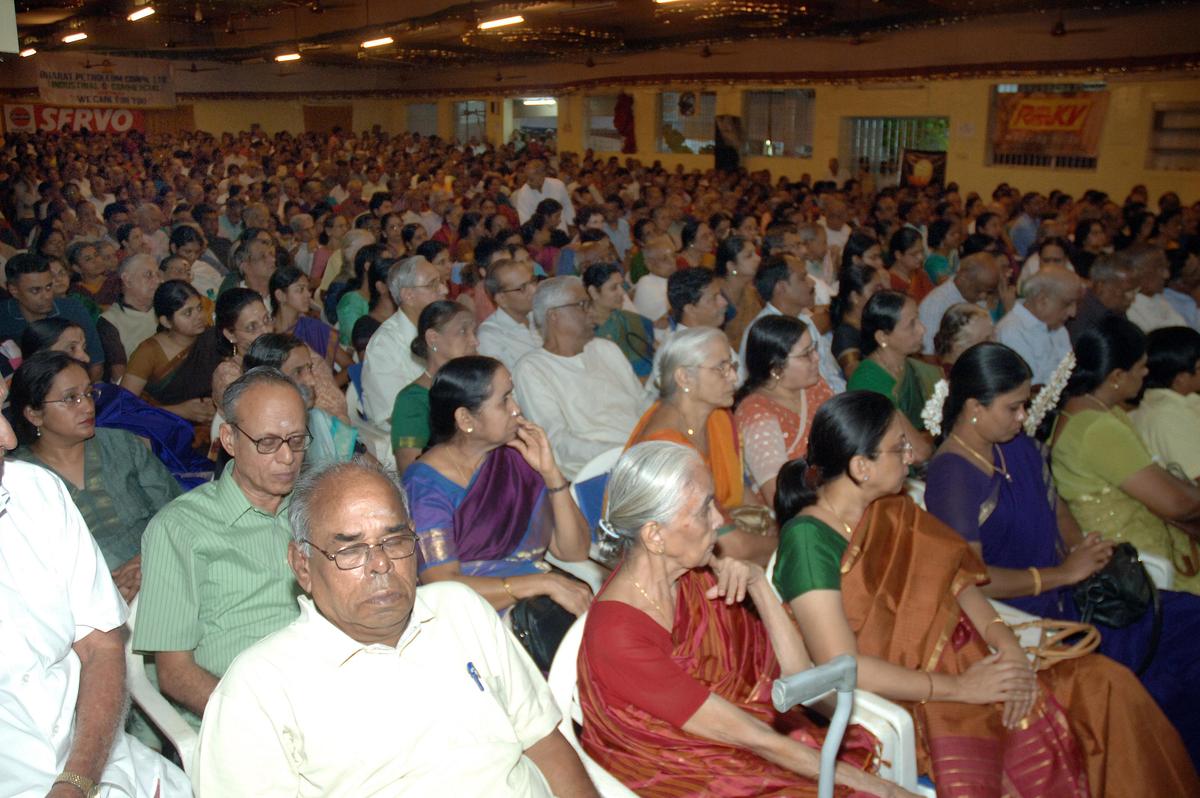
Rasikas enjoying a concert at Sri Parthasarathy Swami Sabha, in Chennai on December 17, 2008.
| Photo Credit:
K.V. SRINIVASAN
When that lease lapsed, the sabha was compelled to seek a new home again. A shift to Mylapore was not merely practical but also culturally resonant, as ‘Thiruvallikkeni’ (Triplicane) is referenced in Azhwars’ verses as part of the broader ‘Maadamaamayilai’ (Mylapore) region. After stopovers at the Mylapore Fine Arts Club and Narada Gana Sabha for a couple of seasons, SPSS found a lasting home at the Vidya Bharathi Kalyana Mandapam in 1997, where it remains a cornerstone of the annual Margazhi festival.
The character of the sabha has been shaped by resilience. The Second World War forced the suspension of most activities in 1939, though programmes continued on key festival days. Television’s arrival in 1975 caused a gradual erosion of its membership. Though this challenge was common to all sabhas, in SPSS’ case, the relocation from Triplicane intensified the strain. Yet, it emerged stronger in its present home — a tenure of 28 years and counting.
At the forefront through much of this modern chapter has been its secretary M. Krishnamurthy. He first joined as a volunteer in 1970, rose through the ranks to become secretary in 1988, and has held the post ever since. A recipient of numerous honours for arts promotion, he has worked alongside other office-bearers to guide the sabha to its present pre-eminent status.
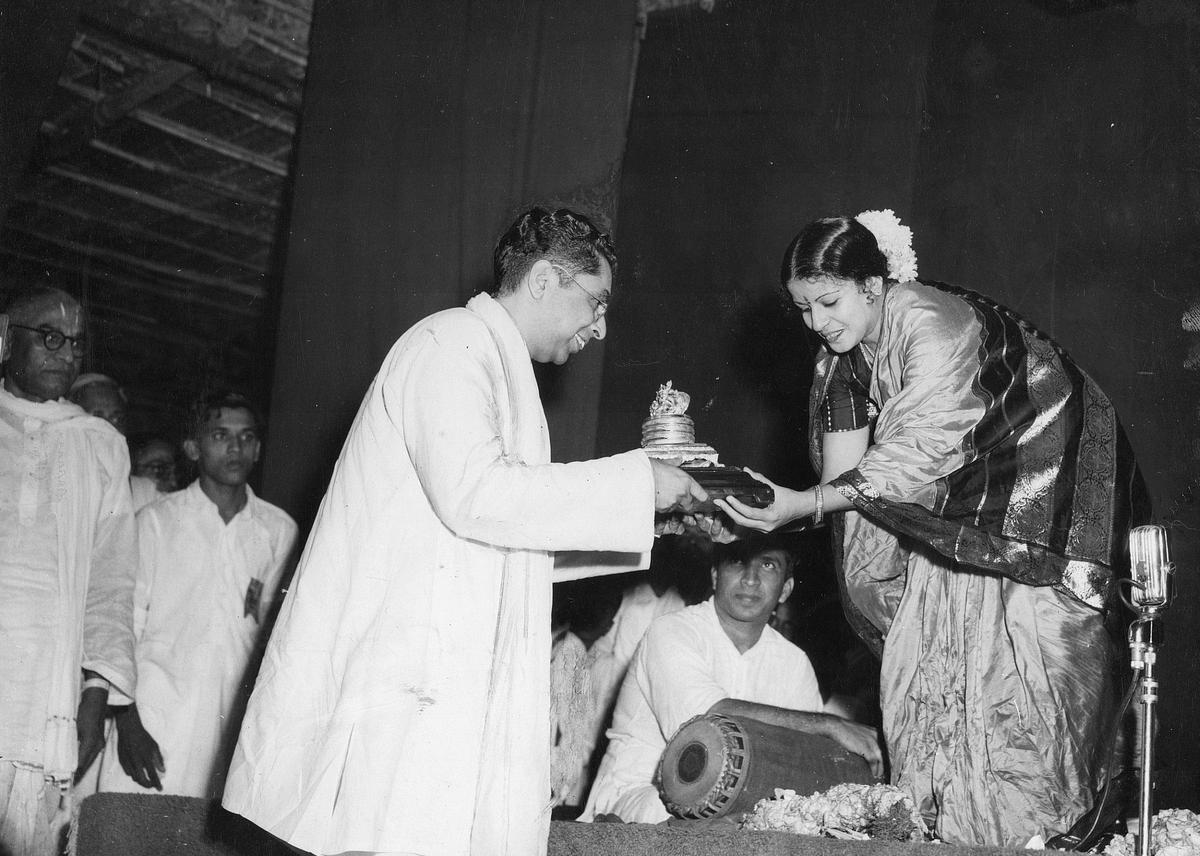
Mr. P.V. Rajamannar, Chief Justice, Madras presenting a silver casket to Srimathi M.S. Subbulakshmi who sang on the concluding day (16-04-1950) of the Golden Jubilee celebration of Sri Parthasarathi Swami Sabha, Triplicane.
| Photo Credit:
HINDU PHOTO ARCHIVES
The sabha is a living chronicle of Carnatic music itself. Its stage has been graced by titans such as Thirukodikaval Krishna Iyer, Poochi Srinivasa Iyengar, Konerirajapuram Vaidyanatha Ayyar, Bidaram Krishnappa, Saraba Sastrigal, Ariyakudi Ramanuja Iyengar, Maharajapuram Viswanatha Iyer and Tiger Varadachariar. It showcased the golden era through the voices of Musiri Subramania Iyer, Chembai Vaidyanatha Bhagavathar, G.N. Balasubramaniam, the Alathur Brothers, Semmangudi Srinivasa Iyer, Madurai Mani Iyer, Ramnad Krishnan, T. Brinda and T. Muktha. Then, the trailblazing trio of M.S. Subbulakshmi, D.K. Pattammal and M.L. Vasanthakumari held audiences spellbound, as did stalwarts such as K.V. Narayanaswamy, M.D. Ramanathan, S. Ramanathan, D.K. Jayaraman and M. Balamuralikrishna. This tradition was continued by stars such as T.N. Seshagopalan, T.V. Sankaranarayanan and K.J. Yesudas.

M. Balamuralikrishna’s concert at Sri Parthasarathy Swami Sabha in 2002.
| Photo Credit:
N. Balaji
On the instrumental front, the sabha featured pioneers such as Mysore T. Chowdiah, Veena Seshanna, Karaikudi Sambasiva Iyer, T.N. Rajarathinam Pillai, Parur Sundaram Iyer, his sons M.S. Anantharaman and M.S. Gopalakrishnan, T.N. Krishnan, Lalgudi G. Jayaraman, T.R. Mahalingam and N. Ramani. The sabha has also welcomed leading dancers, theatre artistes and Hindustani legends, including Pt Ravi Shankar and Ustad Bismillah Khan. That former Tamil Nadu Chief Ministers M.G. Ramachandran and J. Jayalalithaa were among its members underscores the sabha’s place at the intersection of art, culture and public life.
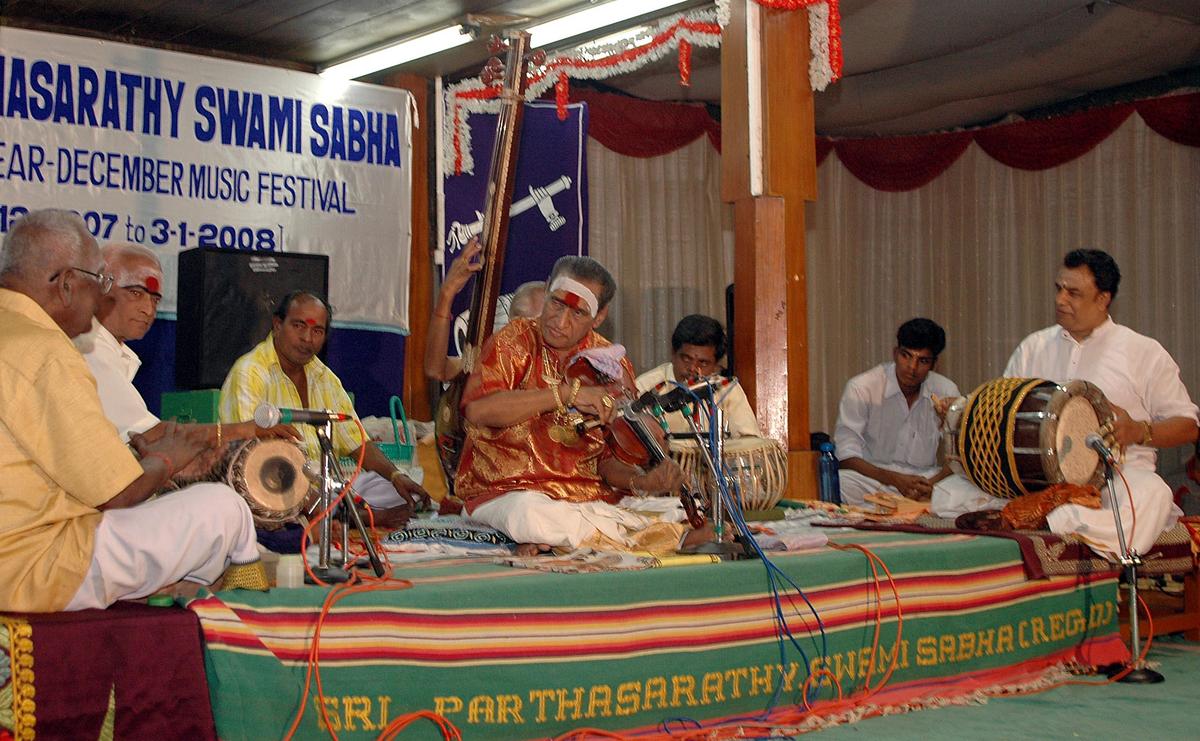
Violin concert by Kunnakudi Vaidyanathan at Sri Parthasarathy Swamy Sabha, Mylapore in Chennai on December 16, 2007.
| Photo Credit:
SRIDHARAN N
Today, SPSS fosters a vibrant artistic ecosystem. Its calendar extends far beyond the December season, featuring events such as the Pallavi Darbar, Bharat Sangeet Utsav, Yuva Sangeet Sammelan, Global Heritage Arts Fest and thematic vocal concerts. Its dance and theatre wings are also active with the Bharat Nritya Utsav and Historical Drama Festival. A special spiritual note is the Vidayatri festival held at the Sri Parthasarathy Swami Temple. Furthermore, the sabha pays annual homage to composer-saints, including Purandara Dasa and Annamacharya, and honours the Trinity, with the Sangeethanjali for Muthuswami Dikshitar being held in Ettayapuram, his final resting place.
SPSS’ educational mission nurtures the next generation through regular music classes and University of Madras-recognised diploma courses at its Triplicane base on Venkatarangam Pillai Street.
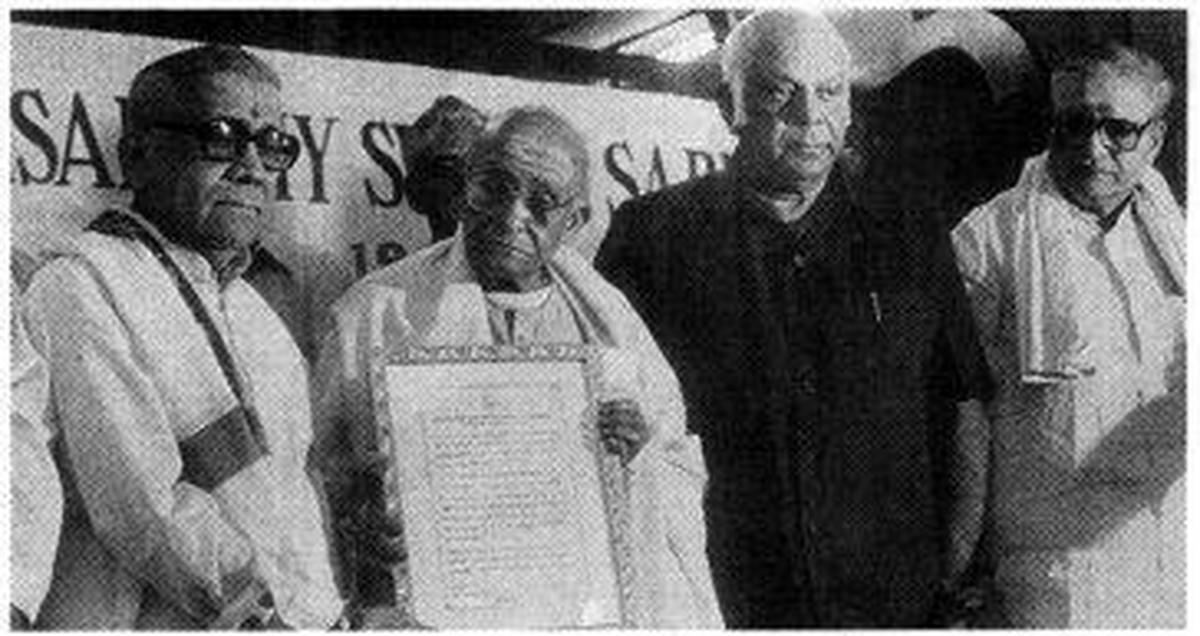
Sri Semmangudi R. Srinivasa Iyer presenting the title of’Sangeetha Kala Sarathy’ to Sri Madurai N. Krishnan (extreme left) at a (function organised by Sri Parthasarathi Swami Sabha) in 1998. M.A. M. Ramaswami, industrialist and Justice K. S. Bakthavatsalam look on.
| Photo Credit:
The Hindu Archives
The sabha’s commitment to excellence is reflected in its awards, which honour achievement across disciplines: the Sangeetha Kalasarathy, Natya Kalasarathy, Nataka Kalasarathy and the Acharya Sarathy (for lifetime contribution). It also nurtures emerging talent through awards instituted in the memory of past masters.
For its milestone year, SPSS has planned an expansive celebration — 300 concerts featuring over 1,000 musicians, across five venues.
For a sabha founded in the 19th century, Sri Parthasarathy Swami Sabha has stayed vital through the 20th and is still vibrantly relevant in the 21st.
Published – December 01, 2025 07:07 pm IST
www.thehindu.com (Article Sourced Website)
#Chennais #Sri #Parthasarathy #Swami #Sabha #marks #125yearmilestone