
The Regional Young Investigators’ Meeting (RYIM) Mumbai 2025 was held on 4 – 5 December 2025 at SVKM’s Mithibai College, Mumbai, in collaboration with the Gujarat Biotechnology University, and Kishinchand Chellaram College, HSNC University. The meeting brought together 112 participants, including young investigators, faculty, postdoctoral fellows, research scholars, clinicians, and industry professionals.
Anchored at a state-funded college and supported by partner institutions from western India, RYIM Mumbai brought together colleges and a university with a shared commitment towards building interdisciplinary research programmes. The meeting created a rare opportunity to seed connections, mentorship, and aspiration among early-career researchers and students who most need access to national research networks. RYIM Mumbai contributed to building pathways to interdisciplinary research in two more ways: seeding collaboration across institutional boundaries and equipping early-career researchers with career and funding awareness.
Hosting RYIM Mumbai at Mithibai College demonstrated the value of placing high-quality scientific dialogue directly within teaching-focused institutions. For many participants, particularly postgraduate students and early-career faculty, this was their first opportunity to interact closely with researchers from premier institutions such as TIFR, ACTREC, and those funded by ICMR and ICAR, as well as industry. This reflected a broader reality across many state-funded colleges in India, where strong teaching ecosystems exist alongside limited access to national research networks. The meeting helped them receive mentorship on research funding in India from scientists whose research is supported by multiple central science agencies, thus giving them a sense of how to navigate funding in India.
Interactions with UG and PG students and faculty from Mithibai and other colleges were very fruitful, and the ‘Ask Us Anything’ session was amazing — a cherry on the top”.
– Tejal Gajaria, Navrachana University, Gujarat, an young investigator who participated in RYIM Mumbai.
Panels and workshops focused on collaboration, careers, and leadership complemented and deepened the conversations. Replicating this format could be impactful in bridging the critical gap between research-intensive institutions and colleges that are building research cultures.
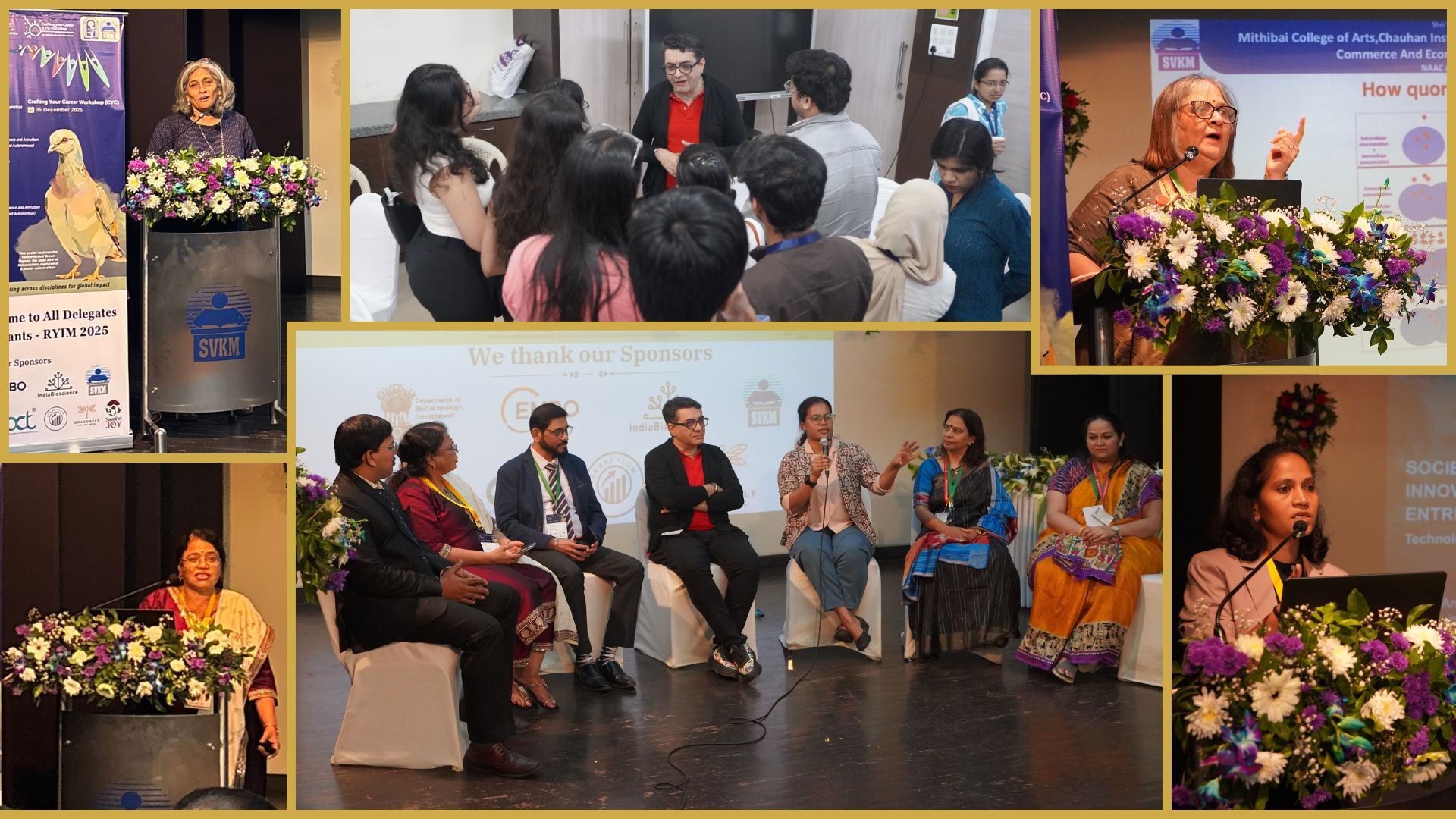
The Mumbai meeting aligns strongly with IndiaBioscience’s broader mission to expand the reach of networking platforms such as YIMs and RYIMs, and it provided a way to do so through such engagements with state-funded academic institutions. Crucially, it reinforces a longer-term approach of building sustained engagement through repeated regional meetings and follow-up activities, bringing diverse perspectives on funding, mentorship, and career development into India’s growing scientific network.
“Science beyond borders” — Building collaboration across disciplines and institutions
In line with the central theme, the panel discussion on ‘Collaboration as the catalyst for scientific progress’ highlighted the need to move from isolated research efforts to shared ecosystems accelerated through pooled resources, interdisciplinary thinking, and external networks. Panellists urged young researchers to approach collaboration as a cultural shift, not just a funding requirement. They further highlighted the role of such regional meetings in creating low-barrier entry points to collaborative research projects and leveraging national funding schemes that support high-risk, high-impact, early-stage ideas. This underscored that interdisciplinary research readiness is as much cultural as it is infrastructural.
Mentorship from India’s research ecosystem
Across two days, participants engaged with mentors from premier research institutions, hospitals, funding-linked research centres, and industry incubators. Talks and interactions covered choosing meaningful, locally relevant research questions; translating fundamental research into applied impact; responsible publishing and research visibility; and the growing role of AI, bioinformatics, and data-driven science. These sessions helped demystify research careers and made senior scientists more accessible and relatable, particularly to participants from teaching-focused colleges.
Day 2 concluded with IndiaBioscience’s Crafting Your Career (CYC) workshop, which focused on mapping skills, interests, and values; exploring diverse career pathways in science (academia, industry, entrepreneurship, communication); and building transferable skills such as networking, communication, and professionalism. The workshop used interactive exercises and peer discussions, enabling participants to actively reflect on their career trajectories rather than passively receiving information.
Exposure to mentors across funding agencies also helped participants visualise research careers as navigable, not opaque.
Seeding long-term partnerships and looking ahead
For IndiaBioscience, RYIM Mumbai reaffirmed the importance of meeting communities where they are and being partners in their capacity-building missions by helping them build connections, improve visibility, and sustain engagement with the wider scientific network in India.
Beyond the formal programme, RYIM Mumbai enabled direct institutional conversations with the college leadership on capacity-building workshops for young investigators and postgraduate and UG students.
These conversations indicate that RYIMs can serve as entry points into longer-term institutional engagement rather than standalone events.
As IndiaBioscience looks to extend RYIMs to more cities and institutions, the Mumbai meeting offered important lessons on the value of engaging state-funded colleges, particularly in democratising access to mentorship and networks, fostering collaboration across institutional boundaries, and supporting early-career researchers in settings where such support can be transformative.
Watch the complete event here and here.
Read the RYIM Mumbai 2025 abstract book here.
indiabioscience.org (Article Sourced Website)
#Building #pathways #interdisciplinary #research #statefunded #institutions #Insights #RYIM