
Like his two immediate former India captains, Shreyas Iyer too plays only one format internationally. But unlike Rohit Sharma and Virat Kohli, retired from T20Is (most voluntarily) and from Tests (potentially nudged), Shreyas isn’t a one-format player by choice. Persistent back issues have compelled him to take a break from the red-ball version while the embarrassment of riches at their disposal have driven the selectors to look beyond the 31-year-old with it comes to 20-over play despite his increasingly impressive returns in the IPL.
It’s in the 50-over game that Shreyas’ current calling lies. He has the numbers – average 47.81, strike-rate 99.01 in 67 innings – to back his standing as one of India’s top ODI batters; the impressive numbers don’t lie in this instance, like they can sometimes do. Shreyas is every bit as effective as the statistics suggest, his value never more apparent than at the Champions Trophy in the UAE last February-March.
ODI batting has evolved exponentially in the last several years, taking a cue from the innovative chaos that has come to characterise its 20-over sibling. Tall scores no longer raise eyebrows, and batting milestones aren’t as dramatically welcomed as in the past. Shreyas’ batting too has evolved, as it must for anyone to remain relevant in the current era, but it has evolved on his own terms, with faith and focus on the basics and the conventional rather than the cute and the cheeky.
Much of Shreyas’ ODI career has been from the No. 4 position which, to many, is perhaps the least glamorous and most demanding of all. In Tests, the best batter in the side usually occupies that slot. India had Sachin Tendulkar at No. 4 for almost all of his career, and after the little big man eventually called time on his Test exploits in November 2013, Kohli slipped seamlessly into that role until his retirement last May. Now, Shubman Gill, the Test and ODI skipper, bats at No. 4, an indication that he is regarded as the most important and influential cog in the batting wheel.
The No. 4 conundrum
In ODIs, however, No. 4 is a little bit neither here nor there, if you know what we mean. Because of how the format has progressed, the clamour is for the top three slots. Flat pitches, shorter boundaries, excellent bats with extended but unobtrusive sweet spots and a slew of restrictions that give the bowlers no joy has taken a lot of the challenge of batting against the new ball out of the equation. Stronger, more powerful and definitely more versatile, batters are today emboldened to hit through the line, to take chances they wouldn’t have dreamt of even a decade back, even when the ball is at its newest and the bowlers at their freshest. Hence the concerted push to fit into one of their first three positions.
The top three set the tone, which means the play has already been made when the No. 4 walks into bat. That could be as early as in the first over in one of those rare instances of two wickets going down in a jiffy, or somewhere in the middle stages of an innings – the more likely scenario. If he walks into a mini-crisis, the two-drop batter is expected to steady the ship without losing sight of the score board. In the latter situation, his brief is to take a little, but only a little, time to get his eye in and then either sustain the scoring rate or improve upon it if the platform is both bountiful and fast-paced.
Shreyas has shown himself to be equally adept at both roles; the biggest consistent challenge of his still developing ODI career came at the Champions Trophy, on tricky pitches that are such a rarity these days in the 50-over version. Tacky and therefore shackling uninhibited ball-bashing, they called for smarts and craft, not just brutal ball-striking. India were forced to chase in four of their five matches – a couple of them straightforward, the two in the semifinals and the final against Australia and New Zealand respectively more demanding – and Shreyas delivered in all except the first of those chases, in the opener against Bangladesh when a fluent Gill century was the highlight of a modest quest.
Without attracting the same encomiums that Rohit did for teeing off in the PowerPlay so that the task of the batters to follow once the ball got softer would get easier, or the inevitable praise that came Kohli’s way for masterminding crucial replies against Pakistan and in the semis against Australia, Shreyas did all that was asked of him. After his 17-ball 15 against Bangladesh, he had a sequence of 56 (67 balls), 79 (98b), 45 (62b) and 48 (62b) in India’s next four matches. His highest came in the only outing in which India batted first, in their final league engagement against the Kiwis after they had already secured their place in the last four. The rest of the efforts, all under pressure of some kind or the other, were compiled with clinical precision, with little risk, as he took his time early on and then opened out without completely taking the bowling apart – the conditions didn’t permit that – to ensure that India never had mounting run-rate issues to contend with.
Such was his commanding if uncelebrated presence in the middle-order that, after masterminding the four-wicket victory over New Zealand in the final with a bruising 76, Rohit called Shreyas the ‘unsung hero’ of India’s glorious campaign. It was just the shot in the arm Shreyas received after having been in the crosshairs previously, not least because his assertion that the niggling back problem didn’t allow him to bat long periods in first-class cricket was met with scepticism, if not disbelief.
Once India’s selectors decided to move on from the Rohit captaincy era in October last year, it was organic that Gill would be catapulted into the hot seat because he had been the Mumbaikar’s deputy at the Champions Trophy. The search for a new vice-captain ended with Shreyas. After all, he boasted impressive captaincy credentials, especially in the IPL where he took Kolkata Knight Riders to their third title in 2024 and Punjab Kings to a rare appearance in the final 12 months later.
The three-match series in Australia in mid-October was to be Shreyas’ first outing in his new avatar as vice-captain. After a tepid start in the seven-wicket loss in a rain-ruined opener in Perth when he only made 11, Shreyas’ 61 was instrumental, alongside Rohit’s 73, in hauling the visitors to 264 for nine in Adelaide. Australia huffed and puffed to a two-wicket win to take an unbeatable 2-0 advantage as the teams headed to Sydney for the final act.
Australia were making the most of choosing to bat, having rattled to 183 for three midway through the 34th over, when a slice of Shreyas brilliance turned the match on its head. Alex Carey, the left-handed wicketkeeper-batter, tried to hammer Harshit Rana down the ground but only managed a top edge that steepled towards the untenanted outfield square on the off-side. From point, Shreyas whirled around and sprinted as if his life depended on catching the ball. Making exceptional ground, he clung on to the little white orb despite it bobbling in his hands, a game-changing moment with the last seven wickets tumbling for 53 runs.
As his teammates converged on him to celebrate a truly sensational grab, Shreyas writhed in pain and agony. The initial thought was that he had hurt his rib when he slammed the ground, but scans later revealed that the injury was a lot more serious – spleen laceration with internal bleeding. After a week in a Sydney hospital under expert supervision, he was discharged but it was obvious that he would miss cricket for at least a couple of months.
India had only one ODI series in that period, at home against South Africa. With Gill (neck) injured, Shreyas would have realised his dream of leading the country had it not been for his terrible mishap in Australia, but that wouldn’t have been foremost in his mind as he embarked on a long journey of recovery and rehabilitation – a journey that he is no stranger to.
Now back in the mix, Shreyas has been named in the squad to play New Zealand in three ODIs, the first of them in Vadodara next Sunday. He hasn’t played a competitive game since October 25, when he sustained the SCG injury, but is expected to line up for Mumbai against Himachal Pradesh in their Vijay Hazare Trophy match in Jaipur on Tuesday to emphatically put to bed any concerns surrounding his fitness. Shreyas has been named Gill’s deputy, which must be seen as confirmation enough that the selectors are reasonably confident that he will come out of the HP game unscathed even though his selection has been greeted with a ‘subject to fitness clearance’ caveat.
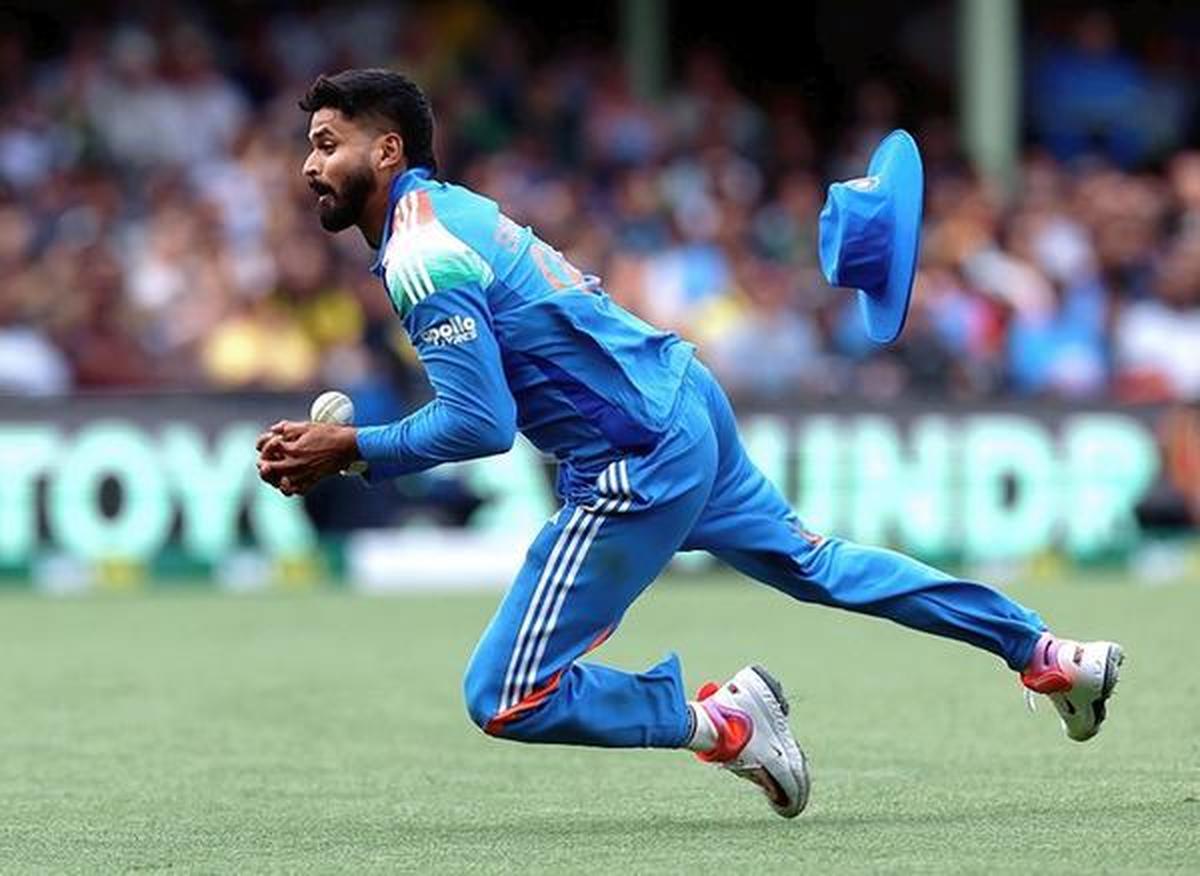
India’s Shreyas Iyer takes a catch to dismiss Australia’s Alex Carey.
| Photo Credit:
AFP
The New Zealand series will be the last of the ‘semi-contextual’ bilateral showdowns ahead of the T20 World Cup beginning in a month’s time. Once the World Cup, and then the IPL, are over and done with, the attention will shift to preparations for the 50-over World Cup, in southern Africa next November. Shreyas should be the fulcrum of that campaign alongside Gill and K.L. Rahul (who led India to victory last month against South Africa in Gill and Shreyas’ absence); after all, at this stage, no one is 100% sure that Rohit and/or Kohli will still be active, and successfully active at that. It is imperative therefore, before he goes briefly into 50-over hibernation, that he gets a feel of the one-day game more than amassing a mountain of runs because he has little to prove to anyone as far as 50-over batsmanship is concerned.
At 31, Shreyas is at the peak of his prowess, with so much to offer tactically and strategy-wise too to his young captain. His own leadership credentials are without question and if that door opens up for some reason or the other at the international stage, Shreyas will acquit himself with credit. Tentative steps in Vadodara then, gradually snowballing into a potential shot at the most prestigious white-ball silverware.
www.thehindu.com (Article Sourced Website)
#Blessed #smarts #skill #Shreyas #peak #prowess