
Since the end of World War II, the US has established a global military network consisting of around 750 bases in roughly 80 countries. While the US government has characterised this presence as a stabilising force, the local populations have often paid for the military’s presence with displacement and long-term exposure to hazardous industrial waste.
Perhaps the most extreme form of this cost is the forced removal of indigenous populations to clear land for military infrastructure. Between 1968 and 1973, for instance, the US and the UK governments forcibly expelled the entire Chagossian population, of 2,000 people, to secure the island of Diego Garcia in the Chagos Archipelago in the Indian Ocean. To pressure the residents to leave, authorities restricted food imports and eventually gassed the islanders’ pet dogs. The population was loaded on cargo ships and deposited in Mauritius and Seychelles, where many faced poverty, while the island became a sterile and restricted military zone.

SOFA, so bad
In locations where the local population has stayed back, they have suffered significant environmental damage. Military bases are essentially industrial bases operating with little oversight. When the US military withdrew from the Clark Air Base and Subic Bay in the Philippines in 1992, it left behind significant quantities of uncontained hazardous waste, including asbestos in deteriorating barracks and polychlorinated biphenyls (PCBs), a known carcinogen, in electrical transformers.
When scientists analysed the soil samples, they found high concentrations of lead and mercury and that solvents used to degrease aircraft engines had leached into the groundwater. Healthcare workers reported elevated rates of leukaemia and kidney disorders in the surrounding areas, including Angeles City, later linked to the ingestion of these heavy metals and hydrocarbons.
Active installations also use aqueous film-forming foam, a specialised fire suppressant used in training drills. The foam contains per- and polyfluoroalkyl substances, a.k.a. PFAS, a.k.a. “forever chemicals” — a name they’ve earned because they don’t break down in ecologically relevant timeframes. Instead, they seep through the local environment and accumulate. At the Kadena Air Base in Okinawa in Japan and the Spangdahlem Air Base in Germany, government officials have documented PFAS in local water bodies for instance. Two specific compounds, PFOS and PFOA, also bioaccumulate in the human body and may be linked to higher risk of testicular and kidney cancers and thyroid disease.
On the flip side, these environmental liabilities are often protected by bilateral treaties between the US and the host countries, called Status of Forces Agreements (SOFAs). Each SOFA determines the legal status of US personnel and property abroad; the one with Japan in particular has been criticised for exempting the US military from complying with the country’s environmental laws. In fact the agreements often contain clauses that absolve the US of the financial obligation to return land to its original condition or pay to remediate pollution, leaving host governments and eventually the local communities to manage the resulting public health crises and to fund the cleanup of toxic sites.
Daily life near these installations also means living with noise pollution from jet aircraft and the physical risk imposed by training accidents. As a result, a US military base operating under a typically lenient SOFA progressively erodes the local community’s ability to control its own environment and safety.
Nuclear waste
In 2019, when US President Donald Trump first floated the idea of purchasing Greenland, experts and scholars worldwide as well as communities in Denmark, Greenland, and across Europe critiqued the proposition on diplomatic and postcolonial grounds. The proposal included a critical material reality and thus merits scientific pushback as well: that the US already holds a significant negative-equity position in Greenland.
Specifically, deep within the island’s ice sheet, the US maintains a shadow inventory of Cold War infrastructure that also poses significant environmental hazards. If the US were to acquire the territory, it wouldn’t just gain mineral rights, it would also formally inherit a large and scientifically complex clean-up exercise that climate change is about to make due. Perhaps the most acute liability is Camp Century, buried around 240 km inland from the coast. In 1959, the US Army Corps of Engineers used large rotary milling machines made by Switzerland to cut out a system of trenches in the ice; the central trench, colloquially called Main Street, was 1,100 feet long, 26 feet wide, and 28 feet high.

Camp Century was a pilot for Project Iceworm, a classified plan for the US to bore 4,000 km of tunnels to house 600 Iceman nuclear missiles. The military expected to be able to use the opaque ice sheet to hide the launchers from Soviet reconnaissance.
The project ultimately flopped because the engineers had misunderstood the material properties of the ice. They treated it as a stationary solid whereas in reality, under the immense pressure of its own mass, glacial ice behaves like a visco-elastic fluid. In other words, the trench walls flowed slowly rather than standing still, eventually twisting out of shape and becoming much narrower, threatening to crush the launchers. The changes were so severe that the US military evacuated the base in 1966 and abandoned it in 1967.
But before it scooted, the US Army had installed a portable pressurised light-water nuclear reactor called Alco PM-2A, which used highly enriched uranium-235 as fuel. When Camp Century was decommissioned, the Army removed the reactor but not the associated nuclear waste. One 2016 study led by glaciologist William Colgan catalogued the inventory left behind, assuming the snow would entomb it forever: there were 2 lakh litres of diesel, 2.4 lakh litres of wastewater and sewage, and large quantities of PCBs and radioactive coolant.
An ancient thermometer
Climate models have indicated that by the end of the century, this area of the Greenland ice sheet could shift from being a zone of net accumulation, i.e. a place where snowing adds mass, to a zone of net ablation, where melting subtracts mass. Whenever this area crosses this threshold, the toxic slurry will start to move and leach into the subglacial aquifers, and eventually flow towards the ocean.
There is a bitter irony in the Camp Century failure: the military project that ignored the dynamics of the ice also inadvertently funded the discovery of climate dynamics. Specifically, while the US Army focused on the deforming tunnels, the Danish palaeoclimatologist Willi Dansgaard was able to secure access to the ice cores that researchers had drilled at the site. In fact the Camp Century core was able to reach the bedrock and extract a cylinder of ice 1.4 km long.
An ice core is a cylinder of ice drilled vertically from a glacier or ice sheet, and which contains physical imprints of the earth’s past climate. The longer the core, the older the imprints it carries. For instance the Camp Century ice core recorded more than a lakh years of climate changes.
Dansgaard analysed the ratio of the quantities of the oxygen-18 to oxygen-16 isotopes in the ice layers. He found that the heavier isotope, O-18, was more prevalent in snow and rain formed in warmer conditions. He also mapped these ratios against depth and thus reconstructed a 100,000-year thermometer.
The data revealed the existence of Dansgaard-Oeschger events — rapid and violent fluctuations in the climate during the last glacial period when the region’s temperature jumped by 8-10º C in just a few decades. The discovery was one of the earliest pieces of hard evidence that the world’s climate is susceptible to drastic tipping points rather than evolving strictly based on how much carbon is pumped into the air.

Cooling a radar
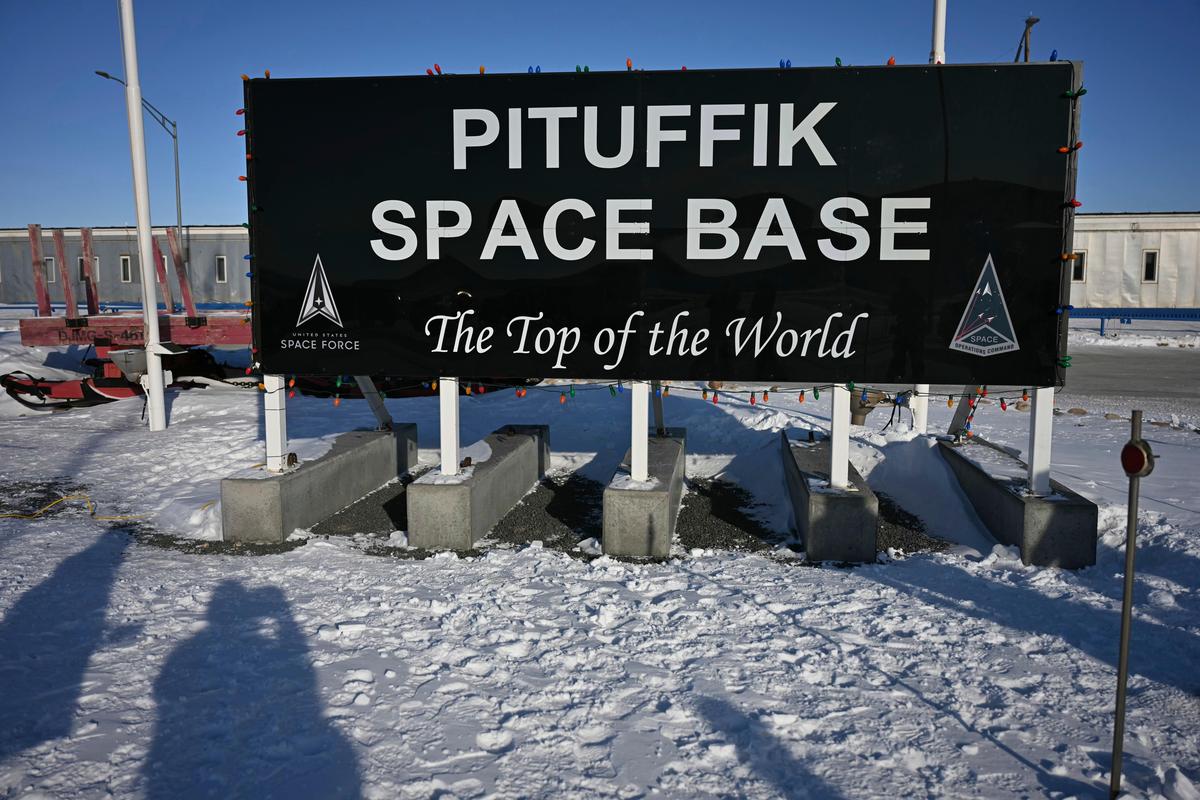
Pituffik Space Base is pictured as US vice-president JD Vance visits, March 28, 2025, in Greenland.
| Photo Credit:
AP
If Camp Century is a ghost today, the US faces an active engineering challenge at the Pituffik Space Base, formerly Thule Air Base — a site that hosts the AN/FPS-132 early warning radar, a critical node in the US Missile Defence network.
The AN/FPS-132 is a solid-state phased-array radar with no moving mechanical parts. Each of its two faces radiates 870 kW of power, an energy output that includes a large quantity of heat that in turn poses a structural threat. The radar sits on permafrost. If the heat from the electronics thaws the ground beneath it, the foundation will settle and throw the radar out of alignment and blind its sensors.
The US Army is aware of this and has installed thermosyphons in the ice. Thermosyphons are passive heat exchange tubes that use a working fluid, usually carbon dioxide or ammonia, to draw from the ground and radiate it into the Arctic air, counteracting the heat from the radar.
The thermosyphons don’t have motors or pumps and depend entirely on the temperature difference between the ground and the air, which means they become less effective as the air warms. Research has already shown that Arctic winters are becoming warmer and shorter, which implies a not too distant point in the future where the ground will start to accumulate heat.
Engineering reviews have also noted a phenomenon called cold-topping. In extremely cold conditions, the gas inside the thermosyphon condenses efficiently. But as the average temperature rises, the internal pressure of the system could change in a way that leads to non-condensable gases accumulating at the top of the radiator, effectively blocking heat transfer.
While the radar is the priority, the airfield is also at risk. One US Army Corps of Engineers study in 2013 found that the permafrost under the runway was thawing despite efforts to mitigate that. In response the Corps attempted to paint the runway white to reflect sunlight and cool the ground but that then reduced the friction for landing aircraft and increased the maintenance cost. A 2023 report from the US Department of Defence to the US Congress thus classified the airfield pavements at Pituffik as being at “moderate to considerable risk” of failure.
Working on thin ice
The sensitivity regarding US operations here is heightened by Project Crested Ice. In 1968, a B-52 bomber carrying four hydrogen bombs crashed onto the sea ice near the base. The conventional explosives in the weapons detonated and dispersed plutonium, uranium, and americium across the ice. The clean-up, which was the project and which included removing large quantities of contaminated snow to a site in South Carolina in the US, was a joint US-Denmark effort that also created a political dispute.

The operation was led by the US Air Force, specifically the Strategic Air Command, and the Danish Atomic Energy Commission. The US provided the heavy equipment, the aircraft, and of course the ultimate disposal site. But while the US military directed the project, it couldn’t land heavy machinery at the site because it cracked the ice. As a result more than 60% of those who performed the dangerous manual labour were Danish and Greenlandic civilians.
The issue? The US Air Force monitored its own personnel for radiation exposure while the civilians received less protective gear and weren’t subject to the same long-term health monitoring. As a result, in the decades following the clean-up, many of the civilian workers developed cancers and other illnesses they attributed to radiation exposure.
While the U.S. compensated the Danish government in the 1990s, which then distributed payments to workers, the US has generally maintained that the radiation levels were too low to cause illness, a stance that continues to cause diplomatic friction.
For decades, the US treated Greenland as a disposable utility; now, rather than remediate the hazardous waste at Camp Century or address the instability at Pituffik, the US is demanding title to the very land it poisoned. From Greenland’s and Denmark’s points of view, this is as much a question of sovereignty now as of dignity: the US has proven itself a reckless tenant that trashed the property, and now it threatens to bankrupt the landlord and seize the deed.
www.thehindu.com (Article Sourced Website)
#Trump #floats #buying #Greenland #Arctic #island #holds #toxic #waste