
How a feisty Irish woman born in India launched the career of the biggest pop band in history and started a club that is still going 60 years on.
Mona (Mo) Best was the mother of one of the original Beatles, Pete Best. Best was the original drummer in the band who would go down in popular music history as being the unluckiest man in the business. Having signed a recording deal with the Beatles, only to be sacked and replaced by Richard Starkey (Ringo Starr).
Alice Mona Best was born in 1924 to Irish parents in Delhi, British India. She was the youngest of four children of Thomas and Mary Shaw. Her father was a major serving with the 11th Bengal Lancers.

Alice Mona Best.
Pete was born, Randolph Peter Scanland, 17 years later, a result of a marriage to a marine engineer, Donald Peter Scanland, who was killed on active service during the Second World War. Mona had joined the Red Cross, and it was whilst serving in Bombay that she met a British Army PT officer, Johnny Best, whom she later married, in 1944, at St Thomas’s Cathedral, in Bombay. A son, Rory, followed in 1945. The family, including Pete, after the end of the war in Europe in 1945, boarded the last troopship, Georgic, bound for England, arriving on Christmas Eve at Johnny Best’s hometown of Liverpool.
Post-war Liverpool was a city in turmoil and deprived, very different from colonial India, where Mona would have enjoyed a life of privilege and relative pleasure. Fortunately, Johnny Best was well-connected; coming from a well-respected Liverpool family with strong sporting links, but life was still looking a good deal gloomier.
The Bests moved into the family home in Ellerslie with Johnny’s sister Edna, but Mona soon realized that the house, though spacious, was not big enough to contain two strong-willed women, so they chose to leave and move to a small flat above a public house in central Liverpool. They then moved into a house in the leafy suburbs around Knotty Ash. Mona also persuaded her parents to leave India and join them in Liverpool.
A horse. A house. My kingdom for a house.
In 1954, Mona, who had always wanted a bigger house, did something incredibly risky. Having viewed a 15-bedroomed Victorian house in Haymans Green, an affluent Liverpool suburb, she decided to pawn all of her jewelry and put all of the money on a horse.
The encouragingly titled “Never Say Die” was a rank outsider ridden by the then-unknown jockey Lester Piggott. The horse romped in at the Epsom Derby at 33-1, and a jubilant Mona took possession of the rambling Victorian mansion at 8 Haymans Green.
Rock in the Casbah
In 1959, rock n’ roll was in its infancy, and Liverpool, with its port location and strong maritime connections, was already fermenting its own distinctive sound, channelling the many musical genres, especially American jazz, blues, and folk, into something uniquely Liverpudlian: Merseybeat.
Mona, tuning in to the local zeitgeist and prevailing cultural explosion, decided that she would avail of the house’s huge, cavernous cellar area and open up her own coffee/music bar, charging half a crown membership. Coffee bars serving espresso and cappuccino were fast becoming the “in places” to listen to recorded and live music, initially proliferating around London’s Soho, then home to a significant Italian population.
On Aug 29, 1959, the Casbah coffee club opened its doors to 300 paying members who squeezed into the dark, dinghy, windowless, low-ceilinged coal-cellar and witnessed history; The first incarnation of the Beatles, The Quarrymen, consisting of John Lennon, Paul McCartney, George Harrison, and Ken Brown. Significantly, they played without a drummer.
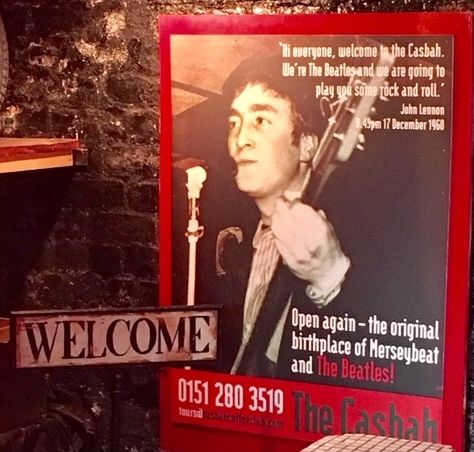
Poster advertising the Casbah coffee club.
John, Paul, and George would become part of the very fabric of the Casbah, playing 37 times as the resident band and even in a more literal sense, by actually helping to decorate the ceilings with distinctive colors and designs, which can still be seen today.
Don’t send the Beatles
In 1960, the band, including Stuart Sutcliffe, headed off to play in Hamburg. Hamburg was undoubtedly a baptism of fire for the Beatles. Without their stints in the clubs in the sleazy, European sex capital, where they laboriously honed their craft, playing their amphetamine-fuelled rock ‘n roll for hours on end there would probably have been no Fab Four.
Pete Best, already acting, with Mona, as a de facto manager, had joined the group as the drummer, which would prove to be a vital ingredient, as the message had come through loud and clear from Germany that they didn’t want the Beatles without a drummer.
Following their grueling Hamburg apprenticeship, the Beatles would return to Liverpool and, with the help of a phone call from Mona to the manager of the Cavern Club, would play their first gig there as the Beatles.
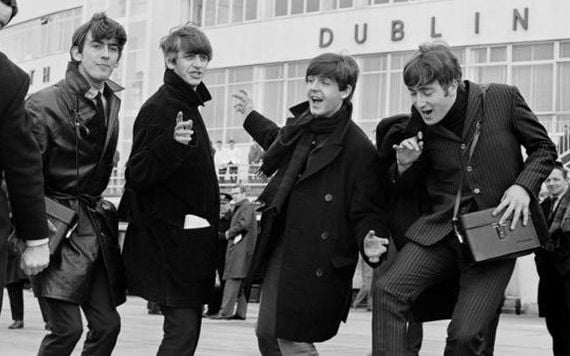
The Beatles, photographed at Dublin airport.
Brian Epstein would get his first taste of the band at a lunchtime concert on Nov 9, 1961, and would comment:
“I was immediately struck by their music, their beat, and their sense of humor on stage—and, even afterward, when I met them, I was struck again by their personal charm. And it was there that, really, it all started.”
On Aug 22, 1962, The Beatles would again play the Cavern Club, and, again, thanks to Mona, for the first time, the gig was televised, but this time without Pete Best
A week earlier, Pete had been unceremoniously sacked by Epstein with the agreement of all the members. This was not a popular decision amongst the fans and shouts of “Best forever. Ringo never” could be heard. George even received a black eye after being head-butted by a disgruntled fan. Lennon harshly maintained that Pete was an awful drummer, a claim contested by some of his musical peers, who argue that Best added an essential ingredient to the Merseybeat sound.
Some fans suggest that Pete posed a threat to Lennon’s fragile ego because he was very good-looking and too popular with some fans. Pete, who was perhaps less outgoing than the other band members, may just have had the wrong personality for the band, which Epstein was molding into something more marketable, harnessing their cheeky, irreverent, knockabout Scouse humor.
Mona died in 1988, but her legacy is still going strong; her three sons, Pete, Rory, and Roag, are all active in running the Casbah as a tourist attraction, and Pete, on occasion, takes to the stage.
Roag, the son of Neil Aspinall, former Beatles road Manager and Apple executive, is also the proprietor of the Magical Beatles Museum, in Matthew St, Liverpool, which features over 400 Beatles items creatively spread over three floors.
“The Casbah was where it all started,” as Sir Paul McCartney put it.
* Originally published in 2019, updated in January 2026.
This article was submitted to the IrishCentral contributors network by a member of the global Irish community. To become an IrishCentral contributor click here.
www.irishcentral.com (Article Sourced Website)
#Irish #Mammy #luck #Irish #Beatles