
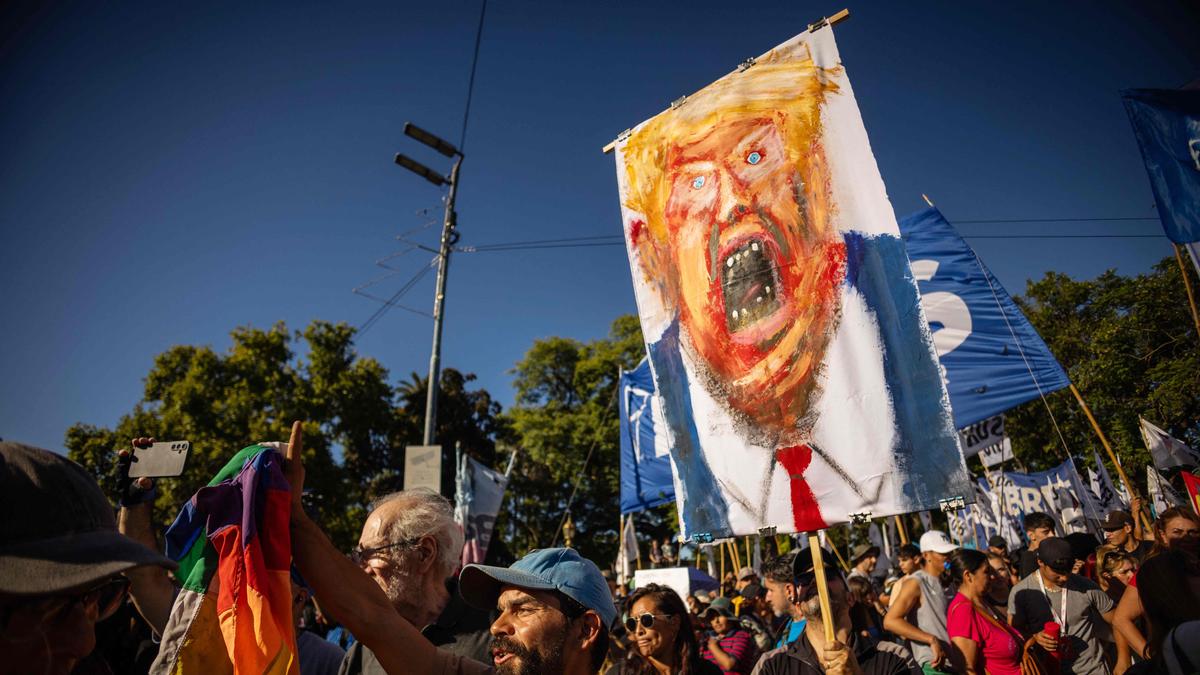
“The U.S. endeavouring to ‘run’ Venezuela is also unlawful, as it amounts to undue interference in Venezuela’s internal affairs”
| Photo Credit: AFP
The attack by the United States on Venezuela and the capture of the Venezuelan President, Nicolás Maduro, is yet another gigantic affront to international law, notwithstanding the authoritarian practices of the Maduro administration. This adventure comes on the heels of a series of illegal American strikes in the last few months on alleged Venezuelan drug boats in the Caribbean Sea.
The subject of the use of force
It is axiomatic that Article 2(4) of the United Nations Charter proscribes the use of force in international relations. The UN Charter, as Oona A. Hathaway and Scott J. Shapiro argue, outlawed war and fundamentally reshaped international law, making war an illegitimate instrument for settling disputes. Article 2(4) permits only two narrow exceptions: force may be used in self-defence or with the authorisation of the UN Security Council. None is present in the extant case.
Editorial | Tragedy and farce: On the U.S. and Venezuela
Legal scholar Nico Krisch has argued that the prohibition on the use of force is the most constraining aspect of international law. Hegemonic states such as the U.S. have consistently sought to overcome this constraint by adopting innovative solutions, including the broadening of the concept of self-defence. Arguably, self-defence is not limited to repelling an ongoing armed attack but also encompasses pre-emptive and anticipatory self-defence to combat cross-border terrorism. Moreover, the use of force has also been invoked to justify humanitarian interventions such as the North Atlantic Treaty Organization bombing of Yugoslavia in 1999.
In the Venezuelan case, the U.S. appears to have surpassed even these contested categories and identified new grounds for the use of force. Senior U.S. officials are on record as stating that this cross-border operation was done as part of a law enforcement measure, bringing accused criminals such as Mr. Maduro and his wife to face trial in the U.S. Other reasons offered are that the President was waging a ceaseless campaign of violence and subversion against the U.S. and posed a threat to the entire region. However, none of these reasons, even if true, passes muster to legally justify the U.S. using force against a sovereign state. The talk of this operation resurrecting the antiquated Monroe Doctrine of American foreign policy is not just an affront to the sovereignty of the countries of the Western Hemisphere but also a pie in the face of the anti-imperial struggles of the Third World people.
Leaders and immunity
The other legal issue this case has thrown up is the treatment of President Maduro. As the International Court of Justice held in the Arrest Warrant Case (Democratic Republic of the Congo vs Belgium), heads of state enjoy inviolability and immunity ratione personae (personal immunity) from the criminal jurisdiction of a foreign court. Accordingly, the U.S. courts lack jurisdiction to try President Maduro for the alleged criminal activities. The argument that Mr. Maduro is not the legitimate President of Venezuela because he came to office through rigged elections in 2024, or that the U.S. does not recognise Mr. Maduro as a legitimate President, cuts no ice under international law. Irrespective of how someone came to office, under international law, what matters is the test of effective control. The Maduro administration exercised effective control over Venezuelan territory. Thus, President Maduro, as the head, is entitled to personal immunity and inviolability under international law.
Holding otherwise would give states a licence to stop recognising regimes or heads of state they do not consider lawful, using their subjective criteria, thereby denying them immunity, which would wreak havoc in the international legal system. Moreover, forcibly taking the custody of a foreigner, let alone a head of state, on foreign land without that state’s consent or without a legal procedure, and physically bringing the person to face trial before a domestic court, is an internationally wrongful act. The U.S. endeavouring to ‘run’ Venezuela — reminiscent of naked imperialism — is also unlawful, as it amounts to undue interference in Venezuela’s internal affairs.
Strengthening international law
The U.S.’s actions create a precarious precedent. It is part of a series of flagrant violations of cardinal rules of international law, including the use of force, that have been observed in recent years. Thus, the larger question is whether the content of international law must change to address its abuse. As public international law scholar Marko Milonevic argues, the problem is not so much with the content of the law as with the complete lack of commitment to comply with it. The meteoric rise of authoritarian regimes, including in countries that were once regarded as the vanguards of liberal democracy, has meant that governments do not want to be constrained by any law, whether domestic or international. The weakening of the domestic rule of law has negatively impacted the efficacy of international law in constraining power. Thus, to strengthen the international rule of law, one must bolster the domestic rule of law and democracy.

While it is true that powerful nations use international law as an instrument to perpetuate their dominance, it is equally undeniable that several elements of international law are antithetical to authoritarianism. Article 2(4) of the UN Charter is one of them. Authoritarian regimes will continue to assault these norms and treat international law with utter derision. Therefore, it is incumbent on the democratic forces to come together to resist them with renewed resolve.
Prabhash Ranjan is a Professor and Vice Dean (Research) at the Jindal Global Law School, O.P. Jindal Global University. The views expressed are personal
Published – January 07, 2026 12:08 am IST
www.thehindu.com (Article Sourced Website)
#Americas #Venezuelan #actions #unlawful