
It’s the judge who first tips off Daniela that something is wrong.
“I am pretty certain that you won’t be coming back to my court,” he tells her and another asylum seeker from Colombia—let’s call her Isabella. (All of the immigrants in this story are identified by pseudonyms, for obvious reasons.)
They’d come to San Francisco one morning at the end of July for a routine asylum hearing, but things had recently become anything but routine. “This is a fairly new thing that Homeland Security is doing,” Judge Patrick O’Brien continues, referring to a motion by an attorney representing the Department of Homeland Security to dismiss both cases.
Daniela knows Immigration and Customs Enforcement agents have been detaining some asylum seekers after court hearings, but her boyfriend, Andres, hadn’t been overly worried. You never knew with President Donald Trump, he’d said, but she’d filed her asylum application on time and had never committed a crime—never even a speeding ticket! Daniela wasn’t so sure. In any case, she’d risen before dawn to make the 8:30 a.m. court date. She donned a white skirt suit and white kitten heels and left home at 5 a.m.
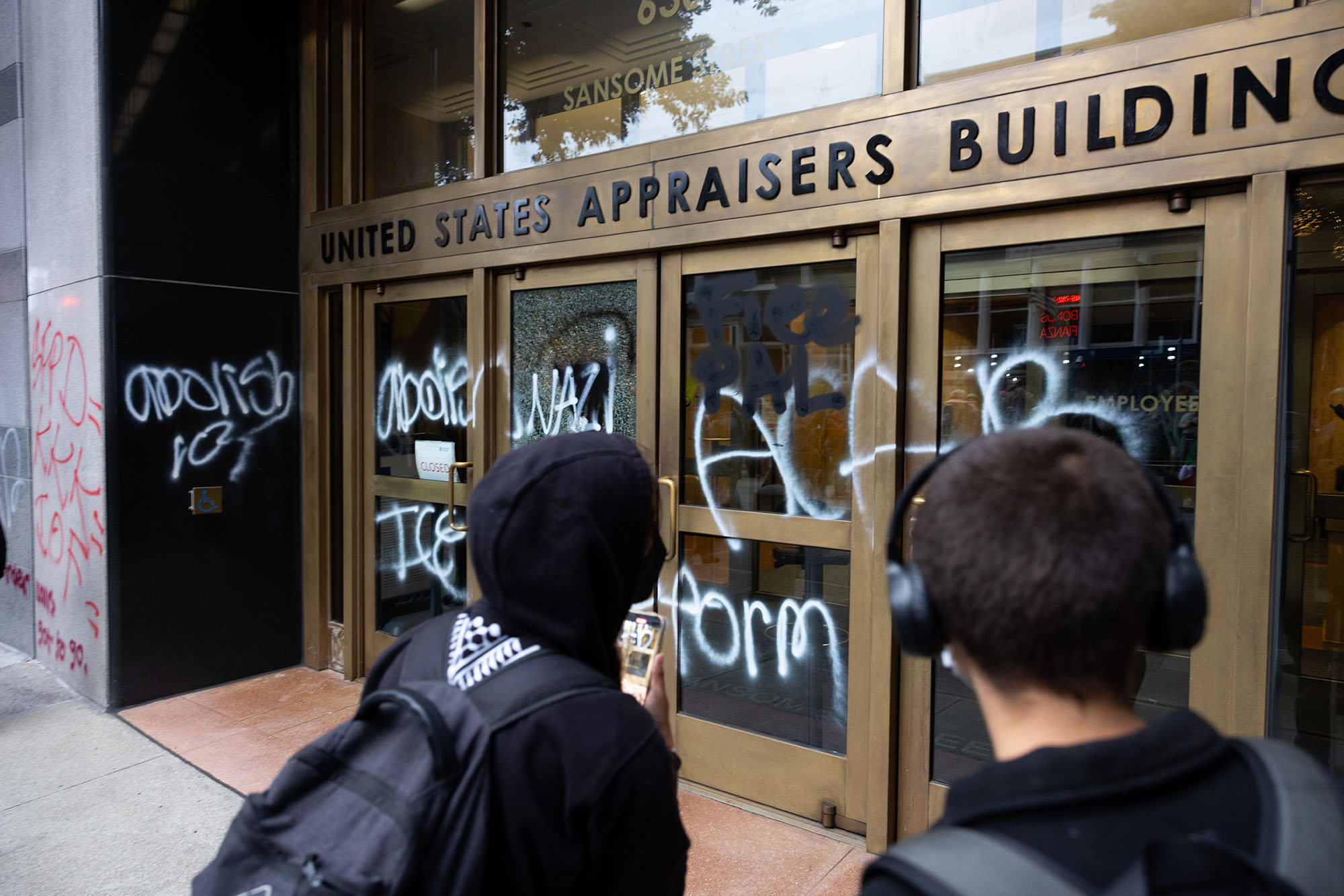
It was good she had. “Traffic was terrible,” she tells Andres over the phone as she pulls into a downtown parking lot. She sprints several blocks in those heels to reach the federal building on Sansome Street, near the iconic Transamerica Pyramid.
After going through security, Daniela rides the elevator to the fourth floor, walks down a narrow hallway, and turns into the courtroom.
Immigration court is a civil process, not a criminal one, so asylum seekers aren’t provided a lawyer free of charge. In San Francisco, most do secure one at some point, but rarely for these master calendar hearings during which the judge simply confirms some basic facts. The final hearing, a longer private affair in which the person makes their case to stay in the United States, comes later— often much later.
That’s because US immigration courts are on the brink. O’Brien’s courtroom, the size of a small elementary school classroom, is certainly hectic—seating area packed, toddlers and babies wailing. Three local journalists, myself included, are squeezed into the last row nearest the exit. The judge at one point gets tied up on hold with a dial-in service seeking an interpreter for Mam, a Mayan language.
The case backlog is epic: As of September (the most recent data available), nearly 2.3 million asylum cases were queued up nationwide, according to the Transactional Records Access Clearinghouse at Syracuse University. Things are only going to get worse. Since early in Trump’s second term, his administration has fired about 100 immigration judges, including more than half of San Francisco’s bench. Five would be abruptly dismissed by email at the end of November. Four more—including O’Brien—were slated to retire by early this year.
The administration plans to replace some of the fired judges across the country—perhaps unlawfully—with military lawyers. The remaining San Francisco judges, along with courthouse staff, were recently told that the main San Francisco courthouse will be shut down next year and they will be transferred across the bay to serve at the immigration court in Concord. Until then, the holdovers will be saddled with the dockets of sacked colleagues. Jeremiah Johnson, one of the five fired in San Francisco in November, told me he’d already been hearing the cases of a judge who’d gotten the boot in September.
After Daniela sits down, O’Brien admonishes three other asylum seekers who scurry in late. (They’d been directed to a different location.) He calls up a couple who had driven from Oregon with their infant and toddler for their hearing. Eventually, he summons Daniela and Isabella, who’d never met. She knew from his tone, she told me later, that she was in trouble.
When he tells them the DHS lawyer has moved to dismiss their cases, my heart sinks. I’d first heard about this tactic a month earlier while covering courts for the nonprofit newsroom Mission Local. Then I witnessed it: The government lawyer makes a motion to dismiss. The asylum seeker—in that case, a gay man in his 20s claiming persecution in Colombia—is arrested outside the courtroom. I watched federal agents load him, handcuffed, into a van waiting outside.
San Francisco has yet to experience the heavy-handed raids the administration has initiated in numerous US cities, notes Milli Atkinson, an immigration attorney at the Justice and Diversity Center of the Bar Association of San Francisco, a nonprofit that helps immigrants get access to legal assistance. Instead, ICE has been arresting people in courthouse hallways. I’ve witnessed dozens of such arrests now. Not criminals, not the “worst of the worst,” as Trump and Homeland Security Secretary Kristi Noem have falsely and repeatedly claimed. Just regular people trying to escape violence and oppression.
The attorney usually present in O’Brien’s courtroom dispensing free legal advice and warning immigrants who have motions to dismiss that they will probably be arrested is absent this morning. I figure Daniela and Isabella are in for a shock.
In fact, Daniela told me later, she was pretty sure ICE would try to detain her. She just thought it would happen on the street. She’d planned to go to the restroom across the hall, call Andres, and they would figure out what to do.
Instead, as she steps out the courtroom door with Isabella, ICE is upon them—a handful of agents, some clad in jackets with “Police” emblazoned on the back. They call Daniela’s name.
Si?
“You’re under arrest,” they say in English.
They spin the women around and cuff them. Both are crying. Daniela catches my eye and says something I couldn’t make out. She tried to ask whether I would call her family. I shake my head, not comprehending: “Soy periodista—I’m a journalist, I can’t do anything.”
The agents marches them through an unmarked door leading to a freight elevator. They take Daniela to a field office two floors up, where they confiscate her purse, documents, cellphone, car keys—even her clothes, giving her a gray sweatsuit to wear. She is allowed a call. She dials Andres just before 10 a.m.
“Don’t panic,” she says in Spanish, her voice breaking. “I’ve been captured. I cannot speak for long. I’m afraid they’re going to deport me.” She needs him to pick up the car. She tells him where. Then she hangs up.
Andres calls his sister at home in the extended family’s cozy apartment in Santa Clara County. Maria is the family’s problem solver. She starts working the phones. On Telemundo, she’d heard about a service, the Rapid Response Network, that offers free legal advice to immigrants. She calls and explains what happened to the person who answers. They say they’ll call back.
A Spanish-speaking lawyer calls back around 10:45. To the family’s immense relief, she says she is there with Daniela at the ICE field office. Then the lawyer asks when Daniela entered the country.
May 2024.
Her tone changes. Under the new rules, the lawyer informs them, anyone in the United States less than two years can be arrested and deported. This proclamation quashes their hopes. Andres had been fired up for a fight; he was sure he could get Daniela released. Now, Maria thought, it felt as though they were speaking with an ICE representative. “Can Daniela hear me?” she inquires. The lawyer says yes.
“Do whatever they want,” Maria advises her. “Say you will leave the country. Do what you have to do to get out of detention as soon as possible.”
To understand why law-abiding asylum seekers are being arrested, consider Trump’s campaign promises. During his first run, he vowed to “build the wall.” The second time around, his promise was far more extreme: He pledged to deport 20 million undocumented immigrants, though only about 14 million are estimated to be living in the United States. “Let’s start with a million,” running mate JD Vance told ABC News in August 2024, “and then we can go from there.”
In May, senior White House adviser Stephen Miller set an ICE arrest quota of 3,000 immigrants a day—about a million a year. That’s more than double the record 400,000-plus annual deportations under President Barack Obama. In October, when it became clear that ICE wouldn’t hit its numbers, the Trump administration walked back that goal and announced a leadership shake-up, replacing key regional ICE leaders with personnel from US Customs and Border Protection, an agency known for aggressive tactics.
Trump officials insist they are focusing on hardened criminals—including “child rapists,” according to Border Patrol Chief Greg Bovino, whom the administration recruited to help coordinate its amped-up efforts. In reality, despite the unprecedented $75 billion Congress approved to help ICE arrest and detain people, there probably aren’t a million unauthorized immigrants with criminal records to target.
Nearly three-quarters of the people booked into ICE custody from October 1 through the end of November had no criminal convictions, according to an analysis by David Bier, director of immigration studies at the Cato Institute. Among those who do, most convictions are for things like gambling and traffic violations, not violent crimes. In fact, people without criminal convictions have been driving the increase in ICE book-ins; Bier found that, compared with October 2024 through April 2025, 80 percent of the increase in daily book-ins were people without any criminal conviction.
A New Yorker analysis points to May 2025 as the month ICE began arresting more people without criminal records than with. It’s also when the San Francisco courthouse arrests commenced. Now, Bier told me, the administration’s priority “is exclusively on the numbers and how many deportations they can get and how many arrests they can get—and the easiest way to make arrests is to go to immigration courts.”
My Mission Local colleagues and I have compiled a fairly comprehensive list of ICE’s courthouse arrests in San Francisco. From late May until Thanksgiving, there were almost 100, most of which we witnessed firsthand. The national picture is murkier. Joseph Gunther, an independent researcher based in New York, analyzed ICE and immigration court data suggesting that nearly 3,000 people were arrested after immigration hearings from May through mid-October, the most recent data available. Gunther suspects this is an undercount.
Daniela had never planned to come to the United States—until her life was upended in April 2024. She was 27 and working at a cellphone store in a major Colombian city. She’d hoped to attend university and study psychology—maybe marketing—but work kept interfering, she later wrote in her asylum application.
One Saturday that month, a man came into the store with a cellphone he needed unlocked. He was agitated. She took the phone and said to come back Monday to give the technician time to check it out. The man seemed frustrated and impatient. He said he’d check back at the end of the day.
Hours later, two male police officers showed up in search of a phone of the same make and model. They didn’t have a warrant. Daniela said to come back when they had one. The officers left.
The first man didn’t return that day—or Monday or Tuesday. On Wednesday, Daniela got curious and opened the cellphone, which the tech had successfully unlocked. It contained a video of the same two police officers. They were sexually assaulting a woman. Daniela was shocked.
She Googled the name of the man who’d left the phone and found his Facebook page. She messaged him. He didn’t respond. But public posts on his feed suggested that he knew the woman and that she was missing. The posts were asking for people’s help finding her.
That evening, Daniela walked to the nearest police station to file a report. The cops were unhelpful. She’d have to file online, they said, so she headed home. When she arrived at her door, someone called her name. She turned around, and a man had a gun pointed at her face. He pulled the trigger.
“I did not immigrate for economic reasons,” Maria wrote in her application, but “the Colombian state did not protect me.”
The gun seemed to malfunction, sparing her, Daniela wrote. She screamed. Neighbors emerged, and the man fled. Daniela left town as soon as she could, heading north. A month later, she crossed from Mexico into the United States. There didn’t seem to be any Border Patrol agents around. She could try her luck without documentation, her smuggler said, or walk four hours to the nearest CBP office and request asylum. She chose the latter. It was a no-brainer, she told me later. If she followed the rules, she would be able to remain in the United States legally. Breaking the rules never crossed her mind, she said.
She met Andres about two weeks later in the Bay Area. She was doing, Daniela admits, a truly horrific job of parking outside a Cheesecake Factory. Andres helped. Then he got her number. Their first date was at the Santa Cruz Beach Boardwalk, an amusement park by the ocean.
Andres, too, was an asylum seeker, a lawyer back in Colombia. He’d run for local office in his hometown on an anti-corruption platform, promising to address officials’ ties to organized crime. Maria, his sister, ran his campaign. Their experience was a lot like Daniela’s. Maria was arriving home one day in 2022 when a man on a motorcycle stopped her outside her house, according to her asylum application and police reports filed with Colombian authorities. The man lifted his shirt to reveal a gun. He said to tell her brother hello. If Andres didn’t cease his political activities, he said, he would come for her.
She left town that day. Two months later, a different man threatened her brother—also with a gun, which jammed. That’s what compelled the whole family to flee: Andres, Maria’s husband and their son, and their aunt. “Tia,” as everyone calls her, insisted on wearing heels as she scrambled through a hole in the border fence. They still laugh about it: She was determined to make a good first impression.
“I did not immigrate for economic reasons,” Maria wrote in Spanish in her application. “I had a stable life in Colombia.” But “the Colombian state did not protect me. Despite my filing official reports, the authorities did not guarantee my security.”
I turn up at the family’s apartment the afternoon of Daniela’s arrest. Asylum seekers are so meticulously documented that their home addresses are read aloud in court. I’ve brought along a Spanish-speaking co-worker to help interpret.
I hear music first. The front door is wide open.
I think: Who leaves their door open when a relative was just taken?
Tia does. We knock on the door frame: “Hello, is this Daniela’s house?” Tia hurries over. “What do you know about Daniela?” she cries in Spanish.
Maria and Andres were in San Francisco picking up Daniela’s effects and searching for her car. Tia invites us in, and we sit on black leather sofas in the living room. She’s the matriarch, having raised Maria and Andres. The apartment has a little dining nook with a table and chairs. Telemundo is always on in the background. One wall is adorned with rows of certifications Maria has earned that allow her to help other immigrants fill out documents.
Tia, who knows about Daniela’s arrest, calls Maria and has her speak with my co-worker. She offers water: sparkling or tap? I tell her what I witnessed. “Did Daniela have a jacket? Was she cold?” Tia demands.
She thinks of Isabella, whom none of us know. She will pray for her, too, she says.
Back at the ICE field office, the women were placed in a cell. Daniela was indeed cold. Her only food in the 20-odd hours she would spend there was two “burritos”—just a smear of beans on a tortilla—an energy bar, and small bottles of water.
She couldn’t sleep: “I stayed awake and talked to Isabella, and I cried.”
“A motion to dismiss when someone wants to have their day in court—it seemed disingenuous to me,” said a recently fired immigration judge.
An ICE officer came by early the next morning. The officer didn’t speak Spanish, but she made it clear that Daniela was being moved. She fanned herself to indicate the destination: somewhere hot. Then she undulated her arms like a hula dancer. “Aloha,” she said.
There are no long-term ICE detention facilities in the Bay Area, so immigrants arrested at local immigration courts are sent elsewhere—to Bakersfield, California, or sometimes to Texas or Louisiana. But even veteran immigration attorneys were surprised when I told them where Daniela ended up.
She was loaded into a van with four other asylum seekers, led through security at San Francisco International Airport, and placed on a United flight to Honolulu. She remembers travelers staring at them. She was crying—and cuffed the entire flight, even in the bathroom, she told me.
In Honolulu, two ICE agents loaded her into another van. In broken English, she begged one of them to let her call her family. He seemed moved. He pulled over and handed her his cellphone. Make it fast, he said. She dialed Andres.
“Amor!” He yelled upon hearing her voice.
“I’m in Hawaii. I can’t talk,” she said. She hung up.
Maria got right to work. There weren’t any ICE detention facilities near the Honolulu airport. But a local paper had reported that ICE was contracting with the Federal Bureau of Prisons to house detainees in the city. Maria eventually found the prison.
She tells me all this at the family dining table three days after Daniela was taken. Telemundo is on as always; Trump and Noem pop up onscreen occasionally. Tia sits on a couch nearby.
Maria has a Google Maps printout of Daniela’s location. She’s contacted a Honolulu church and asked whether they might check on her to make sure she’s okay. All she wants for Daniela, Maria says, is a dignified return to Colombia. She has no hope of her staying in the United States.
Andres calls and says something to Maria, who starts to cry—happy tears. She puts the phone on speaker and breaks the news: “Daniela is pregnant!”
Tia jumps up. “This is a sign you are meant to be together!”
Later, Andres tells me the news made him happy, but it was tempered by a painful realization: “I can’t go back to Colombia,” he keeps saying.
The other family members were determined to keep fighting for their asylum, but they’d already accepted that Daniela wasn’t coming back, and Andres’ little family would be separated before it could even begin.
Daniela’s targeting, immigration experts told me, likely had to do with expedited removal, a process that lets authorities fast-track deportations without putting the person in front of a judge.
It was traditionally used for people in the country less than two weeks and detained within 100 miles of the border—someone, for instance, who comes across to find work, encounters a Border Patrol agent, and admits they aren’t seeking asylum. But after Trump was re-elected, DHS officials said they would use expedited removal “to its fullest extent.” Now it would apply to anyone anywhere in the country who’d arrived within the last two years.
Trump had tried to impose this policy during his first term, but it got tied up in court and was never fully implemented. In late August, a federal judge temporarily blocked this second attempt as well. (A US circuit court began hearing the government’s appeal December 9; the timeline for a decision is unknown.) But that temporary respite came a month too late for Daniela.
There are legitimate reasons for the government to dismiss an asylum case: The person had some other way of qualifying for residency, for example, or the case was a low-priority affair that could be handled via a separate process. Asylum seekers sometimes seek dismissals, too. In the past, “I did not have any qualms about granting those cases,” explains Johnson, the San Francisco immigration judge who was fired in November, but “a motion to dismiss when someone wants to have their day in court—it seemed disingenuous to me.”
“If they fly me back to Colombia, I won’t even leave the airport.”
Judges who do have qualms are under considerable pressure to comply. US immigration courts are overseen by a division of the Department of Justice, which sent out guidance in May instructing immigration judges to rule immediately on dismissal motions without allowing, as is more typical, time after the hearing for the immigrant to respond. The guidance was walked back, but the message was clear: Grant the motions, according to former San Francisco Immigration Judge Shira Levine, who was fired in September. A lack of case law on the issue, Levine says, coupled with the DOJ directive—not to mention the firings—may well make some judges more compliant.
Johnson is concerned about what comes next. After a dismissal, the asylum seeker no longer has an active case, so they lose their legal protection against deportation. This lets federal agents treat them basically as though they’d just crossed the border and place them in expedited removal. Even when judges refuse to grant an immediate dismissal—as O’Brien did in Daniela’s case—ICE tends to arrest the person anyway.
Expedited removal doesn’t apply in such cases, but that may not matter, because ICE does have some powers to detain noncitizens—even those with active asylum cases. Daniela, facing the prospect of indefinite detention, waived her right to asylum and asked to leave the country. I’ve spoken to three other asylum seekers arrested in San Francisco who did the same.
Isabella got lucky. That first day, while she and Daniela sat in the ICE holding cell, her brother wandered, distraught, into a law firm nearby. The firm specialized in other things, but a handful of its attorneys did pro bono immigration work. One was Erin Meyer.
Meyer decided to try a long shot: a habeas corpus petition. This is how student protesters, including Palestinian activist Mahmoud Khalil, got out of detention last year. The argument is that Isabella was detained in violation of her Fifth Amendment right of due process. When she crossed initially into the United States, the Border Patrol arrested her, determined she wasn’t a flight risk, and let her go. Isabella—like most San Francisco asylum seekers, Meyer told me—hadn’t committed any crimes, so the government had no lawful reason to rearrest her.
Meyer filed the habeas petition the morning after the arrest, then proceeded to file for a temporary restraining order to get Isabella out of ICE custody. By this time, Isabella, too, was en route to Honolulu. But by the time her plane landed, a federal district judge had granted the restraining order. Meyer’s firm booked Isabella on a return flight that night.
Habeas petitions quickly became the norm in such situations, at least in San Francisco. Lawyers began staking out courtrooms and starting the process before the immigrant was even arrested. Had Daniela’s hearing been a few weeks later, she and Andres might still be together.
![A woman stands in front of a line of police in riot gear, holding a handwritten sign above her head. The sign reads: "We are children of a mother that was taken away from us in the early 2000 [sic]. This is personal. We rise up for the new generation without a voice that are losing their parents today!"](https://www.motherjones.com/wp-content/uploads/2025/12/6-9-24ICEprotestColinPeck-18.jpeg)
What Andres thought about most in the wake of Daniela’s arrest was the money. The money for Daniela to call him from prison. The money they would need for the baby to come.
Today, it was money for flights. Daniela had just finished her voluntary departure process. This would keep a removal order—which would make it harder to reenter the country legally—off her record. Andres hopes to get asylum, marry Daniela, and bring her and their child back to California. Plenty of things could prevent that, the Justice and Diversity Center’s Atkinson told me. Meanwhile, another key path to asylum—for people who didn’t encounter CBP and applied through US Citizenship and Immigration Services—has been frozen. The administration officially put it on hold December 2, after an Afghan immigrant shot two National Guard troops in DC, killing one of them.
Daniela had been in lockup about a week before a federal judge gave her permission to leave the country. It would be two more before she boarded a flight to Colombia. That may sound like a long delay, but I’ve interviewed people who were incarcerated much longer after requesting voluntary removal. Andres and Maria think the pregnancy helped move things along. Also, Maria had followed up nonstop with a Honolulu-based ICE officer.
Back in California, Tia packed Daniela’s things into five boxes stacked in the living room: shoes, purses, makeup and accessories, regular clothes, and athletic clothing. Daniela thought she’d be free once she arrived in Panama, a layover en route to Colombia. Instead, she had to wait until everyone else deplaned, and someone came to escort her to the next gate. Even upon landing in Colombia, she was told to stay put. A Colombian official came and got her and walked her through customs. Finally, the official stamped her passport and handed it over: “Welcome home.”
The last time I saw Andres was in October, more than two months after Daniela’s arrest. It was his 42nd birthday—the day he’d planned to propose to Daniela. He had intended to pop the question in front of Sleeping Beauty’s Castle at Disneyland. Tia would sneak photos of the moment.
Instead, he was at the family apartment, FaceTiming his love during an informal gathering with his sister, aunt, brother-in-law, and nephew. He opened a birthday card, had a slice of cake. Daniela was doing well enough. Fearful of returning to the city where she’d been threatened, she was living in the countryside and keeping a low profile. (Andres would end up proposing over the phone, after Daniela revealed the baby will be a girl. They plan to name her after Maria and Andres.)
The front door of the apartment was open as usual. Still, things felt different. Andres apologized for his mood. He was tired, he told me. He works three jobs. From 3 to 11 a.m., he’s a dispatcher at a local factory. From 11 a.m. until 4 p.m., he drives for a ride-hailing service. After a break, he works until 8:30 p.m. or so doing food delivery, gets home around 9, and goes straight to sleep. This was his first time off in a while.
There was something else. Andres says he no longer feels welcome in the United States. He watches the news, sees the arrests. He feels like people view him as a criminal. Maria feels much the same—though her son, now fully bilingual in English and Spanish, is thriving in elementary school. The silver lining of Daniela being back in Colombia, Andres said, was that his child won’t be around people who don’t want her.
Maria and Andres are less likely to be arrested at their hearings than Daniela was, but they’re still terrified to go to court. They have been here more than two years, and such people are seldom arrested at court or flagged for expedited removal, Atkinson says—though everything is a coin toss with this administration.
The courthouse arrests have slowed down nationwide since September. Experts aren’t quite sure why. The ongoing lawsuits may be a factor. It’s also possible that ICE has shifted to targeting immigrants in other less public settings, such as green card interviews or interviews during which asylum seekers try to establish a “credible fear” of returning home—an early step in some people’s processes. A new DHS strategy also seems to have emerged: Its lawyers are now asking judges to deport immigrants to third countries, arguing that they can seek asylum there instead.
Daniela had written in her asylum application that, beyond her need for security, she wanted to be an American. She was eager to start working legally, she wrote in Spanish, “and receive a Social Security Number to start paying taxes, which are the foundation of the quality of life in this country, and in this way begin to contribute my small grain of sand to this beautiful nation.”
Both Andres and Maria had once shared that idealism. But on that day in the apartment, Andres’ birthday, the life he’d imagined seemed further away than ever. That best-case scenario of living with his family legally in California is years away at best. His final hearing is scheduled for 2027, and with judicial firings and the legal immigration process in disarray, that timing is far from certain.
Maria’s final hearing is years out, too. The thought of not getting asylum, for her, is unfathomable. “If they fly me back to Colombia,” she tells me in Spanish, “I won’t even leave the airport. I’ll go through customs, immediately turn back, and be on the next flight out.”
www.motherjones.com (Article Sourced Website)
#courthouse #arrest #surprise #pregnancy #familys #shattered #dreams