
How much has AI really changed the marketing and agency industry in the past five years?
The answer: completely.
From all kinds of creative production to audience targeting, digital marketing agencies worldwide redefined (no doubt) their operating models around AI-first systems. So much so that some of them recreated themselves as an AI agency.
This transformation did more than change workflows. It’s changed the very economics of agency growth. OpenText reported that agencies embracing end-to-end AI orchestration achieved 1.6× higher shareholder returns and 1.5× faster revenue growth than their non-AI peers.
Not just agencies themselves, but the relationship between agencies and businesses also transformed drastically.
According to McKinsey’s Superagency in the Workplace (2025), 92% of companies plan to increase their AI investments over the next three years, yet only 1% of organizations say they’ve reached full AI maturity. That gap between intent and execution creates a massive opportunity for agencies that know how to operationalize AI at scale.
Investment in AI has also reached significant levels. So much so that, in 2024 alone, global corporate spending on AI surpassed $150 billion, with projections estimating it will exceed $300 billion by 2027. Much of this investment has gone toward marketing and customer experience systems; precisely the area agencies dominate.
Traditional-firm tech spending1
Global payments technology company
~4%of revenue
Multinational retail corporation
~3%of revenue
Major US insurance provider
~2%of revenue
Energy mgmt. and automation firm
~2%of revenue
Digital-native tech spending1
US-based fintech platform
~12%of revenue
Large-scale online marketplace
~14%of revenue
Digital-first insurance platform
~16%of revenue
Industrial 3D-printing tech leader
~14%of revenue
The Evolution of Search: From Basic AI Adoption to Generative Engine Optimization (GEO)
The pursuit of these gains transitioned from simple artificial intelligence adoption to a focus on maximizing AI’s creative and operational output. This next phase, GEO became essential.
GEO actually involves fine-tuning large language and multimodal models for agency-specific tasks, from brand voice consistency and rapid ideation to high-fidelity, production-ready asset generation.
By treating the AI itself as a system to be continuously optimized, marketing professionals & brand owners moved beyond integrating AI-powered tools.
According to verbit.AI:
Over 40% of AI professionals are currently exploring ways to optimize generative AI outputs.
It’s not surprising, considering that Perplexity AI alone received more than 155 million visits in March 2025; we haven’t even mentioned other AI platforms.
The Rise of the GEO Agency: Maximizing Output in the Era of LLMs
With the large adoption of generative AI, all types of agencies now implement technologies capable of producing original concepts. They use multimodal systems that integrate text, images, and data generation. That gives rise to new types of service models like AI marketing agencies, generative content studios, and, of course, GEO agencies.
In this article, we will look closer at GEO agencies and generative engine optimization.
What’s Inside
What is Generative Engine Optimization? SEO to GEO
As you already know, for nearly three decades, SEO has defined how brands reach audiences via search engines. And, digital marketing success depended on how well marketers could align content with the algorithms of search engines like Google or Bing.
But a new player has entered the field: Generative Engine Optimization.
AI-powered systems retrieve information while synthesizing and summarizing it. These engines, such as Google’s SGE (Search Generative Experience), Microsoft Copilot, and Perplexity.ai, answer user queries directly, without displaying traditional search results.
This evolution has profound implications. Research titled GEO: Generative Engine Optimization explains:
Generative engines typically satisfy queries by synthesizing information from multiple sources and summarizing them using large language models.
They picture the idea as follows:
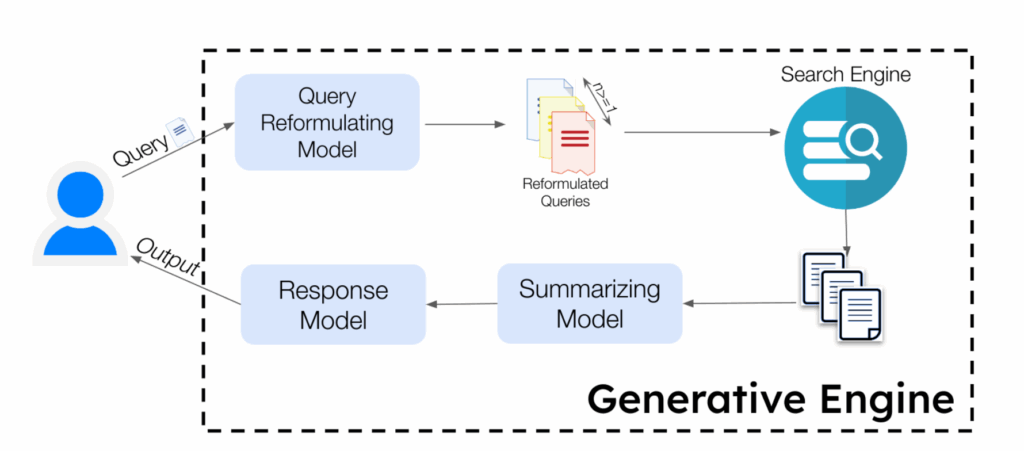
So, in this model, traditional web ranking is replaced by content visibility within AI-generated summaries.
The challenge? Brands and marketers have limited control over how, or even if, their work appears in these generative answers. To address that, GEO aimed at improving visibility and attribution in generative search results.
For a query “Things to do in NY,” generative engines work like that:

Source: https://arxiv.org/pdf/2311.09735
According to the same study, optimized content can boost visibility by up to 40% within generative responses.
In other words, the future of discoverability lies in being the source behind the answer. That’s where generative engine optimization agencies come on the scene.
Let’s finish that section with a quick SEO & GEO comparison:
SEO vs. GEO: Traditional Search vs. Generative AI Visibility
🔍 SEO
- ▣ Focuses on search engine crawlers and index ranking.
- ▣ Goal: Appear on the first page of results (SERP).
- ▣ Relies on keyword density, backlinks, and meta tags.
- ▣ Optimized for human click-through behavior.
- ▣ Measures success in SERP position (Search Engine Results Page).
🧠 GEO
(Generative Engine Optimization)
- ◆ Focuses on generative engines (LLMs) that synthesize and summarize.
- ◆ Goal: Be cited, quoted, or sourced in the AI-generated answer.
- ◆ Relies on structured data, verified citations, and entity context.
- ◆ Optimized for machine comprehension and source attribution.
- ◆ Measures success in AI visibility and inclusion rate.
Who helps brands stay visible in AI-driven discovery?
Even though all AI agency types do a great job in that area, that’s precisely the role of a GEO agency.
They are a new class of marketing partner built for the era of generative engine optimization. Let’s focus on their services to find out more about new-age agencies.
While the specific approach may vary, the GEO service pillars that agencies deliver are:
🦾 AI Visibility Auditing
A GEO agency assesses where the content currently appears within AI-generated outputs. This includes scanning ChatGPT, Perplexity, and other generative search engines to determine:
- How often a brand or product is cited.
- Whether AI engines reference official materials.
- How accurately they represent data or brand messaging.
To understand visibility auditing more deeply, AI researchers are recommending using “visibility metrics” such as:
- AI Citation Frequency (AICF): How often the content is cited.
- Brand Representation Accuracy (BRA): How correctly AI systems describe the brand, product, or service.
- AI Response Share (AIRS): What’s the percentage of generative answers where the brand/service/product appears.
🦾 Content Architecture
GEO agencies re-engineer content so that AI models can parse meaning, verify context, and attribute sources. This involves:
- Applying schema markup that defines relationships between entities.
- Creating semantic layers that highlight brand authority within structured data.
- Building content knowledge graphs that link key topics, products, and claims.
🦾 Generative Content Engineering
Similar to content architecture, GEO agencies re-create content to craft AI-readable content using Natural Language Understanding (NLU) frameworks, Named Entity Recognition (NER) optimization, and cross-modal embeddings that link images, video, and text.
In that way, these agencies balance tone, clarity, and factual accuracy so models see the brand as a trustworthy source.
🦾 Source Verification and Citation Engineering
One of the GEO agency’s most important functions is to ensure attribution. Generative engines synthesize data from multiple sources, but they often misattribute or omit citations. A GEO agency prevents that by:
- Embedding verifiable metadata and canonical links.
- Getting content through just authoritative & crawlable channels.
- Creating reference datasets and fact layers AI models can pull from.
🦾 Continuous AI Monitoring & Optimization
Unlike static SEO audits, GEO is dynamic. As AI models update, GEO agencies use real-time tracking tools to monitor these shifts. They analyze:
- How AI engines are changing their training data or sources.
- Which of the content assets remain cited or get dropped.
- Develop new generative patterns that may favor competitors.
Why GEO Agencies Matter Right Now
As we’ve mentioned so far, generative engines have become the new gatekeepers of online discovery for each industry.
When AI engines summarize industries, they choose which sources define the narrative. GEO agencies make sure the brand, product, or service is one of them.
So, without GEO, brands may be invisible in that ecosystem.
According to Otterly.AI’s Generative Engine Optimization Guide:
Traditional search results, characterized by blue links, are becoming obsolete. To stay relevant, your brand must be prominently featured in AI responses through text, links, branded content, quotes, statistics, videos, and more.
In the same guide, it is explained why AI search is more relevant than LLMs as follows:

So, partnering with a GEO agency offers future-proofed search visibility in a market bursting with AI-driven search behavior. If we are all on the same page, let’s discover some GEO agencies.
Top GEO Agencies
Many agencies operating today do not explicitly label themselves as GEO agencies. These agencies do the same, yet when we examine their marketing strategies and service offerings, it becomes evident that they are effectively providing GEO-like services.
They focus on optimizing content to improve visibility in AI-generated answers and recommendation engines, even if they do not specifically use the term “GEO”.
Let’s see them.
1. Major Tom (HQ: Vancouver, Canada)
Don’t let your valuable content fade into oblivion. We specialize in sculpting bespoke SEO, GEO, and AEO strategies that elevate your visibility, enabling you to reach a wider audience with less effort.
Major Tom is a strong fit for GEO because their entire philosophy is built around precision over noise, which is exactly what today’s AI-driven search demands.
Instead of pushing out more content just to be seen, they build coordinated strategies that connect advanced SEO, GEO, AEO, paid media, and full-funnel campaign execution into one intelligent system. The result? Your brand shows up in the right generative answers, at the right moments, in front of users who already signal high intent.
What truly sets their approach apart is the way they unify every channel, so brands’ presence across generative engines isn’t fragmented or left to chance. This kind of strategic discipline helps brands cut through the clutter, maintain visibility as AI search evolves, and turn shifting demand into sustained, measurable growth. This approach reflects how leading GEO agencies in Canada design AI-search strategies — unified, intentional, and built for long-term visibility rather than short-term wins.
2. Propeller (HQ: London, UK)
Propeller‘s AI-powered SEO is built around smart adaptation, not generic templates.
GEO success, as you already know, depends on understanding how search behaviour shifts inside AI-driven environments. Propeller’s AI-first framework helps identify those nuances with far more accuracy than traditional SEO ever could.
As an AI visibility SEO agency, we align entities, schema, citations, and content to build authority and clarity. We track AI share of voice, monitor zero-click moments, and connect visibility to outcomes.
Their machine learning models analyze how generative engines interpret intent, which competitors are being surfaced in AI answers. What makes Propeller particularly valuable is the balance they strike between human strategy and AI refinement. Their strategists set the direction, and their AI systems constantly adjust, learn, and optimize behind the scenes, so visibility in generative results keeps improving month after month instead of plateauing.
3. CreativeWeb (HQ: London, UK)
Another strong GEO partner for marketers and brands is CreativeWeb, since they work from a clear understanding of how AI tools now influence discovery and brand visibility.
The UK-based GEO agency’s approach focuses on entity clarity and authority signals that generative platforms use when surfacing brands inside AI-generated answers. At CreativeWEb, GEO is treated as a natural evolution of search strategy, aligned with how audiences increasingly find information.
CreativeWeb brings together a team of digital specialists who blend creativity with technical expertise to deliver powerful GEO campaigns. Having worked on more than 500 bespoke websites with tailored digital marketing strategies, we understand what it takes to build visibility that lasts.
How good are they at GEO services? One of their GEO case shows a 140% increase in AI-driven traffic and a 62% rise in AI mentions. That result obviously demonstrates that they measure impact where visibility is shifting.

Combined with their wider SEO and technical expertise, GEO sits firmly within the performance marketing stack and provides teams with a practical way to stay competitive as search behavior changes.
4. Crowd (HQ: Amsterdam, The Netherlands)
Here’s an agency that doesn’t just use AI tools; they build their own AI platforms, and that’s exactly what makes Crowd stand out when it comes to GEO.
With platforms like SightGeo and a dedicated R&D Lab, they’re not guessing how AI search systems surface content, they’re actively studying behaviour patterns, testing models, and developing technology that helps brands stay visible as search shifts from traditional SEO to generative engines.
Crowd’s platforms can analyze how content performs within AI-driven environments, identify what an engine is prioritizing, and reveal the gaps your competitors aren’t addressing. Their team takes those insights and turns them into strategies that help your brand show up inside conversational results, AI snapshots, and assistant-style search flows.
5. GA Agency (HQ: London, UK)
Another London-based organization, GA Agency is a performance-driven digital marketing agency with roots in SEO, data, and growth strategy. We listed since they’ve built real infrastructure around GEO. One of the clearest examples is their proprietary AI visibility tool, BuzzWatch, which handles one of the biggest problems in GEO today: knowing whether your brand actually shows up inside AI-generated answers.
BuzzWatch is our proprietary AI brand visibility tool that tracks how your brand appears across leading AI platforms like ChatGPT, Google AI Overviews, Gemini, Bing Copilot, and Perplexity. It shows exactly where and how your brand is mentioned when users ask AI for recommendations – with real-time analytics, competitor benchmarks, and actionable insights in one intuitive dashboard.
What we really value is how practical their GEO approach is. GA focuses on semantic clarity, entity positioning, and content that actually answers real questions. They back this up with solid technical foundations like clean architecture, and search hygiene, then layer in human-led strategy and brand storytelling. The result is work that helps brands show up in search results, AI summaries, comparisons, and recommendations.

In a space where many agencies are still experimenting, GA Agency is building feedback loops and systems. And which is exactly why they deserve to be recognised at the top of the GEO category.
6. SmartSites (HQ: New Jersey, USA)
SmartSites provides services that align closely with the core principles of Generative Engine Optimization, even though the agency does not explicitly label itself as a GEO provider.
Their recent initiatives use machine learning models to forecast how search algorithms (and now generative engines) prioritize content.
The agency has begun developing structured-content pipelines that improve how brand data is interpreted by AI systems. For example, SmartSites’ enterprise SEO teams are now integrating schema-level data enrichment and contextual linking frameworks, both core to Generative Engine Optimization services.
With its strong foundation in SEO, SmartSites is uniquely positioned to lead the next wave of Generative Engine Optimization, securing vital visibility for U.S. brands within AI answers — a capability increasingly expected from top GEO agencies in the USA as AI-driven search reshapes brand discovery.
7. Shout Digital Marketing (HQ: Sydney, Australia)
Shout Digital‘s GEO service is designed to understand exactly how generative engines read, structure, and deliver information, then engineer content and technical setups that align with those models.
The agency rebuilds the entire search strategy around AI-driven ranking factors; entity strength, semantic clarity, trust signals, and contextual relevance.
What stands out about Shout is their commitment to creating content architectures that generative systems can interpret without friction, supported by machine learning tools that continually refine your visibility as models update.
For brands that want a partner who truly understands how AI engines decide what to surface (not just how Google used to work) Shout Digital Marketing offers a smart, forward-looking approach built for the next generation of search.
8. Luminary (HQ: Melbourne, Australia)
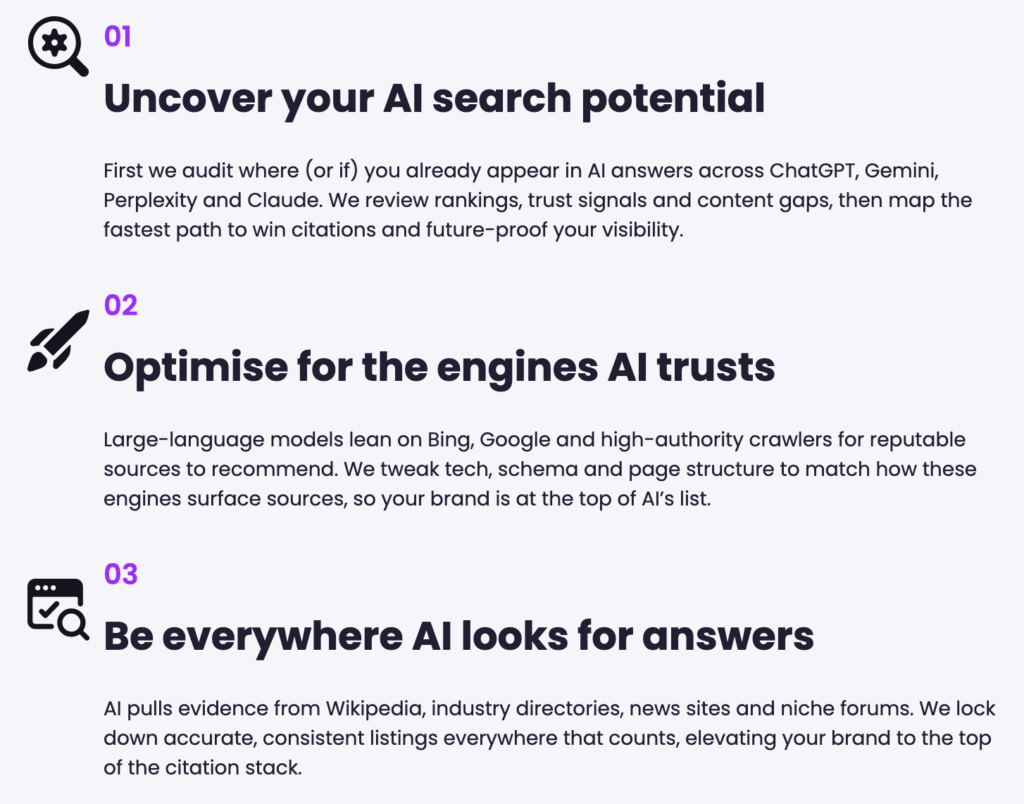
GEO isn’t a replacement for SEO; it’s an evolution. And Luminary‘s approach focuses on helping brands show up in AI answers by cleaning up how content is structured, and how entities are connected across a site. It feels like making sure your brand story is easy for AI to understand and trust.
We make sure generative AI tools can reliably access and interpret your content. When we build websites, our approach prioritises server-side rendering and pre-rendering because they provide consistent, machine readable HTML that LLMs can parse more effectively.
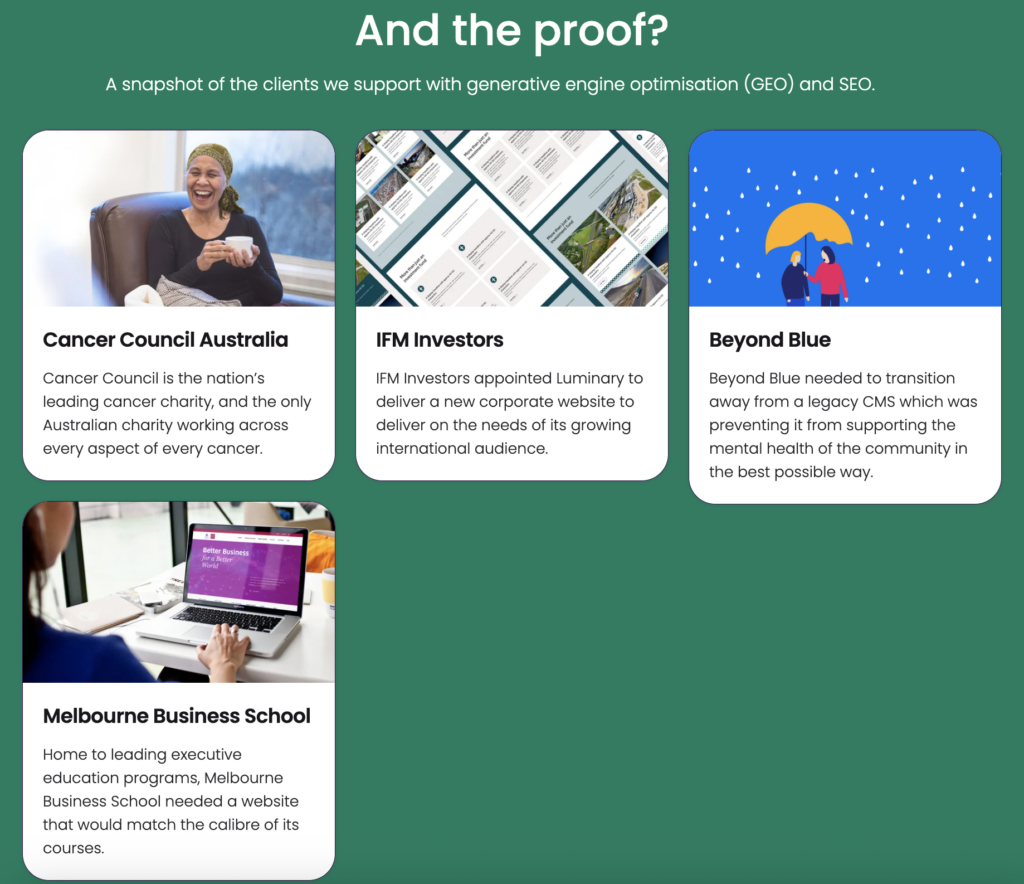
What makes Luminary genuinely good at GEO? Luminary has partnered with organisations like Beyond Blue, IFM Investors, Cancer Council Australia, and Melbourne Business School, all brands where trust, accuracy, and clarity matter. Their case studies show they’re comfortable working with complex content ecosystems and turning them into something AI tools can navigate.
Luminary leaders like their SEO Principal Shayna Burns regularly publish thoughtful guides and insights on GEO best practices; that shows they’re actively learning alongside the evolving AI landscape and helping clients stay ahead of change.
9. SEO Brand (HQ: Miami, USA)
SEO Brand is a strong choice for GEO since they don’t just tick boxes on a local SEO checklist.
The Miami-based agency approaches GEO with a clear focus on how generative search engines interpret, rank, and surface information.
Their process begins by pinpointing what makes your business uniquely valuable, then shaping that into AI-ready assets built specifically for SEO, PPC, and AI Search GEO.
We identify what makes your business special and target your ideal customer profile. We then create content, ads, or a mixture of both for SEO, PPC and AI Search GEO, Then Launch.
Rather than relying on outdated, one-size-fits-all SEO playbooks, they build an adaptive framework that evolves as generative engines evolve.
For brands seeking a partner that treats GEO as a forward-looking AI discipline (not a repackaged version of traditional SEO), SEO Brand brings a practical, hands-on, and genuinely future-ready approach.
Why Should You Work with a GEO Agency?
Repeating one more time, the way people discover brands online is changing faster than ever. Across multiple studies, researchers confirmed that ChatGPT, Perplexity, Gemini, and Google’s SGE generate synthesized answers, often quoting or referencing only a few trusted sources.
So, if your brand & service aren’t optimized for inclusion in those AI summaries, you risk losing relevance, awareness, and referral traffic.
A GEO agency specializes in preventing that loss.
That kind of agency restructures the content and metadata into an “AI visibility layer” by embedding schema markup, semantic HTML, and verified citations. This move ensures the asset is compatible with how large language models (LLMs) retrieve and reuse content.
What’s more? See why you need a GEO agency:
Key Benefits, Activities, and Goals for AI Visibility
| Benefit/Service | Key Activities & Methodology | Goal/Result |
|---|---|---|
| Recover Lost Visibility | GEO agencies use structured data, schema markup, and entity mapping to help your brand remain visible when AI engines summarize content. | Optimized sources can gain **30–40% higher citation visibility** in generative responses. |
| Build Trust and Authority in AI Search | GEO professionals ensure your content earns authority through Wikipedia listings, reputable news mentions, and verified citations. | Directly improving how your brand **appears in AI answers**. |
| Understand and Monitor AI Visibility | Agencies leverage AI visibility tools (like OtterlyAI x SEMrush) to track where and how your brand is mentioned in AI search and monitor citation sources. | Identify **emerging opportunities** for improvement. |
| Future-Proof Your Content Strategy | GEO agencies help you restructure owned content (website, blogs, resources) to be machine-readable and semantically rich, creating an **“AI-ready architecture.”** | Ensures LLMs can consistently interpret and credit your information even as search models evolve. |
| Unlock Data-Driven Growth | By understanding how generative systems surface and rank sources, GEO experts can align marketing analytics, PR, and content creation with AI ranking logic. | Bridging technical optimization and brand storytelling for the **new era of discovery**. |
FAQ about GEO Agencies
1. What is a GEO agency?
A GEO agency helps brands be cited and accurately represented within AI-generated responses in LLMs rather than traditional search results on Google. These agencies make content readable and trustworthy to generative engines such as Gemini, ChatGPT, Perplexity.ai and more. As defined in OtterlyAI’s Generative Engine Optimization Guide (2025), GEO agencies “make content discoverable, citable, and contextually accurate inside AI outputs.” Their purpose is to ensure that when AI summarizes the industry or product, the brand is one of the trusted sources it uses.
2. How does GEO differ from traditional SEO?
As you already know, traditional SEO aims to rank content higher in search results for “real humans,” while GEO optimizes content for generative engines for citation. Instead of keywords and backlinks, GEO focuses on making content interpretable by large language models. As is known, generative engines synthesize information rather than rank it; that means brands must be part of what AI models summarize, not just what they index. In short, SEO gets the content seen by people; GEO gets it understood by machines.
3. What are the main services a GEO agency provides?
A generative engine optimization agency delivers technical, analytical, and creative services that make brands visible in AI-driven discovery. This includes AI visibility audits, structured data and schema optimization, generative content engineering, citation and attribution management, and real-time AI monitoring.
4. How to choose the right GEO agency for your business?
The best GEO agencies combine AI literacy, structured data expertise, and ethical marketing practices. Studies show us that brands that work with AI-proficient partners see nearly 2× faster implementation and 1.9× higher marketing ROI. When evaluating a GEO agency, looking for proven AI search experience, schema and metadata implementation, transparent reporting metrics (AI inclusion rate, citation frequency), and alignment with ethical frameworks is a good call.
5. What KPIs should you track for GEO performance?
Because GEO targets AI systems, its metrics differ from SEO. Key KPIs for GEO performance include AI Citation Frequency (AICF), Brand Representation Accuracy (BRA), AI Inclusion Rate (AIR), and Visibility Retention Rate (VRR). These indicators measure how often the brand & content are cited in AI-generated answers and how accurately they are represented.
6. How long does it take to see results from GEO optimization?
GEO optimization produces measurable results within 8 to 16 weeks, with full visibility gains typically seen after six months. Otterly.AI’s 2025 benchmark study found that optimized content increases inclusion in AI-generated summaries by 35–40% within this period while Princeton’s research showed similar improvements in generative citation frequency.
7. Can traditional SEO agencies offer GEO services?
Traditional SEO agencies can transition into GEO providers, but doing so requires more than adding AI tools, no doubt. It demands model-level understanding and structured data fluency. As marketers already know, working with generative engines is beyond optimizing for algorithms; it’s about collaborating with intelligent systems. In other words, implementing AI for SEO is not GEO.
digitalagencynetwork.com (Article Sourced Website)
#GEO #Agency #Top #GEO #Agencies #Leading #Search #Optimization