
You might have heard that SEO is dead and that the only thing you have to care about now is GEO. Well, in reality, this is far from the truth. In fact, the whole SEO vs. GEO battle shouldn’t be a battle at all. Because GEO can only work when it’s built on top of strong SEO.
Still, of course, generative search has introduced numerous changes. And understanding them is a must to get cited by AI and stay visible in the LLM era. These are exactly the things we’ll address in today’s guide to help you learn how the AI search works and how you can optimize for it.
What Is Generative SEO, and How Does It Work?
Generative SEO (often called GEO or Generative Engine Optimization) is basically the process of optimizing for AI search. This includes Google’s AI Overviews and LLMs like ChatGPT, Perplexity, etc.
If you’ve been doing SEO before, you understand how Google ranks its pages. But that’s not how AI models choose their sources. In fact, most of the AI citations don’t overlap with the top 10 results in the traditional Google/Bing search.
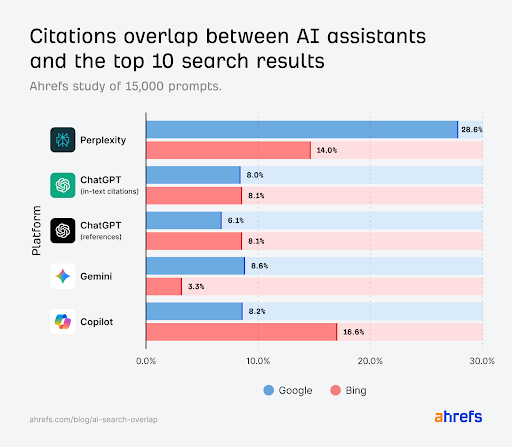
Source: Ahrefs
Why does this happen? To answer this question, we need to understand how AI answers work in the first place. Of course, it’s quite a technical process, but if we simplify it, it comes down to the following 3 steps:
- Query analysis. First, AI tries to understand what a user actually needs (i.e., the search intent). Based on this, it will start looking for the necessary information both online and within its internal knowledge.
- Retrieval and extraction. This is the process where AI starts to collect all the potential sources and extract some of the passages and other information to form an answer.
- Answer delivery and citation. Here, AI takes all the information it got and creates the actual response (usually by writing its own answer instead of copy-pasting someone else’s). Then, it cites some of the major sources it used.
SEO vs. GEO: Similarities and Differences
While AI adoption is huge these days, and we often hear that AI can replace humans in many areas, GEO isn’t here to replace traditional SEO. At least, not yet. Instead, you need to use both for your visibility.
So, how are generative SEO and organic search engine optimization different?
There are several distinctions in the primary goals, tactics, user interactions, and metrics you measure. Here is a quick visual comparison:
| GEO | SEO | |
| Main goal | Get cited in AI Overviews and LLMs (ChatGPT, Gemini, etc.) | Get higher rankings in traditional search engines |
| Your focus | Become a trusted source in your niche | Rank particular keywords in your niche |
| Major tactics | Improve brand exposure, structure content properly, boost your trust | Optimize for keywords, work on domain authority, get backlinks |
| Metrics to track | AI citations, brand mentions | Organic traffic, CTR, rankings |
| User interaction | Users often get the answer directly and may see your brand without clicking | User clicks the link to get the information from your web page |
Still, SEO and GEO also have several things in common, as both:
- Require quality content and good structure.
- Need backlinks from relevant websites.
- Rely on topical authority and the overall credibility.
- Are long-term metrics that take time to deliver tangible results.
Now, the most important question: do you need both SEO and GEO? Absolutely!
6 Proven GEO Tactics to Get Cited by AI
Many websites aren’t ready for AI search results. That’s true. But it’s also quite easy to fix when you know what you’re doing. So, how do you optimize for generative SEO? These are our tested strategies that will improve your AI citation.
1. Make Your Brand More Visible Online
Today, the mentions your business gets matter more than ever. Of course, strategies for building quality backlinks have existed for a long time. But with the current GEO era, you have to pay special attention to your visibility.
AI models rely on your brand references as one of the major trust signals. And often, your business will appear in AI Overviews or ChatGPT thanks to a mention on Reddit, Quora, G2, YouTube, etc. What’s more, to get cited, even an unlinked name drop can work.

Source: SurferSEO
That’s exactly why you should prioritize the following:
- Creating company profiles on review platforms. Whether it’s G2, Trustradius, Capterra, or Clutch, all of these can help you get more reviews and, therefore, visibility.
- Building more backlinks from relevant websites. You can gain these by writing guest posts, doing PR, getting niche edits, partnering with other businesses in your niche, etc.
- Having active social media accounts. This gives you more exposure and more opportunities to get your content shared further.
- Being present on forums. Managing your communities on Reddit, Quora, and other forums will help you get cited in generative search. It works because these are popular AI sources to get more realistic reviews and suggestions.
- Try getting on “X best/top…” lists. ChatGPT and other LLMs often rely on these lists to select the best options to recommend. So, work on getting mentioned in these.
2. Build Your Trustworthiness
Since your main goal for generative engine optimization is to become a source for AI, you have to make sure that LLMs can trust you. While trust sounds too broad and is generally hard to measure, there are some very particular things you can do to improve it:
- Make it clear what you do all over the internet. If you’re an SEO agency, that’s what you should be everywhere. You can’t be a link-building company on one website, a technical optimization service on another, and a content marketing platform somewhere else.
- Work on your industry leadership. You have to make sure that your name means something in your niche. For this, write expert content, attend industry conferences, collaborate with others, do quality content marketing, etc.
- Only gain and mention trusted links. When getting backlinks, you have to make sure the referring domains can be trusted. The same goes for the outbound links you add to your website. So, when it comes to backlink building and your write for us strategy, be selective and, if needed, use AI SEO tools to assess potential web pages.
- Write trustworthy content. It might be tough for AI models to understand whether your blog posts are credible. So, it’s important you reference well-known sources, add author bio (preferably with links to socials), use research and data to prove your points, add real-life examples, etc.

3. Structure Your Content for AI
In order for AI models to use your content, it needs to have a proper structure. Otherwise, it will be impossible for them to retrieve the data. What does “proper structure” mean, though? Overall, it comes down to the following:
- Use subheadings (H2, H3, H4). These are important to help both readers and LLMs navigate through your content and understand its scope faster.
- Add bullet points and numbered lists. It’s a very simple touch that makes your copy much more digestible.
- Write in short, clear sentences. The more fluffy your copy gets, the harder it is to get cited by AI. So, always check your readability with Hemingway or any other similar tool.
- Give direct answers. If your H2 is “What is keto diet?” Your answer should be very direct: “Keto diet is…” And only after can you add any additional details you want.
- Add small summaries throughout the content. A really good practice is to add TL;DR, key insights, etc., in your articles (especially when they’re long).
- Use FAQs. Direct and easy-to-follow FAQ sections help LLMs get the necessary information from your website. But only add these when they actually offer more context.

4. Use Schema Markup
Schema markup is structured data that helps AI models (and traditional search bots, for that matter) understand your content.
Besides, it can also help you get rich results, which often improve CTR thanks to the additional information displayed in SERPs (like reviews, prices, address, images, etc.). While it’s optional, it can be really helpful to add context and clarity to your content.

Source: Ahrefs
5. Write Deeper Content
You can’t possibly expect to create some low-quality articles that have no real value and get cited with that content. If you want your generative SEO to work, you need to work on the depth of what you publish. Why does this matter?
You see, to give better answers, LLMs typically use a query fan-out approach. This means analyzing several related searches instead of just one. By doing this, they can give users a more detailed response.

Source: Semrush
That’s exactly why when your articles address several questions related to your topic, you get more chances of getting cited. The easiest way to start is by:
- Addressing your topic from different angles.
- Aiming for longer pieces (500 words can’t be enough to cover any topic well).
- Adding your personal experience and new perspectives.
- Supporting your copy with relevant visuals.
- Trying to write fuller and deeper articles than what’s already out there.
6. Make Sure Your Traditional SEO Is on Point
Even if you hire a specialized GEO agency, they will likely tell you to fix your SEO first. And this can be quite surprising to many. But you already know the real difference between the two, so it shouldn’t be that shocking for you.
Reality is this: you can optimize for AI search as much as you wish, but if these SEO basics are off, your results will be far from perfect:
- Clear website structure (yes, AI loves structure)
- Indexability and crawlability (your content has to be available to rank or be cited)
- On-page optimization (all the meta tags still matter)
- Page speed and Core Web Vitals (your website can’t take forever to load)
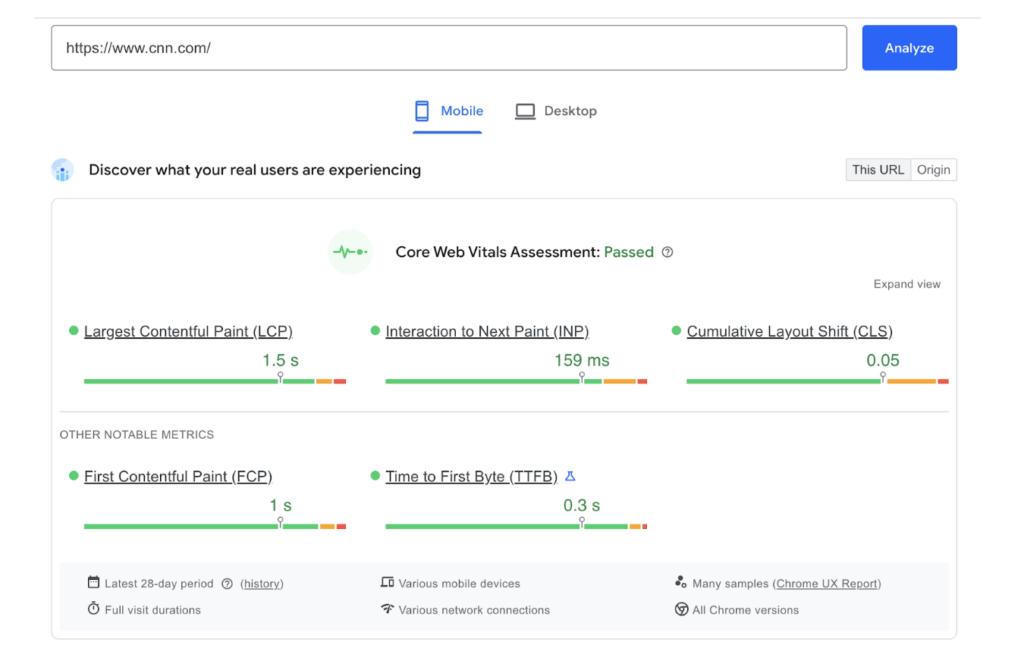
Source: PageSpeed Insights
FAQ
What is the difference between GEO and traditional SEO?
The main difference is that GEO is focused on optimizing for AI citations while SEO is all about getting ranked in the top 10 search results.
Will GEO replace SEO?
No, at least not in the near future. While GEO tactics are different from the usual SEO, traditional optimization is still a foundation of GEO.
Why is GEO important in SEO?
Doing SEO today without accounting for GEO makes no sense because generative search is getting more and more popular. So, to remain visible online, you have to get your brand and content cited in AI.
Conclusion
Now, you know that SEO vs. GEO “combat” isn’t about who wins. It’s about using both to get the best results and rank in both traditional and generative search engines. Simply start by making sure your good old SEO is doing well, and then gradually layer in all the GEO tactics we’ve seen today.
digitalagencynetwork.com (Article Sourced Website)
#Cited #GEO #Tactics #Generative #Search #Era