
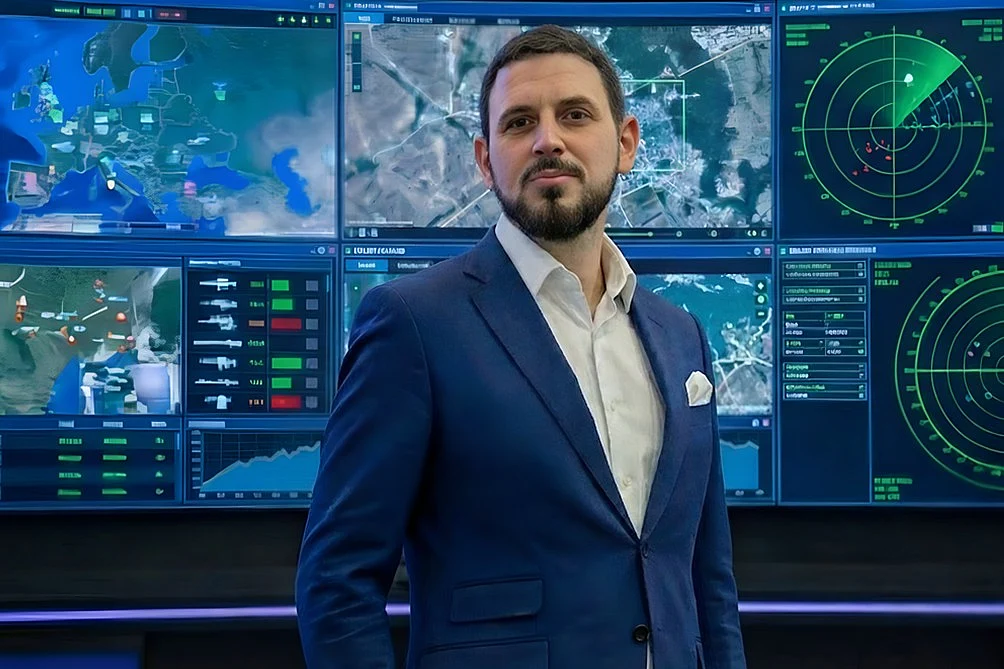
Connecting fragmented information to support faster, informed responses
The mosaic behind modern decision making
Public safety and government decision making are entering a quiet but important transition, and it can be explained with a simple image. Imagine standing in the middle of a crowded room where everyone is speaking at once. The information is there, but it arrives as noise. Now imagine taking small fragments from that noise and assembling them into a clear picture, a mosaic that reveals what matters. That is the challenge modern governments face, and it is the idea that led to the creation of RAKIA Group.
Today, government organisations and agencies are surrounded by data. Sensor feeds, operational systems, maritime and aviation data, financial records, cyber signals, open information, and internal databases generate constant streams of input. Individually, most of these signals mean very little. Together, when connected correctly, they can save lives, prevent harm, and support faster, more accurate decisions. The difficulty is not data availability. It is turning scattered pieces into a real time mosaic that humans can understand and act upon.
Built in Dubai with a global vision
RAKIA Group was founded in Dubai with this exact problem in mind. It is not a security technology company in the traditional sense. RAKIA is an AI data fusion company focused on helping government organisations and agencies connect lawful data into real time operational clarity. What began only a few years ago as an AI and fusion startup has grown into a global provider of data fusion solutions supporting tens of countries across the GCC, the Middle East, and other regions worldwide.
The company’s roots are closely tied to Dubai’s evolution as a centre for advanced technology. Over the past decade, the city has moved beyond being a regional business hub and has become a place where ambitious technology companies are built with global intent. RAKIA was among the first AI driven startups in Dubai to focus specifically on large scale data fusion for government use, at a time when the concept was still poorly understood outside specialist circles.
From data overload to human readable insight
From the beginning, RAKIA made a deliberate choice. It would not compete on who could collect more data. Instead, it would focus on making existing data useful. Its platforms are designed to integrate legally permitted data sources across land, air, maritime, cyber, financial, and open-source domains, and align them into a single, continuously updated operational picture.
RAKIA takes fragmented data in real time and builds a human readable mosaic that helps governments see risk earlier and protect lives. Small anomalies that would normally be ignored can, when fused with weak signals from other systems, reveal emerging threats or operational opportunities. This ability to connect the dots early allows agencies to move from reaction to prevention.
Many government organisations face the same paradox. They have invested heavily in digital systems, yet critical information remains fragmented. Data sits in silos, arrives too late, or lacks the context required for action. RAKIA’s fusion approach addresses this gap by assembling disconnected particles of data into a live, evolving picture that reflects reality as it unfolds.
Designed for a hybrid world
Modern challenges rarely fit into a single category. A single situation may involve physical movement, digital coordination, financial activity, regulatory data, and public information all at once. Treating each domain separately creates blind spots. RAKIA’s fusion environments are built to remove those blind spots by revealing relationships across systems, agencies, and jurisdictions.
Artificial intelligence plays a supporting role in this process. It is used to prioritise, correlate, and highlight connections at a scale no human team could manage alone. It does not replace judgment or decision making. Analysts, operators, and officials remain responsible for interpretation and action. This human centred design reflects the reality that public missions demand accountability, transparency, and trust.
Governance is not an afterthought. Legal authority, auditability, and human oversight are treated as foundational elements of the system. This approach has helped RAKIA gain trust in environments where legitimacy is as important as speed, and where technology must operate within clear boundaries.

The founder behind the vision
Behind this approach is the company’s founder and CEO, Omri Raiter, a Romanian national who came to live in the UAE from Cyprus years ago and became part of the country’s growing technology ecosystem at an early stage. A successful entrepreneur that brings more than 18 years of experience across artificial intelligence, BigData, cyber security, and Cyber Threat Intelligence.
Widely recognised as a leading expert in the field, his background spans operational intelligence environments, large scale analytical systems, and real-world decision making under pressure. That experience shaped RAKIA’s philosophy from day one, with a focus on systems that support human judgment, accountability, and trust.
From Dubai to Washington DC
In just three years, RAKIA has grown from a Dubai based startup into a world known leader in AI data fusion for government organisations. Its solutions are now used to support public safety, national resilience, and operational coordination across multiple regions. While specific deployments are often confidential, the scale of adoption reflects a broader shift in how governments approach complexity.
In 2024, RAKIA expanded its operations to the United States, opening offices in Washington DC. The move marked the beginning of its active presence in one of the most demanding government technology markets in the world. Establishing a base in Washington placed the company close to federal agencies, policy makers, and institutional partners, while demonstrating confidence in its governance first approach.
The expansion into the United States did not change RAKIA’s direction. It reinforced it. Real time fusion, responsible use of AI, and human accountability remain central to its work. These principles are not regional preferences. They are global requirements for any solution designed to support government decision making at scale.
More power to protect
RAKIA’s story also reflects a broader narrative about innovation in the Gulf. Being proud of its origins is part of the company’s identity. From Dubai, RAKIA has shown that advanced AI data fusion platforms can be built locally and deployed globally, and that a startup can become a leader in its industry within a short time by staying focused on real problems rather than trends.
At the heart of the company’s mission is a simple idea: RAKIA – More power to protect. Not through excess data or intrusive systems, but through clarity. By turning noise into a mosaic in real time, RAKIA helps governments act earlier, coordinate better, and protect human life and public safety more effectively.
As complexity continues to grow, the demand for intelligent data fusion will only increase. RAKIA’s rise from one of Dubai’s first AI startups to a global leader in government data fusion is not driven by hype. It is driven by experience, discipline, and a clear understanding of how modern public missions truly work, and by the belief that connecting the right pieces at the right moment can make all the difference.
www.khaleejtimes.com (Article Sourced Website)
#RAKIA #Group #Turning #noise #clarity #public #safety