

PPC vs SEO: a debate that’s been around for years. Although new acronyms for search optimisation have emerged in the last couple of years, deep at the core of it we can break it down in two ways:
- Am I paying any kind of budget for my brand to appear in the search engine? If yes, then it’s PPC.
- Am I creating content for my brand to appear free of charge in the search engine? If yes, then we’re talking SEO.
So how is the PPC vs. SEO debate still relevant going into 2026? Here we deep dive into the channels to try and answer the question.
What remains true in 2026?
PPC remains the fastest way to generate traffic and conversions. It offers immediate visibility and the ability to target users with very high intent.
With the integration of AI in Search and Social platforms, more complex and powerful ad delivery systems are released: Smart Bidding is becoming more sophisticated, accurate audience signals are deployed in campaigns, as well as creative automation, all giving businesses powerful tools to scale.
SEO, on the other hand, continues to shine as a long-term investment. Organic traffic remains one of the most cost-efficient acquisition channels. It builds trust, strengthens brand credibility and supports the entire customer journey from discovery to conversion.
So, which channel delivers the best ROI?
As a short answer, PPC remains the fastest way to start and scale. For businesses launching new products or needing quick traction, PPC is the most reliable path.
Over the long term however, SEO usually delivers a higher return. Once initial investment is made, the cost per acquisition drops significantly, and traffic continues to grow without paying for every click. Even with the changes in search experiences, a strong SEO presence remains a competitive advantage.
However, to give the long answer, we need to break it down further.
The new Search landscape
Search engines, and mainly Google (which is still home to approximately 90% of all searches), have changed the way SERPs answer queries.
From an SEO perspective, visibility is harder to secure due to AI-generated content and constant algorithm shifts. Ranking has also become harder due to the introduction of search generative experiences that often replace traditional organic listings.
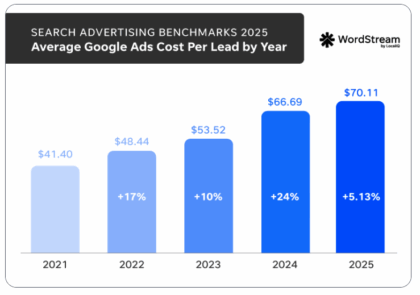
From a PPC perspective, costs are rising (with Wordstream reporting that the average Google CPC increased for 87% of industries in 2025), marketing budgets are shrinking and competition is tougher.
What drives ROI?
ROI-drivers in PPC
Now before diving into comparison, let’s identify the ROI-drivers for each channel.
A key driver for PPC is your creative strategy – and we’re not talking about having the right size images, formats and translations for ads. We’re talking about engaging, thumb-stopping creatives that feed through your entire brand strategy.
A recent media analysis found that 52% of ad spend is deployed on low and medium-quality creatives, which means standing out from the crowd is still possible despite the rising competition.
A curated creative strategy improves relevance and increases click-through rates, hence improving your cost-per-click and ultimately driving a stronger overall ROI.
Next comes your landing pages and the crucial role of a well-designed user experience. The ad is only the doorway, but conversions rely on a good landing page. Without a high-converting design and easy-to-navigate forms, even the most compelling ads can fall flat. It’s about creating a seamless journey from ad to action.
Then we have your first party data. From customer lists that provide better audience segmentations, personalised messaging and dynamic retargeting, to feeding back your offline conversions into your ad accounts, first-party data significantly enhances the relevance and effectiveness of your paid ads. It helps you optimise targeting signals and improve your bids, eventually leading to higher engagement, higher conversion rates and ultimately a higher ROI.
ROI-drivers in SEO
When it comes to SEO, and the rise of AI generated answers in the SERP, two key things remain relevant for investment.
First is your Content Strategy. Whether you’re optimising for search engines or LLMs, content remains essential for driving ROI. It helps build the relevance, authority and trust that search engines reward.
High-quality content answers real user questions and demonstrates expertise, making your brand discoverable via Search Engines or LLMs, which then translates into capturing qualified traffic and converting that traffic into long-term revenue.
Second is your PR Strategy. High-quality outreach targets the right publications, offers genuine value and secures mentions that actually matter for authority. It constitutes the backbone of your backlink profile and directly contributes to sustainable SEO ROI.
The complexities of attribution
So assume we work on improving all the elements stated above. You then look at the data, decide which channel brings higher ROI and invest more in it. Easy, right?
Not quite. Not when attribution is becoming increasingly hard to measure with depreciating third-party cookies, lack of cross-device tracking and privacy rules that make tracking inconsistent or incomplete.
In fact, even the most sophisticated data-driven attribution model is not an ultimate truth that accurately suggests where a click or a conversion has come from. It is a model based on statistical predictions.
Plus attribution often ignores what happens after a conversion, and this is particularly true for B2B lead generation. If you’re not harnessing your first-party data, attribution fails to give you the real picture of what is driving value.
Don’t get me wrong, data and attribution is very important, but we need to shift our mindset – rather than trying to pin down which channel to thank, we should be asking “how did the conversion happen?”
Observing user journeys, looking at patterns over time and understanding how combinations of exposure (ads, content, retargeting, organic search, reviews, UX, social proof, timing etc.) all interlock to build trust and lead to conversions.
The complex user journey
The user journey has become far more complex and fragmented. People move fluidly across channels, devices and offline touch points, leaving behind fewer clear signals and making attribution harder.
A single acquisition path can span social platforms, search, messaging apps, physical stores and word-of-mouth, with no linear sequence to track.
At the same time, user expectations have shifted. Users are now looking for meaningful value, useful information, trustworthy experiences and interactions that feel coherent across channels.
This shift raises the bar for brands; requiring deeper understanding, consistent storytelling and an experience that supports users on whichever channel they decide to engage with.
Choosing the right mix of channels for your brand
The truth is that the strongest ROI rarely comes from choosing between PPC and SEO. It comes from integrating them.
When both channels work together, they amplify each other’s strengths. A unified approach is the way to go.

A well-integrated approach typically starts with PPC providing fast results and valuable keyword data. SEO then builds authority around the highest-intent topics. Landing pages are improved based on insights from both channels which lifts performance across the board. Over time, PPC is used more strategically to support key campaigns, protect branded terms and accelerate demand when needed, whist SEO becomes the primary driver of cost-efficient growth.
In conclusion, there is no single winner in the PPC vs SEO debate. Maximising ROI will often require activating both channels coupled with strong measurement, clean conversion data, consistent testing and high-quality content.
If you want to understand how to make the best out of your Search strategy, get in touch.
The post PPC vs SEO: Which channel delivers the best ROI in 2026? appeared first on Hallam.
hallam.agency (Article Sourced Website)
#PPC #SEO #channel #delivers #ROI