
Jury trials, Rayner’s return, an early election, second-choice parties, and the leaders at Christmas
My last poll of 2026 asks what voters make of government plans to restrict trial by jury, how they view the prospect of Angela Rayner returning to the Cabinet, whether they will have more or less to spend this year on festive celebration, the most important issues facing the country, whether they want an early election, and which party different kinds of voters see as their second choice – as well as our regular political trackers.
The leaders at Christmas
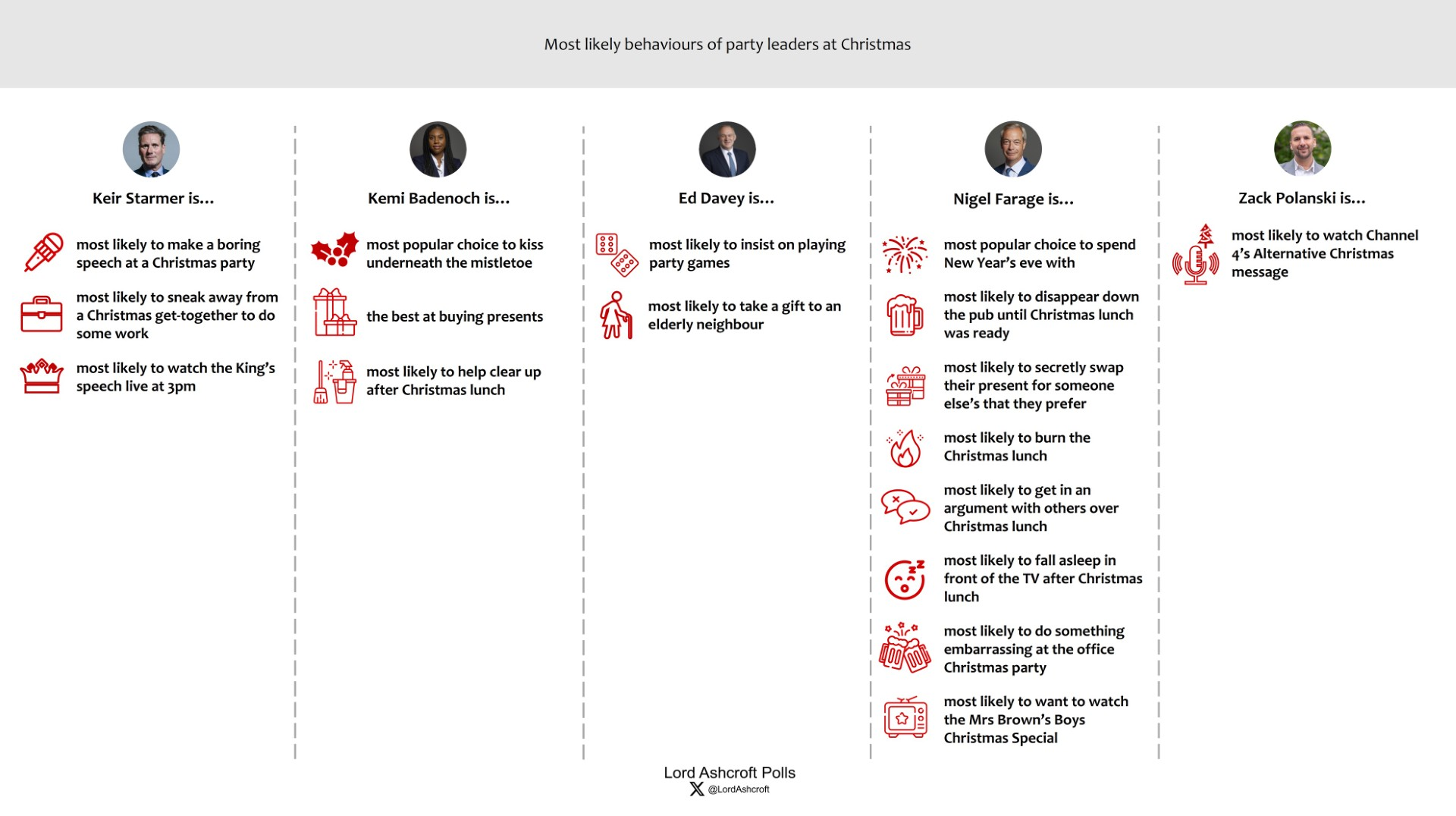
In a deceptively festive but in fact strategically critical question, we found that Keir Starmer was thought the leader most likely to make a boring speech at a Christmas party, sneak off from a Christmas get-together to do some work, and watch the King’s Christmas broadcast live at 3pm on Christmas Day.
Kemi Badenoch would be best at buying Christmas presents, would be the most likely to help clear up after Christmas lunch, and was the leader voters would like to kiss or be kissed by under the mistletoe. Ed Davey was thought the most likely to take a Christmas gift to an elderly neighbour, and to insist on playing party games. Zack Polanski was thought the most likely to watch the Channel 4 Alternative Christmas Message.
Nigel Farage was thought the most likely to disappear down the pub until Christmas lunch was ready. burn the lunch, get into an argument with someone over lunch, fall asleep in front of the TV after lunch, secretly try to swap their present for someone else’s that they preferred, watch the Mrs Brown’s Boys Christmas Special, and do something embarrassing at the office Christmas party. He was also the leader voters would most like to spend New Year’s Eve with (Zack Polanski coming a close second).
What have people noticed – and who has noticed what?

The Budget dominated people’s recollections of recent political news, especially when combined with stories about Rachel Reeves allegedly making misleading statements about the state of the public finances. Doctors’ strikes were the second most likely to be mentioned. The Bondi Beach shootings occurred midway through fieldwork, hence their relatively low position on the list.
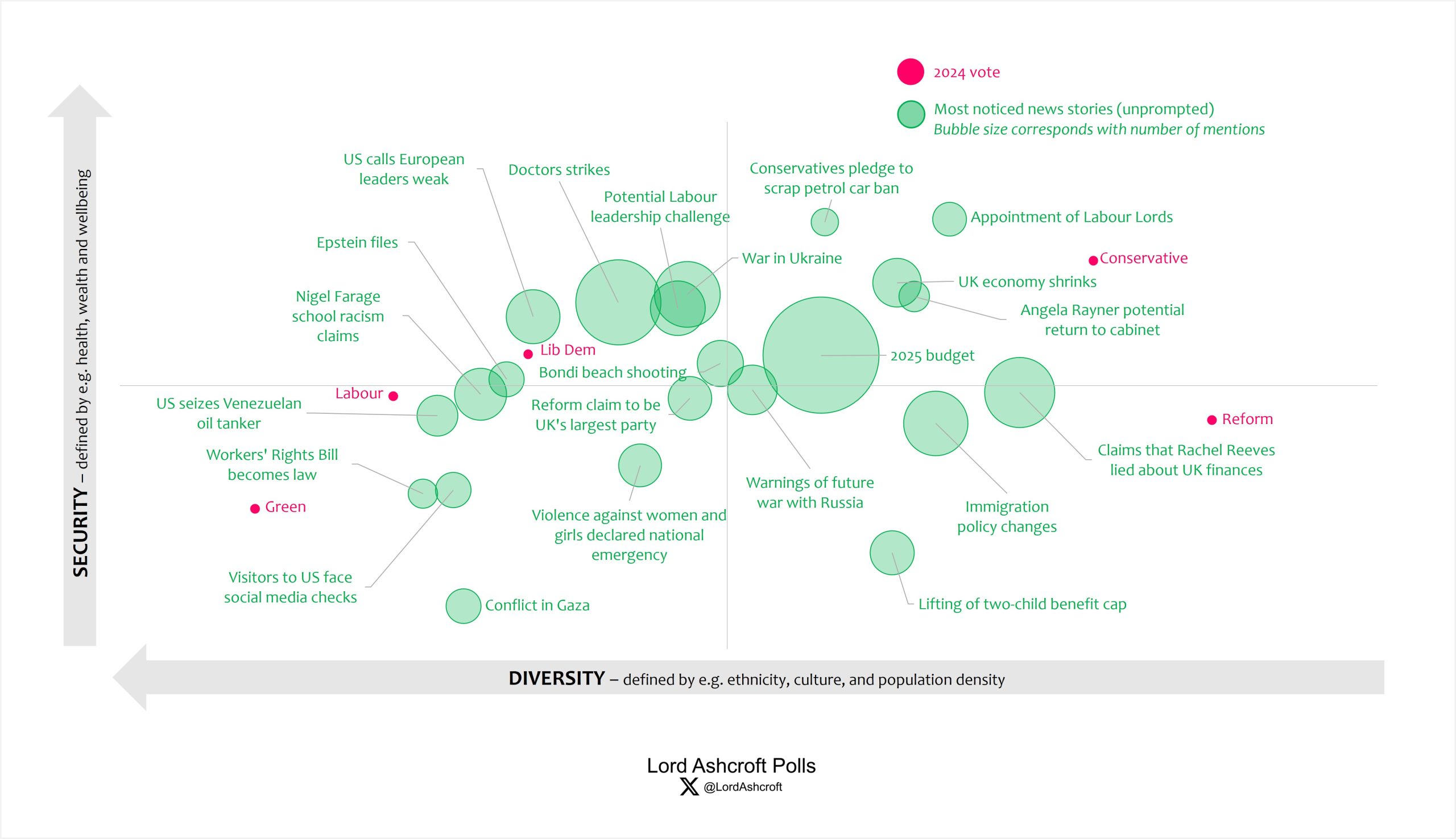
Our political map shows what kind of voters were most likely to recall which news. Stories about the Budget appear close to the centre, suggesting it was not confined to any one part of the electorate, while claims about Rachel Reeves misleading the public and stories about a shrinking economy were more likely to have been noticed in Conservative and Reform-leaning territory, while news about doctors’ strikes and workers’ rights were most likely to have been recalled in left-leaning parts of the map. Stories about Angela Rayner’s possible return to the cabinet were most likely to have been noticed on the right, while those about Nigel Farage at school were more likely to be mentioned on the left.
What has the Labour government done?

For the first time, means-testing the winter fuel allowance has been toppled as the Labour government’s most recalled action. This month, lifting the two-child benefit cap tops the list, with tax rises also occupying two of the top five positions, along with failing to reduce illegal migration.
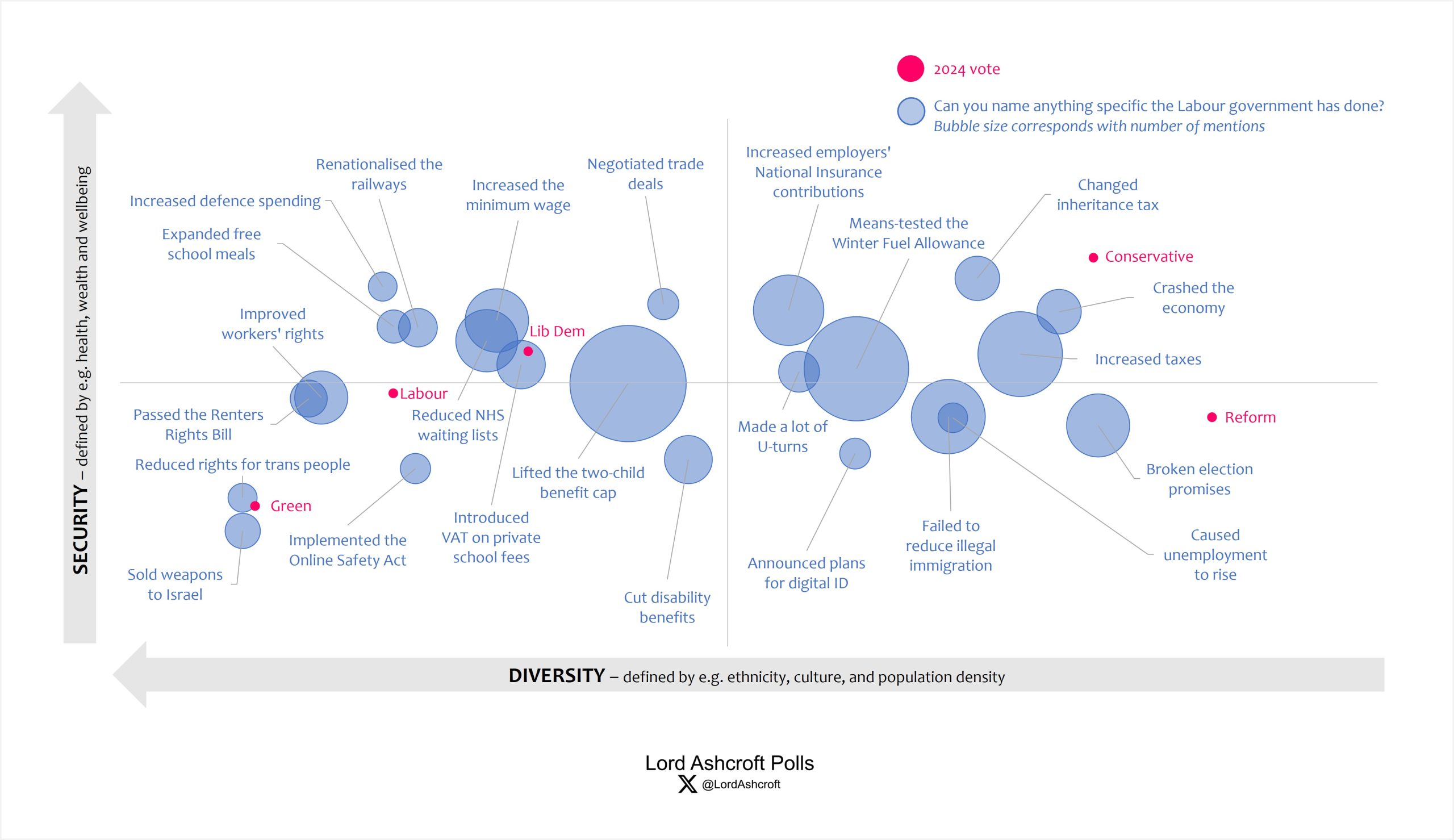
Lifting the two-child benefit cap appears close to the centre, but slightly towards Labour and Lib Dem-leaning territory. Winter fuel, tax rises, digital ID, U-turns and failures on illegal migration were more likely to be recalled in right-leaning parts of the map, while actions including raising the minimum wage, the Online Safety Act, raising defence spending and expanding free school meals were most likely to be mentioned in Labour and Lib Dem-leaning territory.
Jury trials

Six in ten agreed that judges sitting alone would allow courts to get through trials more quickly. However, only just over one in ten thought such trials would be more likely to deliver fair verdicts; a majority thought jury trials were more likely to do so. There was little variation between supporters of different parties.
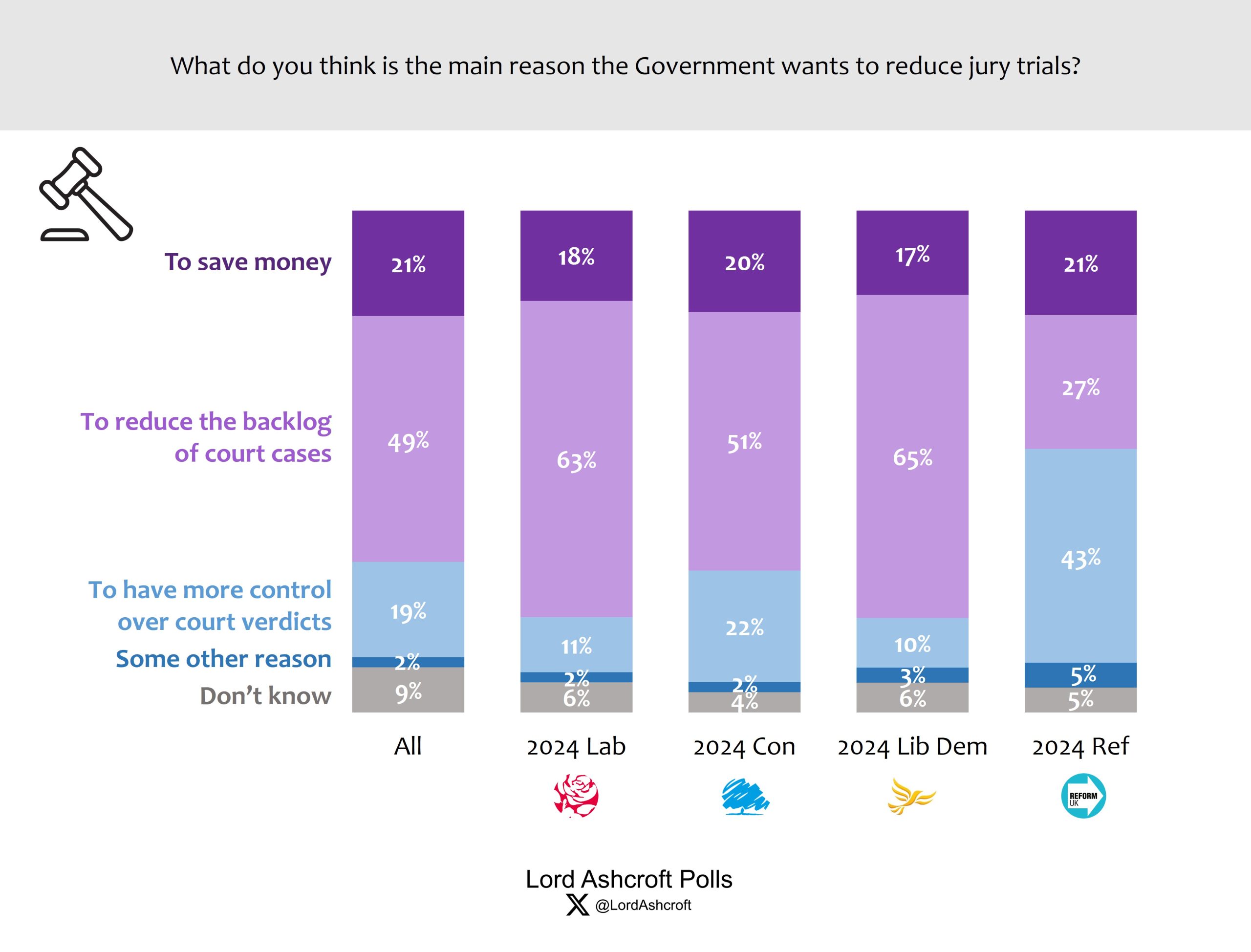
Just under half thought the government wanted to restrict the use of jury trials for its stated reason of reducing the backlog of court cases. Just over one fifth thought the aim was to save money, while almost as many thought the motive was to have more control over court verdicts. In a separate question, a clear majority, including majorities of all parties’ voters, said that if they were charged with a crime they would want the verdict to be decided by a jury. Fewer than one in five said they would rather the decision was made by a judge.
Most important issues
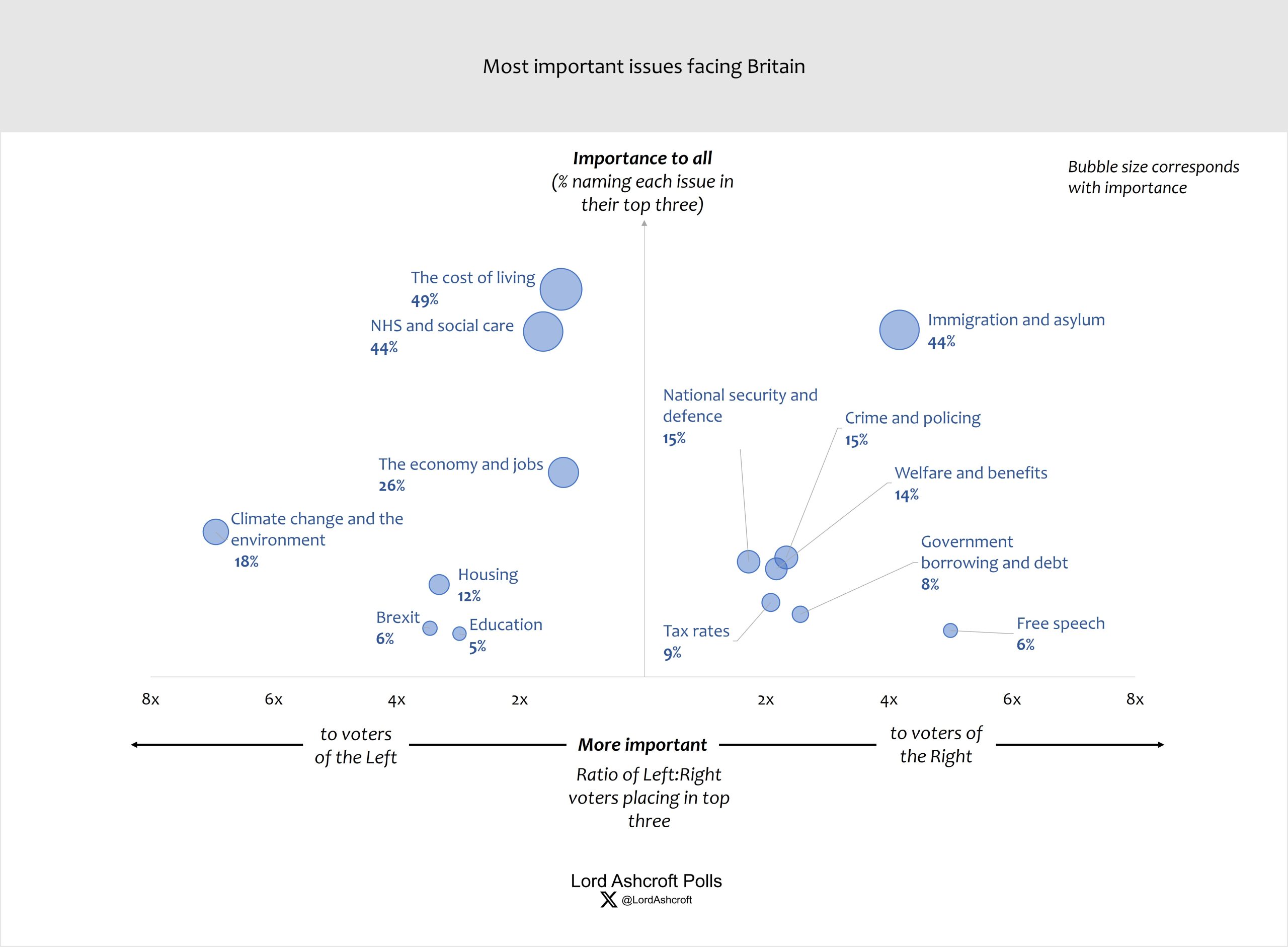
The cost of living is seen as the biggest issue facing the country, named in the top 3 by just under half of all voters. Joint second were the NHS and social care, tied with immigration and asylum – though there were sharp differences between Labour and Lib Dem voters and Conservative and Reform voters.
Christmas spending and trust on the economy
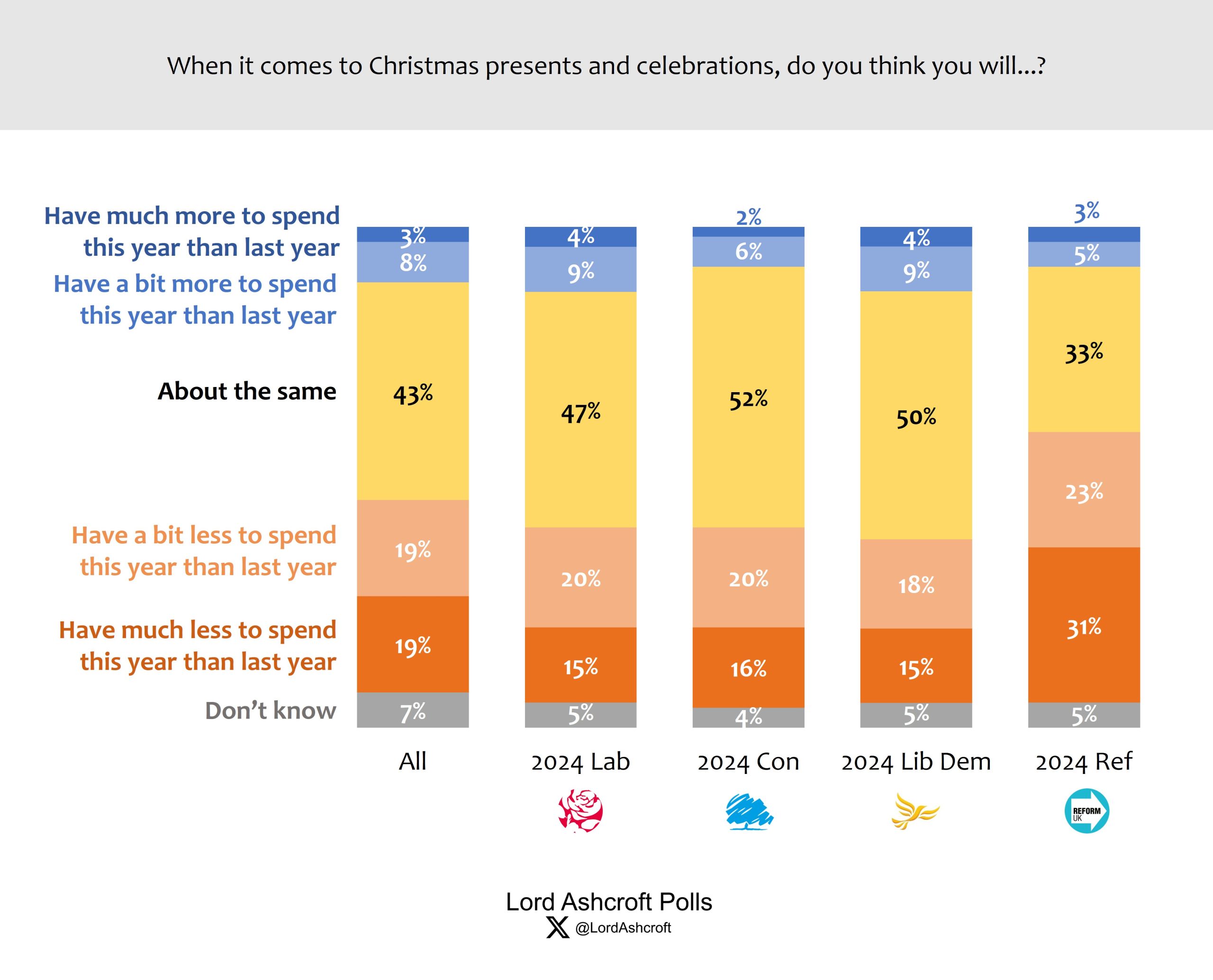
Voters as a whole were more than three times as likely to say they would have less to spend on Christmas than they did last year than that they would have more. Just under half said they would have about the same. Looked at another way, 54 per cent said they would have the same or more; 81 per cent said they would have the same or less.
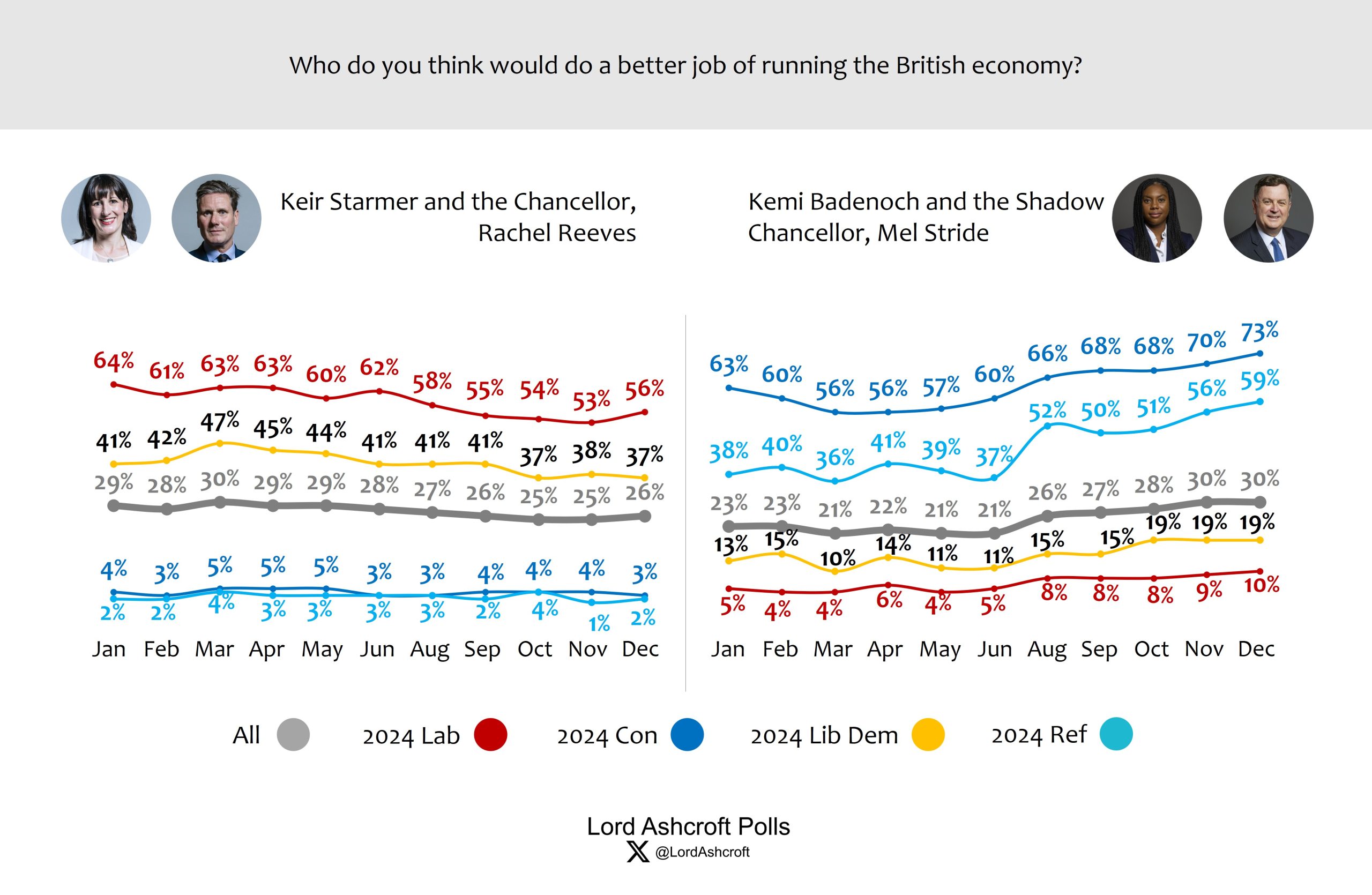
Asked who would do the better job running the economy, voters chose Kemi Badenoch and Mel Stride over Keir Starmer and Rachel Reeves by a four-point margin, with 44 per cent saying “don’t know”. Only just over half of 2024 Labour voters named the Labour team; nearly three quarters of 2024 Conservatives chose the Tory team.
Angela Rayner

Only just over a quarter – including only just over half of 2024 Labour voters – said it would be acceptable for Angela Rayner to return to the Cabinet. A majority said it would be unacceptable.
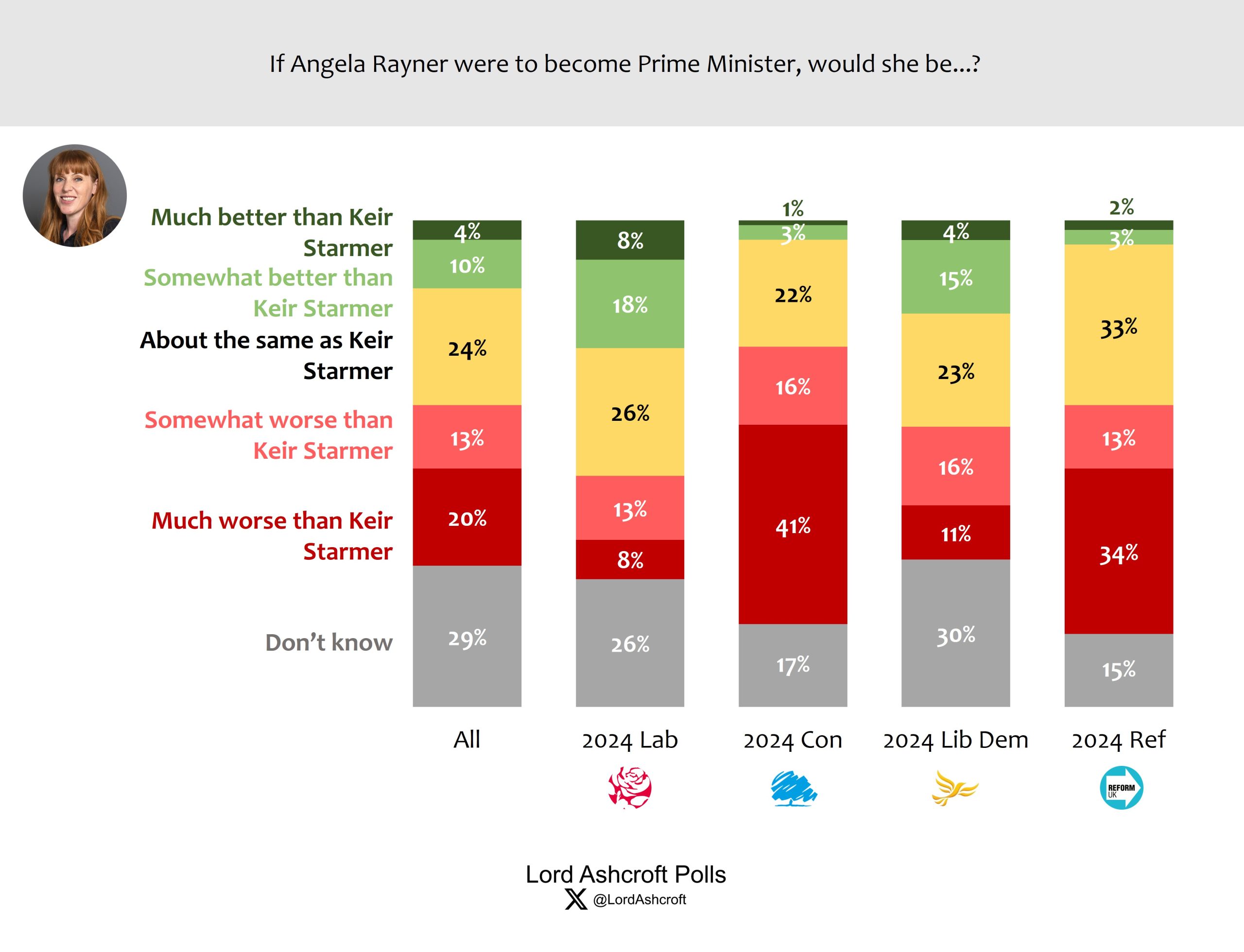
Overall, voters were more likely to think Angela Rayner would be a worse PM than Keir Starmer (33 per cent) than a better one (14 per cent). 2024 Green voters were the only group to think by a clear margin that Rayner would be better. Those currently intending to vote Labour were slightly more likely to think Rayner would be better (25 per cent) than worse (21 per cent).
Party leaders and best prime minister

The proportion thinking Kemi Badenoch will still be in her job in a year’s time is up ten points since we last asked the question in October, to 34 per cent. The number saying the same for Starmer is down five points to 21 per cent (including only just over one third of 2024 Labour voters), and the proportion expecting Farage still to be leading Reform is down seven points to 58 per cent. While only one third say they expect Zack Polanski still to be leading the Greens, more than half say they don’t know enough to form an opinion.

Given a choice between Starmer and Badenoch, voters overall say Starmer would make the better prime minister by a two-point margin. Those who voted Reform UK in 2024 said they preferred Badenoch to Starmer by 59 per cent to three per cent. Given a choice between Starmer and Farage, voters as a whole chose Starmer by a 12-point margin.
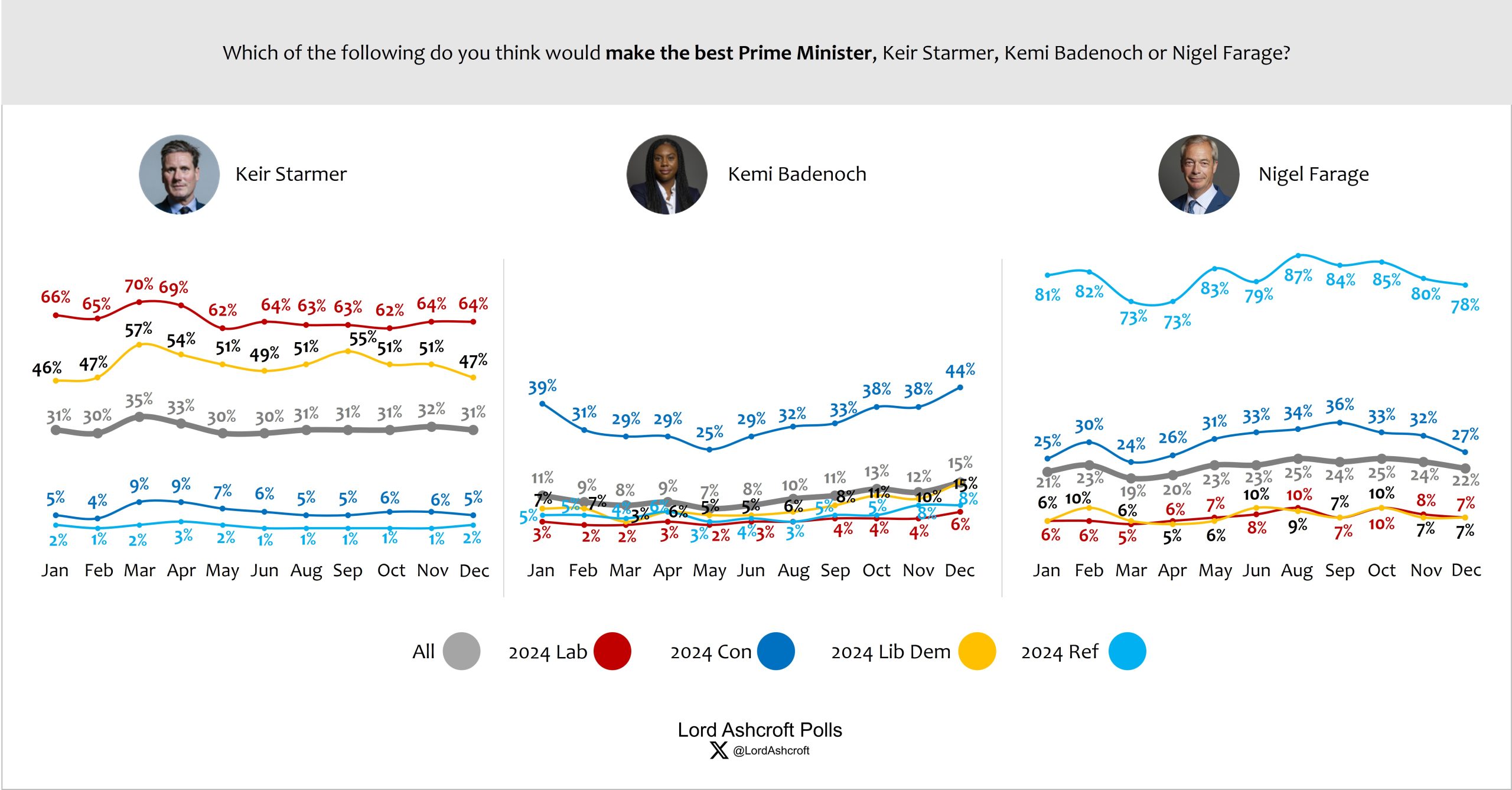
Offered a choice between Starmer, Badenoch and Farage, voters chose Starmer over Farage by an nine-point margin, with Badenoch in third place on 15 per cent. 2024 Conservative voters preferred Badenoch over Farage by a 17-point margin (up from 6 points last month), and 2024 Labour voters preferred Starmer over Farage by 64 per cent to seven per cent.
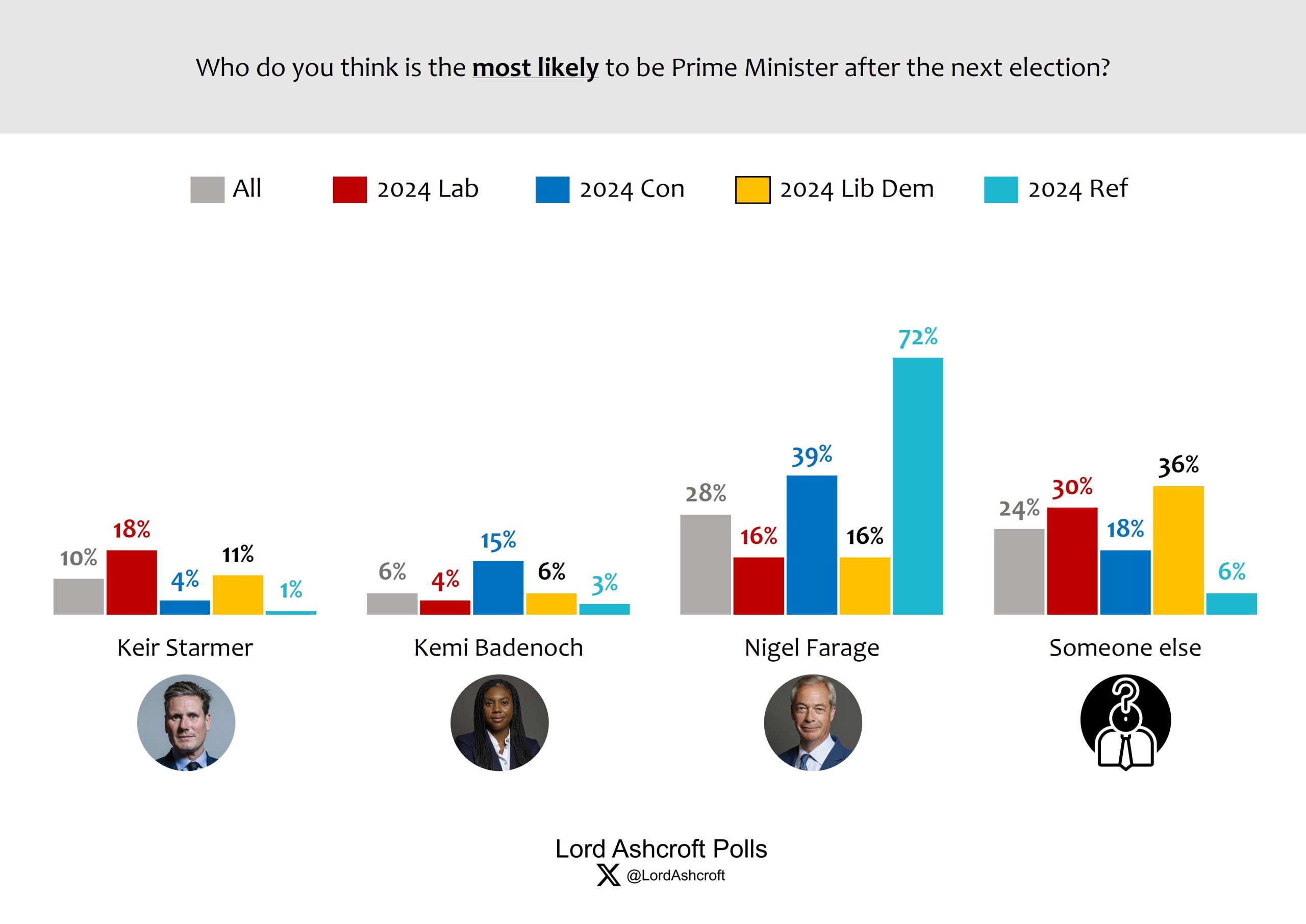
Nigel Farage was thought the most likely person to be prime minister after the next election, with 28 per cent naming him as the most likely candidate (down from 34 per cent in October). Only one in ten thought Starmer would still be in the job and six per cent named Badenoch. Nearly a quarter thought someone else would be prime minister. More than three quarters of those currently intending to vote Reform thought Farage would be prime minister, compared to just over one third of current Labour leaners who thought Starmer would be prime minister and just under a quarter of current Conservative supporters who thought Badenoch would have the job.
The next election and the next government

Nearly four in ten voters said they would like to see a general election in 2026, including majorities of Conservative and Reform voters. The next biggest bloc wanted to wait for the government to complete a 5-year term in 2029 – especially those currently intending to vote Labour, Lib Dem or Green.
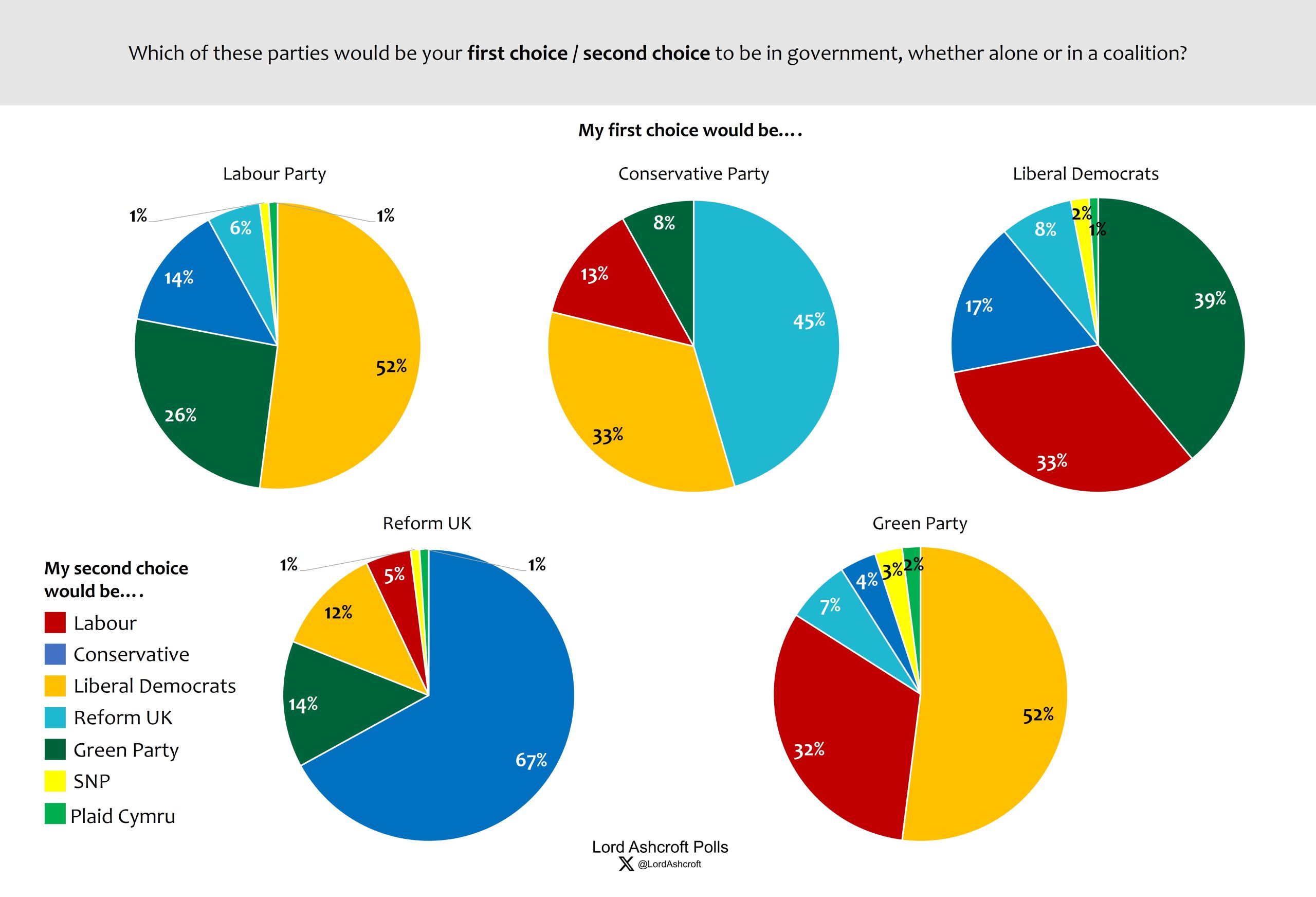
We asked respondents which party they would most like to see in government, whether alone or in coalition, and then which party would be their second choice. While two third of those who named Reform as their first-choice governing party named the Conservatives as their second choice, only 45 per cent of Conservative ‘choosers’ named Reform; one in three said the Lib Dems would be their second choice.
Those naming Labour, the Greens, the Lib Dems and the nationalist parties overwhelmingly had a party of the left as their second preference. Two thirds of Reform choosers stayed right, naming the Conservatives. For Conservative choosers, Reform was the biggest second preference (45 per cent), but a majority named their second choice as either Labour, the Lib Dems or the Greens.

This analysis shows some of the differences in attitude between these different groups of Conservative and Reform-leaning voters: those who put each others’ partiers as their second choice, and those whose second choice is a party of the left (Labour, Lib Dem, Green, SNP or PC). We can see that
Tory-inclined voters whose second choice of government would be a party of the left dislike Nigel Farage more than Tory-inclined voters whose second choice would be Reform. They are also more optimistic about the country’s future and it’s (even) more important to them that the Tories have changed since the last election. In policy terms they are even more serious about austerity (including benefit cuts to boost defence spending), are mildly less anti-immigration and mildly more in favour of better relations with the EU as opposed to the US, than those whose second choice would be Reform. These voters are also less attracted to a coalition government.
Reform-inclined voters whose second choice would not be the Tories like Nigel Farage more than Reform inclined supporters who would switch to the Conservatives. Reform-leaners whose second choice would be a party of the left are noticeably more inclined to question who benefits from austerity, and dislike the idea of welfare spending cuts to boost defence spending and the idea of paying for tax cuts by controlling public spending. They are even more inclined than other Reform voters to think that the Conservatives haven’t learned from their defeat.
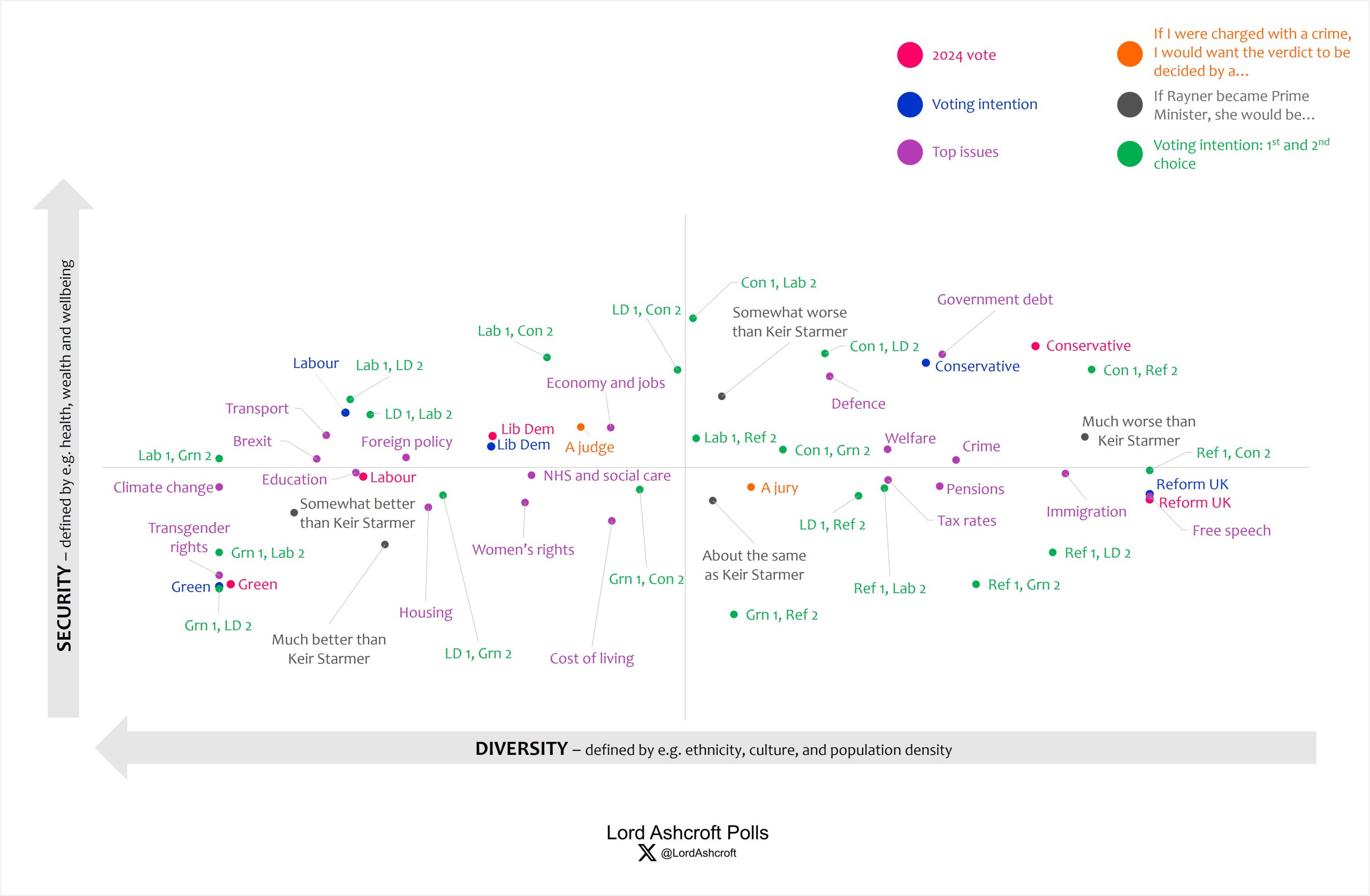
As above, our political map shows how different issues, attributes, personalities and opinions interact with one another. Each point shows where we are most likely to find people with that characteristic or opinion; the closer the plot points are to each other the more closely related they are. Here we can see the different policy priorities of different kinds of voters, their attitudes to jury trials and the potential return of Angela Rayner, and the distribution of voters who put different combinations of parties as their first and second choice.
When we asked how likely people were to end up voting for each party at the next election on a 100-point scale, those who voted Labour in 2024 put their chances of doing so again at the next election at an average of 44/100. Those who switched to Labour in 2024 put their chances of voting for the party again next time at 33/100, and those who switched from the Conservatives to Labour in 2024 put their chances of voting Labour again next time at an average of 27/100. Those leaning towards voting Reform or the SNP were the most intense supporters – they gave themselves a higher mean likelihood of doing so (90/100) than those leaning Conservative (86), Labour (83) or Lib Dem (82).
Looking at those more likely than not to vote for a particular party (those whose highest likelihood of voting for one party was at least 50/100), this implies current vote shares of Reform UK 25 per cent, Conservative 22 per cent, Green 19 per cent, Labour 18 per cent, Lib Dems 10 per cent, Others six per cent.
Full data at LordAshcroftPolls.com.
conservativehome.com (Article Sourced Website)
#Lord #Ashcroft #Christmas #approaches #party #leaders #coal #voters #Conservative #Home