
In the aftermath of conservative activist Charlie Kirk’s murder on September 10, his admirers were offended by online messages that denigrated him, condemned his views, and in some cases even celebrated his death. The people outraged by that commentary evidently included Nick Weems, sheriff of Perry County, Tennessee, who used the powers of his office to strike back at Kirk’s detractors.
As Reason‘s Joe Lancaster reported in October, Weems arranged the arrest of a Kirk critic, Henderson County resident Larry Bushart, on a flagrantly frivolous criminal charge. Because Bushart was unable to cover the staggering $2 million bond demanded for his release (which would have required him to “pay a bondsman at least $210,000,” Lancaster noted), he spent 37 days in jail before the district attorney for Perry County dropped the charge against him after the case drew widespread criticism.
Bushart’s arrest for constitutionally protected speech violated the First Amendment, the Foundation for Individual Rights and Expression (FIRE) argues in a federal lawsuit against Perry County, Weems, and Jason Morrow, an investigator in the sheriff’s office. The complaint, which was filed on Wednesday in the U.S. District Court for the Western District of Tennessee, says the defendants also violated the Fourth Amendment by arresting Bushart without probable cause. And because they pursued a malicious prosecution, FIRE argues, they should be liable for punitive as well as compensatory damages.
“I spent over three decades in law enforcement, and have the utmost respect for the law,” says Bushart, whose career included 19 years at the Jackson Police Department, five years at the Haywood County Sheriff’s Office, and nine years at the Tennessee Department of Correction. “But I also know my rights, and I was arrested for nothing more than refusing to be bullied into censorship.”
Weems was irked by Bushart’s response to a candlelight vigil for Kirk that was scheduled for the evening of September 20 on the lawn of the Perry County Courthouse—an event that the sheriff himself had promoted on Facebook. That day, Bushart saw a post about the vigil on the “What’s Happening, Perry County?” Facebook page. Commenting on that message, Bushart shared eight anti-Kirk memes, including one highlighting a comment that Donald Trump, then a presidential candidate, made the day after the January 2024 mass shooting at Perry High School in Iowa.
“I want to send our support and our deepest sympathies to the victims and families touched by the terrible school shooting yesterday in Perry, Iowa,” Trump said during a campaign rally in Iowa. “It’s just horrible, so surprising to see it here. But we have to get over it. We have to move forward.”
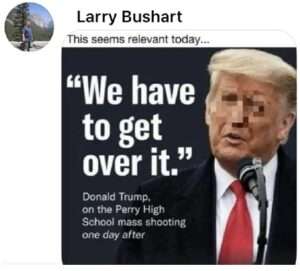
The meme that Bushart shared, which included a photo of Trump, quoted the “we have to get over it” part and noted that he was talking about “the Perry High School shooting one day after.” The message also included a comment by the original poster: “This seems relevant today…”
The widely circulated meme—which falsely implied that Trump had nonchalantly dismissed the murders in Perry, suggested that people likewise should not care about Kirk’s death, and could be read as an allusion to Kirk’s Second Amendment advocacy (a common theme of left-leaning commentary after his assassination)—was certainly insensitive and tendentious. Weems claimed it was also criminal.
How so? Under Tennessee law, “a person who recklessly, by any means of communication, threatens to commit an act of mass violence on school property or at a school-related activity commits a Class E felony,” punishable by up to six years in prison. Weems averred that Bushart had violated that law because local residents might have confused Iowa’s Perry High School with Tennessee’s Perry County High School.
“Investigators believe Bushart was fully aware of the fear his post would cause and intentionally sought to create hysteria within the community,” Weems said on September 22, the day Lexington, Tennessee, police arrested Bushart and transferred him to the sheriff’s custody. “Creating mass hysteria in our community will not be tolerated. We will continue to act quickly and decisively to protect our students and our citizens.”
The next day, Weems elaborated on his rationale for arresting Bushart in an interview with The Tennessean. Bushart meant “to indicate or make the audience think [the post] was referencing our Perry High School,” Weems said. “This led teachers, parents and students to conclude he was talking about a hypothetical shooting at our school. Numerous [people] reached out in concern.” He claimed the meme “caused considerable concern within the community, and we were asked to investigate.”
The sheriff’s assertions about the alarm supposedly generated by the meme that Bushart shared were dubious from the beginning. In response to the confusion generated by Bushart’s arrest, The Intercept‘s Liliana Segura noted in October, Weems conceded on Facebook that “we were very much aware of the meme being from an Iowa shooting.” He nevertheless insisted that the message “created mass hysteria [among] parents and teachers” because it “led the normal person to conclude that he was talking about our Perry County High School.”
Weems presented no evidence to back up those claims. “Perry County and Sheriff Weems have refused to respond to multiple public records requests seeking information pertaining to the alleged threat and the public reaction,” Bushart’s lawsuit says. And Eric Lomax, director of Perry County Schools, said he had “no records” indicating “mass hysteria” among “parents and teachers” or even “considerable concern within the community.”
The lack of evidence that anyone actually made the improbable mistake that Weems claimed would alarm “the normal person” was not the only problem with the case against Bushart. The law that Weems cited applies to someone who “recklessly…threatens to commit an act of mass violence on school property.” And under the Supreme Court’s 2023 ruling in Counterman v. Colorado, the “true threat” exception to the First Amendment requires proof that “the defendant consciously disregarded a substantial risk that his communications would be viewed as threatening violence.”
When Bushart posted the meme that offended Weems, he “did not conceive—or have any reason to think—that any person might interpret his post as a threat,” the lawsuit says. “Nor did he intend to threaten anyone or anyplace.”
Weems either did understand or willfully ignored the state of mind required by the statute and by Counterman. Bushart “admitted to making the post and advised that he was not taking it down,” the sheriff told a local TV station after the charge was dropped. “So, therefore, he was showing the intent.”
Given the manifest problems with Weems’ interpretation of the law, how did he manage to obtain a warrant for Bushart’s arrest? The lawsuit notes that the magistrate who approved the warrant was “a nonlawyer with no formal legal education.” She nevertheless might have been more skeptical if the inartfully worded affidavit that Morrow submitted in support of the warrant had not omitted an important piece of information.
Morrow noted that the Facebook post referred to “the Perry High School mass shooting,” and he asserted that it constituted “a means of communication, via picture, posted to a Perry County, TN Facebook page in which a reasonable person would conclude could lead to serious bodily injury, or death of multiple people.” Grammatical infelicities aside, that did not make much sense, since the message itself could not possibly have injured or killed people. Although Morrow alleged that Bushart was guilty of “Threatening Mass Violence at School,” he did not explain in what sense that was true. And crucially, the lawsuit notes, Morrow “omitted from his affidavit the information that the Meme referred to a shooting that occurred in Iowa nearly two years earlier.”
The affidavit “did not support a finding of probable cause to arrest Mr. Bushart because it described solely protected political speech,” the complaint says. “Had the reviewing magistrate known that the Meme—posted on September 20, 2025—referenced an Iowa shooting [in] 2024, the absence of probable cause would have been even clearer to her.”
Morrow “omitted this material information from his affidavit with the purpose of manufacturing probable cause where there was none,” the lawsuit alleges. His affidavit “described at most ‘the kind of political hyperbole’ that the Supreme Court has clearly established does not meet the definition of a ‘threat.’ Weems and Morrow knew that Mr. Bushart’s posting of the Meme on Facebook was political speech protected by the First Amendment.”
Any “reasonable police officer” would have understood that, Bushart’s lawyers say, and “no reasonable officer” would have interpreted Bushart’s post as “a threat of violence.” Treating protected speech as a crime was itself a violation of the First Amendment “under color of law,” the complaint argues, and given the context it was also unconstitutional retaliation for exercising the rights protected by that guarantee.
“Because he disagreed with the viewpoint expressed in the Meme, Sheriff Weems ordered Defendant Morrow to arrest Mr. Bushart for his protected expression,” the lawsuit says. “Mr. Bushart’s protected expression was a motivating factor in Defendants’ wrongful, retaliatory, and punitive conduct, which included (but was not limited to) collectively and unconstitutionally subjecting Mr. Bushart to wrongful arrest, wrongful prosecution, and 37 days of wrongful incarceration.”
Bushart’s arrest was “particularly humiliating given his former role as a law enforcement officer,” the complaint notes. His incarceration was “emotionally stressful and physically uncomfortable,” and he lost his “post-retirement job in medical transportation” because “his 37-day incarceration made it impossible for him to perform his duties.” His wife had to “retain the services of a criminal defense attorney as a result of the charge against him.”
Bushart’s lawyers note that the threat of such consequences is apt to have a chilling impact on freedom of speech because it “would deter a person of ordinary firmness from continuing to engage in constitutionally protected expression and would likely deter others who are similarly situated from engaging in similar protected expression.” Bushart himself “has limited his participation in online political conversation because he is afraid that something like his arrest and incarceration might happen to him again.”
After local police took Bushart to a jail in Lexington, an officer informed him that he was accused of “threatening mass violence at a school.” Bushart was flummoxed. “I played on Facebook,” he said. “I threatened no one.” He conceded that “I may have been an asshole, but—” The officer interjected, “That’s not illegal.”
That cop seemed to have a better understanding of the law than Weems or Morrow. Under the First Amendment, you have a right to be an asshole by saying “outrageous” and “contrarian” things, as Charlie Kirk himself noted a few months before his death. “If police can come to your door in the middle of the night and put you behind bars based on nothing more than an entirely false and contrived interpretation of a Facebook post,” says FIRE senior attorney Adam Steinbaugh, “no one’s First Amendment rights are safe.”
reason.com (Article Sourced Website)
#Tennessee #man #spent #days #jail #sharing #antiTrump #meme #cops #pay