

Paid media budgeting has never been simple, but heading into 2026, it’s becoming one of the most strategically complex decisions CMOs have to make.
Rising media costs, increased platform automation, AI-driven creative, longer buying cycles and renewed pressure on brand investment are all reshaping how budgets should be set and defended. At the same time, CFO scrutiny hasn’t eased. If anything, expectations around accountability and efficiency are higher than ever.
The old “last year plus 10%” budgeting model no longer works. CMOs who rely on it risk underfunding growth channels, over-investing in short-term performance, or failing to adapt to how platforms are actually behaving.
This guide breaks down how to think about paid media budgeting in 2026, what’s changing, and how CMOs can build budgets that are both commercially credible and future-proof.
Why Paid Media Budgeting Needs a Rethink in 2026
Media inflation isn’t going away
Despite occasional dips, CPMs and CPCs across Google, Meta and LinkedIn have trended upwards over the last five years. According to IAB UK, digital ad spend continues to grow year-on-year, increasing competition for attention and ad inventory.
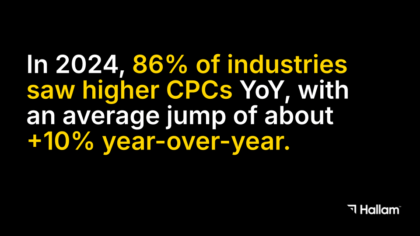
Key takeaway: paying more for the same outcomes is now the baseline, not the exception.
Budgeting purely around historical efficiency metrics ignores the reality that:
- Auction pressure is structural, not temporary
- Incremental gains increasingly require incremental spend
- “Efficiency” often declines before scale improves
- Platform automation and AI evolution in ads changes how spend performs
Google’s move towards broad match, Performance/AI Max and automated bidding isn’t just a tactical shift, it fundamentally changes budget dynamics.
Automation tends to:
- Require larger, more stable budgets to learn effectively
- Perform worse when budgets are constrained or frequently changed
- Blur the line between prospecting and remarketing
CMOs budgeting too tightly often see volatility that gets misdiagnosed as a strategy problem, when it’s actually a budget sufficiency problem.
The Biggest Paid Media Budgeting Mistakes We See CMOs Make
Over-indexing on last-click ROI
Attribution models haven’t kept pace with media complexity. Yet many budgets are still allocated based on whichever channel “wins” in GA4 or the CRM.
From our client work, this typically leads to:
- Underinvestment in upper-funnel channels & brand building activity
- Over-reliance on branded search and remarketing (i.e. quick wins)
- Artificially inflated performance expectations
If your paid media budget is built solely around last-click ROI, you’re not budgeting for growth, you’re budgeting for harvest.
Key takeaway: channels that create demand rarely look efficient in isolation.
Treating brand and performance as separate line items
In 2026, the distinction between “brand” and “performance” media is increasingly artificial.
Meta, YouTube, TikTok and LinkedIn can all sit somewhere in the middle of the funnel depending on:
- Creative quality
- Audience strategy
- Measurement approach
The most effective budgets we see are designed around outcomes, not labels, for example:
- Demand creation
- Demand capture
- Demand conversion
How Much Should You Budget for Paid Media in 2026?
You’ll hate me for this, but: there’s no universal benchmark.
But, there are useful frameworks to help you set the right budgets for your business needs.
Budgeting as a percentage of revenue
For many B2B and DTC brands, paid media budgets typically fall between:
- 5–10% of revenue for established brands focused on efficiency
- 10–20% of revenue for growth-stage brands prioritising scale
What matters more than the percentage is how flexibly the budget is deployed across the funnel.
Budgeting based on growth ambition
A more robust approach we recommend to CMOs is working backwards from growth targets:
- Define revenue growth targets for 2026
- Model required pipeline or demand volume
- Assess organic contribution realistically
- Fund paid media to close the gap
This avoids the common trap of setting a budget first and retrofitting expectations later.
Key takeaway: ambitious growth targets require budgets designed to support them, not limit them.
Allocating Budget Across the Funnel
Upper-funnel: buying future demand
In uncertain markets, upper-funnel spend is often the first to be cut… and the most expensive to rebuild later.
Channels typically funded here include:
- Paid social (Meta, TikTok, LinkedIn)
- YouTube
- Display and native
From our experience, CMOs who protect 20–40% of paid media budget for demand creation tend to see:
- Lower long-term CPAs
- Stronger branded search performance
- More stable performance in downturns
This reflects Hallam’s thinking on full-funnel paid media, where strategic investment in awareness and upper-funnel activity helps drive stronger performance further down the funnel and supports long term growth.
Mid- and lower-funnel: capturing existing demand
Lower-funnel channels matter, but they’re increasingly constrained by:
- Finite search demand
- Cookie loss
- Platform signal degradation
Over-allocating budget here often results in diminishing returns rather than incremental growth.
A healthier approach is to:
- Fund lower-funnel channels to saturation
- Redirect incremental budget upstream
- Measure success at blended, not channel, level
You can explore this further in Hallam’s guide to measuring paid media performance beyond last click.
Accounting for AI, Creative and Production Costs
One of the most common blind spots in paid media budgeting is everything that sits outside media spend.
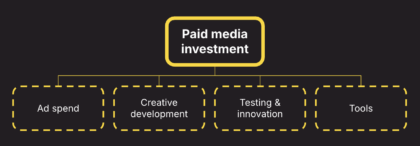
In 2026, competitive advantage increasingly comes from:
- Creative volume and testing velocity (the importance of this highlighted further by Meta’s latest Andromeda update)
- AI-assisted production
- Ongoing experimentation
Yet many paid media budgets still don’t account for creative development.
We recommend CMOs explicitly allocating:
- 10–20% of paid media budget to creative production and testing
- Additional resource for AI tools, feeds and data infrastructure
Key takeaway: skimping on creative means even a well-funded media budget won’t deliver its full potential.
Forecasting, Flexibility and In-Year Reallocation
Why rigid annual budgets fail
Markets shift faster than annual planning cycles. Platforms change algorithms often. Consumer behaviour can change overnight.
The most effective paid media budgets we see are:
- Set annually, but reviewed quarterly (sometimes more frequently)
- Held centrally, not locked to channels
- Reallocated based on marginal returns
This approach also makes budget conversations with finance teams easier. Performance becomes a continuous optimisation exercise, not a one-off justification.
Planning for experimentation
Every paid media plan should include a test-and-learn budget.
Typically:
- 5–10% of total spend
- Clearly defined hypotheses
- Time-bound testing windows
This creates space to explore:
- New channels
- New formats
- New audience strategies
Without it, innovation gets deprioritised in favour of short-term certainty.
What CMOs Should Do Now to Prepare for 2026
If you’re planning budgets now, focus on these actions:
- Stress-test performance assumptions against rising media costs
- Model blended ROI, not channel-level efficiency
- Ring-fence budget for demand creation and creative
- Build flexibility into how budget can be reallocated
- Align finance stakeholders early around realistic expectations
Key takeaway: the strongest budgets are defensible, adaptable and aligned to growth not just short-term efficiency.
Final Thoughts: Budgeting as a Strategic Advantage
Paid media budgeting in 2026 isn’t about finding the “right number”. It’s about creating a system that allows your marketing team to respond intelligently to change.
CMOs who treat budgeting as a strategic lever, rather than an annual admin task, are better placed to:
- Protect long-term growth
- Navigate platform volatility
- Demonstrate commercial leadership internally
At Hallam, we work closely with CMOs to build paid media budgets that balance ambition with accountability and performance with brand.
If your 2026 budget still looks like 2025 with inflation added, it’s probably time to rethink it.
The post Budgeting for Paid Media in 2026: A Practical Guide for CMOs appeared first on Hallam.
hallam.agency (Article Sourced Website)
#Budgeting #Paid #Media #Practical #Guide #CMOs