
To those of us who watched cricket in the 1980s and 90s, Wasim Akram appeared to be a magician in the disguise of a fast bowler. So spellbinding was the left-armer’s artistry, hooping the ball in either direction at will and bewitching opponents and onlookers alike.
The poetry of his bowling action was symbolised by a scurrying burst into his delivery stride and a quick-arm release that gave the batters little clue of their impending doom. Once the ball – new or old — left his hand, with the seam canted perfectly to procure swing, it would invariably do some mischief to hoodwink the batter at the opposite end.
The wizardry was best encapsulated by Wasim’s sublime show in the 1992 ODI World Cup final, when he followed up an outswinger to Allan Lamb from around the wicket with an inswinger to Chris Lewis from the same angle to castle them off successive deliveries. The peach to dismiss Rahul Dravid at the MAC Stadium in 1999 in a humdinger of a Test springs to mind as another compelling example of his genius.
Such deliveries in the midst of his match-winning spells cemented his status as the finest practitioner of left-arm pace that the game had ever seen. So, when he bid adieu from international cricket in 2003, it seemed inconceivable for another left-armer to come along and surpass his feats.
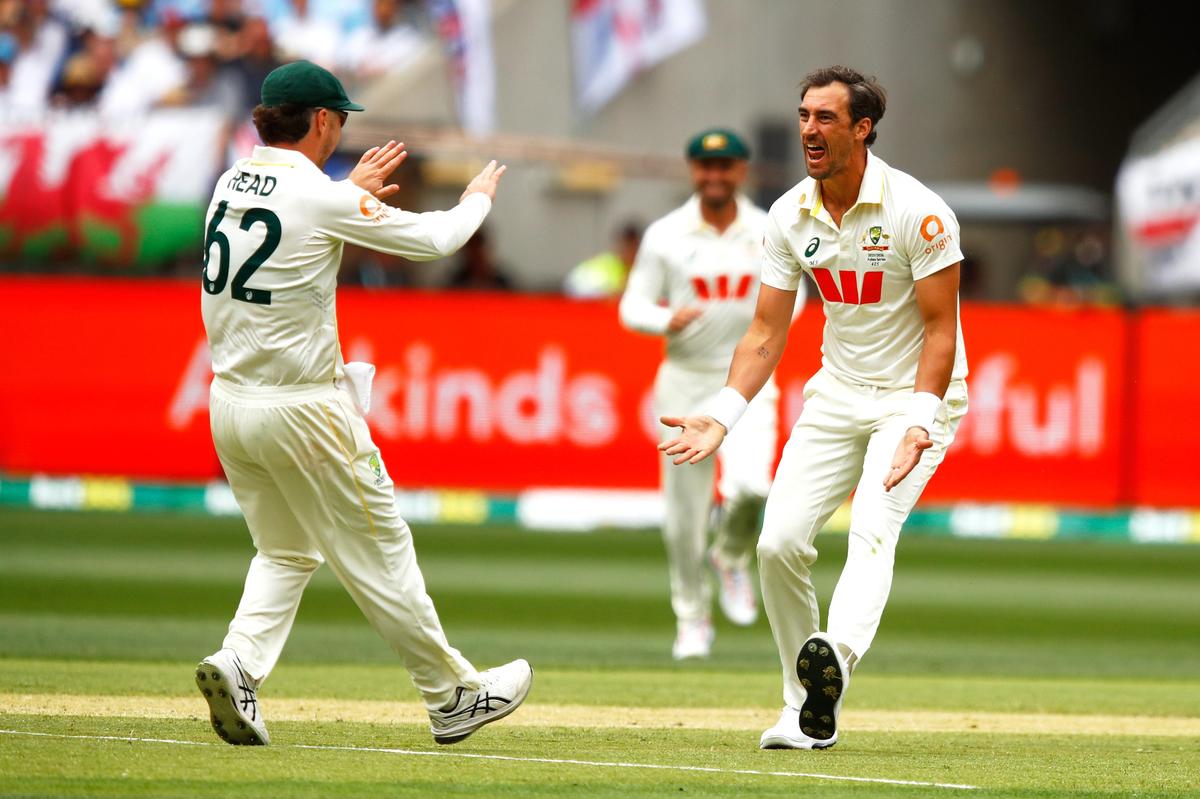
Mitchell Starc, right, celebrates with Travis Head after dismissing Zak Crawley in the Perth Test.
| Photo Credit:
AP
It is remarkable, then, that Mitchell Starc has managed to go past the great fast bowler, statistically speaking, this past week. The affable Aussie left-armer did so by coaxing Harry Brook into an airy drive to the slip cordon in a six-wicket haul in England’s first innings of the second Test in Brisbane, which the hosts won by eight wickets to canter to a 2-0 lead in the five-match affair. It has taken his tally in the longest format to 420 wickets in 102 Tests, six more than Wasim’s 414 in 104 matches. It is also worth noting that Starc’s current strike rate of 46.9 is the best for any bowler who has played 100 or more Tests.
Shortly after his special feat on the opening day of the pink-ball Test, Starc was asked for his reaction to overtaking the Pakistani, both of whom have coincidentally starred in World Cup-winning campaigns culminating at the Melbourne Cricket Ground (MCG).
“I will reflect on it later. Wasim was still a far better bowler than I am. He is still the pinnacle of left-armers, and certainly right up there with bowlers to ever play the game. So, it is nice to be spoken about around him, but I will just try to keep churning a few out,” the soft-spoken speedster would respond modestly.
Taking into cognisance Starc’s own assessment, it is best to stay away from comparisons. Where Starc is strikingly similar to Akram, of course, is in his ability to recognise and seize moments that alter the course of a match.
A match haul of eight for 139 and a contribution of 77 in the day-night encounter at the Gabba, which yielded Starc his third successive Player-of-the-Match award in the format, was the latest proof. In the opener at Perth Stadium, which lasted all of two days, Starc scalped seven for 58 and three for 55 across the two innings in an emphatic victory.
By delivering rousing performances in each of the first two Tests when Australia was without skipper Pat Cummins and Josh Hazlewood due to injuries, he has already gone a long way towards ensuring that this series is remembered as Starc’s Ashes.
Setting the tone
As he has done in the past, Starc set the tone in the opening over of the series in Perth. Having dismissed Rory Burns off the very first ball of the 2021-22 Ashes series at home, he had to wait until the final ball of his first over this time to get rid of Zak Crawley for a blob. Before his first spell came to a close, he would also trap Ben Duckett plumb in front and find Joe Root’s outside edge. When he returned after the lunch break, he added Ben Stokes, Gus Atkinson, Jamie Smith and Mark Wood to his list of victims in the space of 29 balls to finish with a career-best seven-for.
By running through the English line-up with a ball that had gone out of shape pretty quickly, Starc underscored the subtle improvements he has made to his game at this stage of his career. Even with his stock weapon – the deadly inswinger to a right-hander – curtailed, he was able to maintain his wicket-taking threat with his shrewd use of the wobble-seam delivery. It is a variation that enables Starc to push the ball away from the right-handers and into the left-handers, and reduces his reliance on the ball moving in the air.
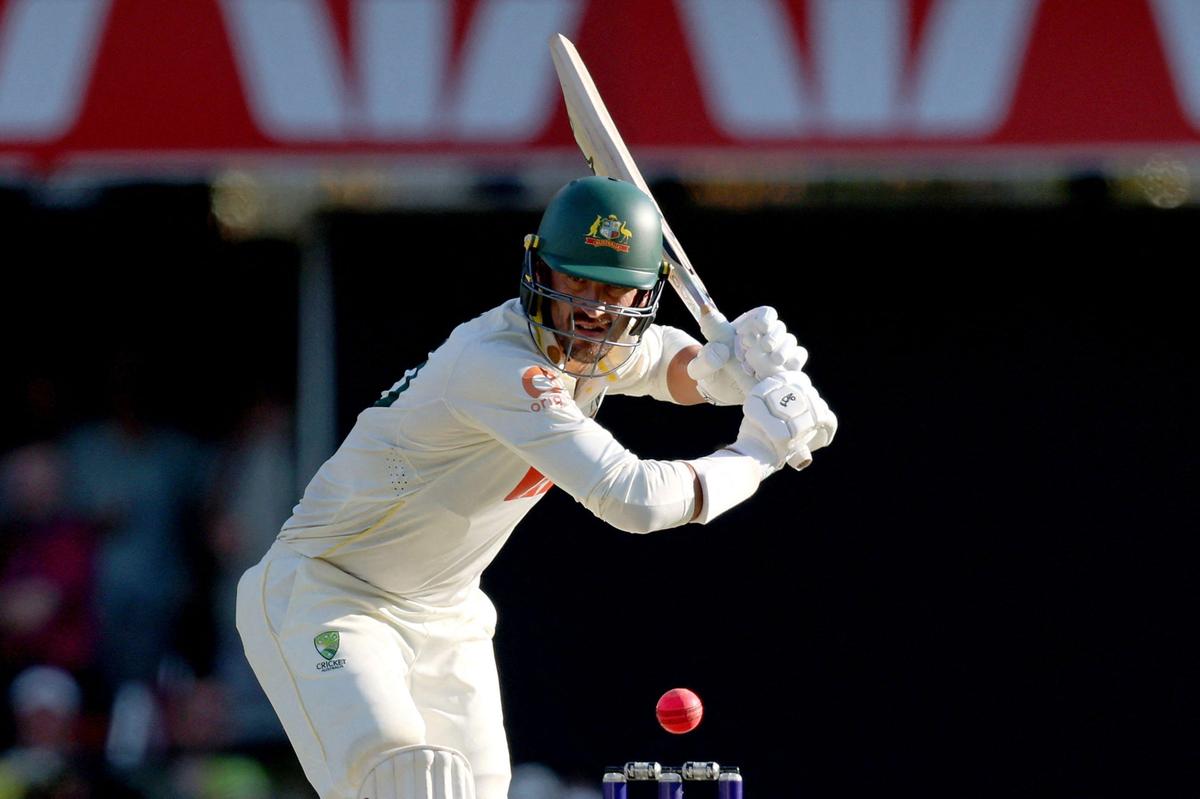
Mitchell Starc top-scored for the home team in the second Test at the Gabba.
| Photo Credit:
AFP
True to his self-effacing demeanour, Starc deflected the praise to Cummins and Hazlewood, his two best mates, when asked about the addition to his armoury.
“Two of my best mates are two of the best exponents of it in the world. To learn off Josh and Pat… if I had listened to those two a bit earlier, I may have added it to my repertoire a bit earlier,” he told the media.
Starc’s evolution reflects unequivocally in his numbers. In nine Tests in 2025, he has snared 47 wickets at an average of 16 and a strike rate of 26.9, the latter two figures being better than any previous year.
Top priority
For the 35-year-old from Sydney to be going stronger than ever before is a testament to his fitness. It has been facilitated by his unflinching commitment to donning the Baggy Green for Australia, with Starc notably eschewing the opportunity to land lucrative IPL deals from 2016 to 2023 – a period when he was among the best white-ball bowlers going around.
He has turned up unfailingly for Australia in marquee white-ball events too, winning two ODI World Cups (2015, 2023) and one T20 World Cup (2021) along the way. It was only in September this year that Starc announced his T20I retirement with the intention of prolonging his Test career further and featuring in the 2027 ODI World Cup.
Though Starc’s choices may have deprived him of a few financial gains, he has the honour of a long career in whites to cherish for the rest of his life. By playing his 100th Test, against West Indies in July, he became just the second Australian pacer after Glenn McGrath to reach the three-figure milestone. In recognition of Starc’s achievement, Cummins offered fitting praise at the time.
“A huge effort. As a fast bowler, I can’t fathom playing 100 games and keeping that 145 kmh speed. He is just a warrior. He turns up every week and wants to play no matter what,” the Australian skipper, who has featured in 71 Tests himself, had said.
Starc’s endurance was epitomised by his efforts on the third day of the Brisbane Test. Having curbed his attacking stroke-play and stayed in the middle for 34.2 overs through the afternoon heat, his body was still robust enough to charge in at full tilt with the pink ball and touch speeds hovering around the 145 kmh mark in the very last over of the night session.
How much longer can Starc, who will turn 36 in January, potentially stretch himself in the five-day game? Akram, in an interview to News Corp before the Brisbane Test, prophesied where Starc could end up.
“He has plenty of cricket in him. I think he will get 500 Test wickets,” the former Pakistan skipper said.
That won’t be music to the ears of the England batters.
www.thehindu.com (Article Sourced Website)
#Making #Starc #difference #Ashes