
Buy-and-hold investing is a popular long-term investment strategy that involves purchasing stocks and holding onto them for an extended period, generally 5-10 years or more.
This approach is often used by individual investors with a low risk tolerance who are looking to build wealth over time.
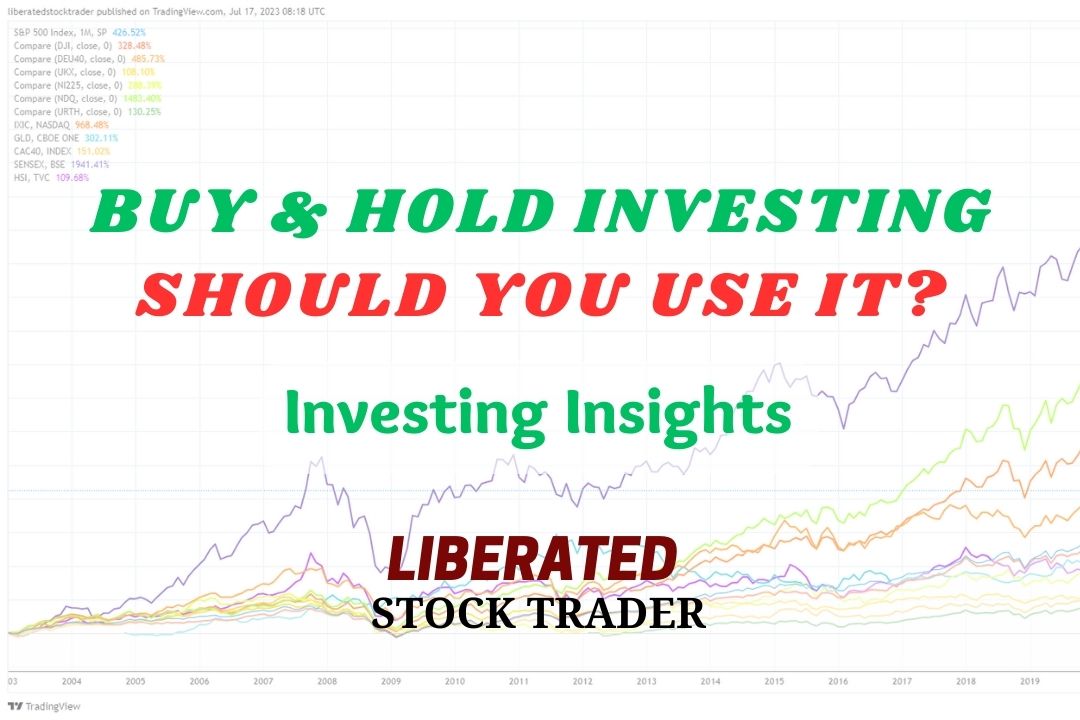
Based on our 30-year research, adopting a buy-and-hold stocks strategy is annually 4% more profitable than actively trading stocks or investing in alternative assets such as corporate bonds, real estate, gold, or treasuries.
If you’re eager to embark on a buy-and-hold stock strategy, our expert strategy guide will steer you in the right direction!
1. Know that Buy-and-Hold Beats Day Trading
A buy-and-hold investor takes a long-term approach, aiming to accumulate assets and income over 10 to 30 years with minimal effort. However, in recent times, the allure of buy-and-hold has faded. The prevailing culture of instant wealth gravitates towards the thrilling rush of day trading in high-risk assets like currencies, CFDs, or options, hoping to get rich quickly.
Our research shows that day trading crypto, currencies, or stocks is a losing proposition for 85% of traders, who wipe out their investments within six months. Only the truly dedicated traders who backtest unique trading strategies have a chance of success.
But for buy-and-hold investors, the future is much less time-consuming and more profitable.
2. Buy-and-Hold Beats Bonds, Real Estate & Gold
Based on our research findings, historical annual returns in the stock market (10.7%) have exceeded those of bonds (4.8%), real estate (4.8%), corporate bonds (7.2%), and gold (6.8%). However, it is crucial to consider that stocks exhibit higher volatility than bonds and other investments. Therefore, it is essential to carefully evaluate how various investment classes can be effectively utilized within a portfolio to optimize returns while mitigating risks.
| Buy-and-Hold Assets | 30-Year Compound Annual Return |
| Stocks: Nasdaq 100 | 13.10% |
| Stocks: S&P 500 | 8.20% |
| Corporate Bonds | 7.20% |
| Gold | 6.80% |
| US T. Bond | 4.90% |
| Real Estate | 4.80% |
| 3-month T.Bill | 2.20% |
Source: Liberated Stock Trader Statistics & NYU
Real estate has unique advantages as an asset class, distinguishing it from stocks, bonds, and gold. It offers consistent income from rent and potential long-term capital gains from appreciation. Additionally, real estate provides tax benefits, such as deducting mortgage interest and depreciating property.
Bonds are an appealing investment choice because they offer a stable return with minimal risk. Typically, the principal amount is repaid at maturity, while interest payments, known as coupons, are paid regularly during the bond’s life. Amongst this asset class, government bonds are widely regarded as the safest option due to their backing by the full faith and credit of the issuing government.
No one talks about buy-and-hold because brokerages want you to buy and sell often, so they get more trading commissions through order-flow.
3. Implement a Buy-and-Hold Dividend Strategy
Dividend investing is a tried-and-true method of building long-term wealth. To implement this strategy, select stocks that pay dividends regularly. Once your portfolio is assembled, the focus should shift to establishing an automatic reinvestment plan for future dividends received (this will enable compounding returns). The primary benefit of dividend-paying investments is that they can provide steady cash flows, even during bear markets.
Ultimately, a buy-and-hold strategy offers investors maximum upside potential and minimal downside risk. When properly implemented, it can be a powerful way to build wealth over time. Additionally, depending on your filing status, dividends may provide you with tax benefits.
A High Dividend Yield Strategy
Investing in high dividend-yield stocks can be a double-edged sword. While a higher yield may seem appealing, it can also signal potential challenges for the company to sustain these payments. This correlation arises from the inverse relationship between the dividend yield and the stock price; the yield increases as the stock price declines. Therefore, it is crucial to consider the dividend payout ratio alongside yield when evaluating investment opportunities.
Implementing a High-Dividend Yield Strategy
- Get a Free Stock Rover Premium Trial
- Click > Screener > Create New Screener
- Select the following criteria: Market Capitalization > $500 M, Dividend Yield > 3%, Dividend 1 Year Change % > 2%, Dividend 3 Year Average % > 2%, EPS 5 Year Average > 0, Payout Ratio < 50
Please read our article How to Find High Dividend Yield Stocks for further details.
A Dividend Growth Strategy
A dividend growth strategy seeks stocks that have historically paid increasing dividends and are likely to continue doing so. It involves searching for dividend stocks with a track record of consistently increasing dividends.
Companies that continually raise their dividends are usually growing sales and market dominance. What if you could find companies that have experienced dividend growth over the last ten years and are on sale at bargain-basement prices? This is called Dividend Growth + High Margin of Safety.
Implementing a Dividend Growth Strategy
- Get a Free Stock Rover Premium Trial
- Click > Screener > Create New Screener
- Select the following criteria: Dividend Yield > 1.5%, Dividend 1 Year Change > 8%, Dividend 3 Year Change > 8%, Dividend 5 Year, Change > 8%, Dividend 10 Year Change > 8%, Payout Ratio >10 < 40, Margin of Safety > 0
Please read our article Dividend Growth Stock Screener 5-Step Strategy for further details.
4. Build a Buy-and-Hold Value Investing Strategy
Value investing is a strategy based on the premise that the stock market often fails accurately to assess a company’s true worth. Guided by this belief, value investors seek to identify undervalued companies, aiming to reap substantial, long-term profits.
Value Invest Like Warren Buffett
Warren Buffett and Charlie Munger have proven to be the most successful investors of all time over the last 50 years. With an average compound rate of return of 23.3% per year, Buffett and his good friend Charlie Munger have a reputation that Wall Street can only dream of. Wise investing has grown Buffett’s company, Berkshire Hathaway (BRK.A), into a behemoth worth over $750 billion.
Set up a buy-and-hold value stock strategy
- Get a Free Stock Rover Premium Trial
- Click > Screener > Browse Screener Library
- Click > Import Buffettology Inspired Screener
Read our article Building the Best Value Stock Screener for further details.
This screener means you will find stocks with the following:
- Good long-term profitability
- Low Debt to Equity
- Strong Market Leadership & Dominance
- Strong Cash Flow & Revenue Growth
- A Track Record of Paying Dividends
- High Margin of Safety
- Low to Medium Price to Earnings Ratio
Great Articles Related to Value Investing Strategies
5. Start a Buy-and-Hold Growth Stock Strategy
A growth stock strategy is an investing approach focused on buying stocks in companies exhibiting above-average growth. Investors who use a growth stock strategy look for stocks with strong financial metrics such as revenue, earnings per share (EPS), and cash flow. Growth investors will often hold onto the stock for long periods to capitalize on the future growth potential.
A buy-and-hold growth strategy can be a great way to diversify an investment portfolio and provide investors with the opportunity to benefit from any upward price appreciation driven by strong financial growth.
The best approach is to create a list of criteria that any stock you consider investing in should meet.
This is where stock screening plays a considerable part. Screening for stocks to hold for the long term usually involves selecting fundamentally sound companies.
Try the Liberated Stock Trader Beat the Market System
This strategy requires buying and holding up to 35 stocks for one year before refreshing the portfolio. The Liberated Stock Trader (LST) Beat the Market Screener is tailored to identify stocks with a high potential to outperform the S&P 500’s returns.
By analyzing growth in free cash flow and explosive EPS growth, along with incorporating Joel Greenblatt’s ROC and Earnings Yield formulas (also known as “the Magic Formula”), we have curated a portfolio of stocks that have consistently surpassed market performance in 8 out of the last nine years.
Use the Famous CANSLIM Growth Strategy
CANSLIM is touted as a highly profitable stock market strategy designed by William J. O’Neil to deliver market-beating returns. The strategy involves investing in companies with high earnings growth, new products, and low institutional investment and buying only in bull markets.
You have to remember:
The stocks you purchase for long-term buy and hold strategies, need to be able to outperform the market. If you cannot select the right stocks, you are better off buying an Index Tracking ETF.
6. Get Qualified Dividends with Tax Benefits
Buying dividend stocks and holding for the long term means you will pay less tax as your dividends will be “Qualified,” meaning they qualify as capital gains tax, not income tax, meaning at the lowest tax band, 0%; we all like zero tax.
Qualified Dividends are typically either regular cash dividends or extra dividends that “Qualify” for different tax treatments in the USA. As an investor, you are subject to taxation on your profits by either income tax or the lower long-term capital gains Tax. Buying and holding dividend stocks makes sense for investors looking to pay less in taxes.
Additionally, when you buy and hold a stock, you can collect quarterly dividends without paying taxes if it qualifies as a Qualified Dividend. A 15-20% withholding tax is applied to the gross amount received from a non-qualified dividend.
DRIPs allow you to reinvest your dividends automatically into the same stock, further growing your profits with compounding and time. Best of all, no tax is due on reinvested dividends when using a qualified dividend stock. So, if you want to minimize your taxes while still earning high returns from the stock market, look for stocks that offer DRIPs and qualify for a Qualified Dividend. With these investments, you can reinvest your dividends back into the stock without worrying about any tax implications!
Dividend Reinvestment Plans are a great way for long-term investors to build wealth, delay taxes, and get commission-free purchasing and preferential pricing.
8. Invest in Buy-and-Hold ETFs
Buy-and-hold ETFs are designed to provide investors with a simple way to invest in the long run and minimize their trading costs. By investing in an ETF, you can own all the stocks it contains without buying each separately, allowing you to diversify your portfolio at a lower cost and with less effort. Many of these ETFs also have low expense ratios, making them an even more attractive investment option.
Additionally, by holding on to these ETFs for several years instead of actively trading in and out, you can avoid any short-term capital gains taxes while still earning a return from the dividends paid out by the underlying stocks. Furthermore, since ETFs are structured as index funds, they are designed to track the performance of their underlying assets, so you can be sure that your investments are not subject to the whims of individual managers.
Ultimately, ETFs offer investors a way to benefit from the stock market without taking on excessive risk or trading costs. Investing in an ETF allows you to gain exposure to multiple stocks and benefit from long-term compounding.
Exchange Traded Funds (ETFs) are baskets of stocks and other financial instruments that track various asset classes or markets.
Top ETFs for Buy-and-Hold Investors
Here are three ETFs that are good for buy-and-hold investors:
- Vanguard S&P 500 ETF (VOO): This ETF tracks the S&P 500, which comprises the largest 500 publicly traded companies in the US. It presents investors with a remarkable opportunity for long-term investment growth. Notably, the ETF boasts an expense ratio of just 0.03%, significantly lower than the industry average of 0.24%.
- Invesco S&P 500 Equal Weight ETF (RSP): The ETF tracks the S&P 500; however, it uses equal weights rather than market capitalization. This approach mitigates concentration risk by providing extensive exposure across all 500 stocks within the S&P 500. Moreover, the ETF’s expense ratio stands at a commendable 0.2%.
- iShares MSCI World ETF (URTH): The MSCI World Index is an international equity index that tracks stocks from 23 developed countries. This ETF provides broad-based exposure to various global industries and is an ideal pick for buy-and-hold investors looking to diversify their portfolios. In addition, it has a low expense ratio of 0.24%.
9. Take Advantage of Dollar-Cost Averaging
Dollar-cost averaging is an investment strategy in which a fixed amount of money is regularly invested in the same security, regardless of price. This strategy allows investors to take advantage of market volatility by buying more units when prices are low. Furthermore, over time, this strategy can lead to higher returns by spreading market risk and enabling investors to buy stocks at regular intervals. Taking advantage of dollar-cost averaging can be an excellent way to invest in the stock market.
If you set aside a regular monthly amount to invest in an Index Tracker or Index ETF when the prices are higher, you buy fewer stocks, and when prices are lower, you get more shares for your money; this is called Dollar-Cost Averaging. Compounding this over the long term brings better returns.
10. Unleash Compounding
Compounding is reinvesting profits to unlock the potential for exponential growth. This strategic approach empowers investors to maximize their long-term returns, making it an invaluable tool. To fully harness the power of this investment strategy, investors should combine dollar-cost averaging with compounding. By doing so, they can amplify their gains and unlock the full benefits of this powerful investment tactic.
A great example of compounding in action is Warren Buffett’s investment strategy. He acquired a stake in Berkshire Hathaway in the 1960s and has since reinvested his profits to compound his gains. Over time, he was able to take advantage of natural market fluctuations to purchase more shares at lower prices. His approach enabled him to earn multiple returns on his investments, and he is now widely known as one of the wealthiest people in the world.
Compounding isn’t limited to leading investors like Warren Buffett. Smaller investors can also benefit from this powerful approach by using dollar-cost averaging alongside compounding. This way, they can strategically add new funds to their portfolio at regular intervals, given the current market conditions. With this method, they can benefit from even small returns over time as their profits grow larger with each compounded investment
11. Use the Best Buy-and-Hold Investing Tools
Buy-and-hold investing is a great way to benefit from the long-term growth of your assets. To manage investments optimally, investors need tools such as a stock screener, analysis reports, and portfolio analysis tools. These tools should have broker integration to enable detailed performance reporting, enabling them to make informed decisions about which stocks to buy and hold long-term.
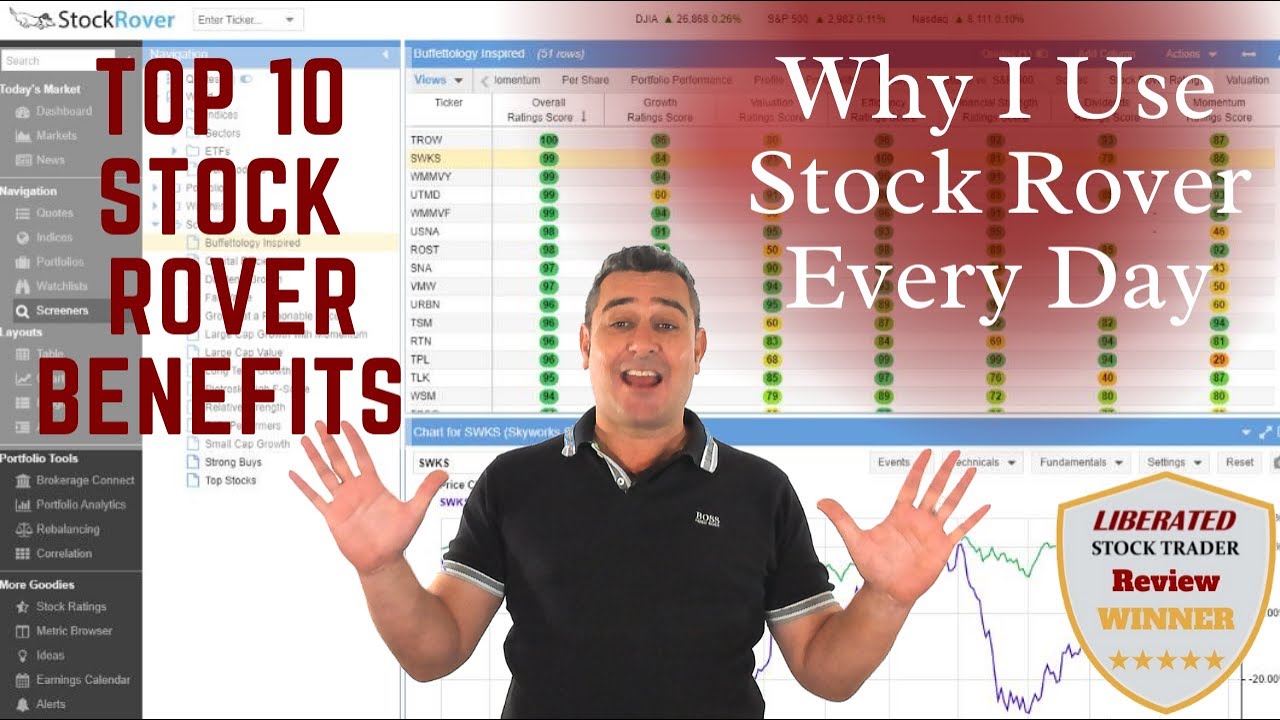
Only one tool meets these criteria: Stock Rover, our valued partner and winner of our best stock screener awards.
Stock Rover 4.7/5⭐ : My Top Pick for Smart Investors
Investing In Stocks Can Be Complicated. Stock Rover Makes It Easy.
★
Growth Investing – with industry-leading
Research Reports ★
★ Value Investing – using Warren Buffett’s Fair Value and Margin-of-Safety ★
★ Income Investing – rank by yield, growth, quality, and safety using 650 metrics ★
“I have been researching and investing in stocks for 20 years! I now manage all my long-term investments using Stock Rover.” — Barry D. Moore, Founder: LiberatedStockTrader.com
Additionally, Stock Rover uses automated portfolio rebalancing to maintain target allocations and ensure investments are properly diversified. With Stock Rover, investors can maximize their returns over time and reduce the risk of market volatility.
12. Managing a Buy-and-Hold Portfolio
Managing a buy-and-hold Portfolio with Stock Rover is intuitive and easy. As investors add new stocks to their portfolios, Stock Rover will provide real-time analytics to help them make informed decisions. Stock Rover offers built-in portfolio management tools that let investors track their holdings and compare performance against benchmark indices.
Stock Rover also provides comprehensive performance views with detailed charts, tables, and forecasts. Stock Rover connects to your existing brokerage account, analyzes your portfolio, and helps you screen different asset classes to uncover investing opportunities. It is targeted at individual investors and enables value, income, and growth investors to manage their stock portfolios. Stock Rover’s ability to perform portfolio correlation and balancing, plus screening for dividends, value, and growth stocks, is a key benefit.
Related Articles: Finding Great Stocks With Stock Rover
FAQ
What is a buy-and-hold stock strategy?
A buy-and-hold stock strategy is a passive, long-term investment strategy where investors purchase stocks and hold onto them despite market fluctuations.
Is a buy-and-hold strategy better than active trading?
Our research shows that long-term buy-and-hold outperforms 85% of active trading systems due to the difficulty of consistently timing the market.
What is the best buy-and-hold investing software?
When it comes to buy-and-hold investing, Stock Rover is our recommendation. Its comprehensive set of features empowers you to conduct thorough research on stocks, ETFs, REITs, and bonds, guiding you in creating a well-diversified, long-term portfolio.
How does a buy-and-hold strategy work?
A buy-and-hold strategy entails investing in companies with proven track records of generating consistent returns. This diversified portfolio across sectors and asset classes helps mitigate risk. Investors periodically monitor and rebalance their holdings for optimal performance. Over time, this strategy should deliver stable returns with reduced volatility compared to active trading.
What are some examples of good buy-and-hold stocks?
Stocks like Microsoft Corp. and Apple Inc. are often recommended for their stability, long-term growth potential, and historical performance. Both companies pay dividends and are AAA investments.
Are dividend stocks good for a buy-and-hold strategy?
Yes, dividend stocks can provide regular income and are often less volatile, making them suitable for long-term buy-and-hold investment.
Is a buy-and-hold strategy risk-free?
No investment strategy is risk-free. Market volatility may affect stock prices, but holding long-term, for at least ten years, usually mitigates short-term risks.
Does a buy-and-hold strategy require regular portfolio monitoring?
While buy and hold is a passive strategy, periodic portfolio reviews with tools like Stock Rover help ensure your investments align with your financial goals and are well-diversified and balanced.
What’s the minimum recommended time horizon for a buy-and-hold strategy?
A buy-and-hold strategy typically works best over long periods, often suggested as ten years or more. Over the previous 30 years, the US stock markets have averaged a 10.5% compounded annual growth rate (CAGR).
Can all types of stocks be used in a buy-and-hold strategy?
While any stock can theoretically be held, stable companies with solid fundamentals are generally preferred for long-term holding; avoid penny stocks and OTC stocks in your portfolio.
Do I need a large amount of money to start a buy-and-hold strategy?
No – you can start a buy-and-hold strategy with any amount of money. That said, it’s important to be mindful of the fees associated with investing. Typically, lower balance accounts will have higher percentage costs for commissions and account management fees.
How do I know when to buy or sell my stocks?
It is best to avoid making decisions to buy or sell based on emotions. A successful buy-and-hold strategy relies on an investor having a strong understanding of the fundamentals and economics of the stock market and making well-informed and rational decisions.
What is a compounded annual growth rate (CAGR)?
The Compound Annual Growth Rate (CAGR) is used to measure the growth rate over a set period. It is calculated using a formula that considers the annual returns throughout your investment. This allows you to compare different investments over periods of varying lengths more accurately.
Is diversification important for a buy-and-hold strategy?
Yes, diversification is an important part of a successful buy-and-hold strategy. Having a mix of different investments, such as stocks, bonds, and mutual funds, can help reduce risk and exposure to potential losses due to market volatility. Including different asset classes in your portfolio, such as international or emerging markets, can also help to spread risk and provide greater potential for long-term growth.
Final Thoughts
Buy-and-hold investing is the best way to accumulate wealth over time. Whether you invest in stocks, bonds, real estate, or gold, staying in the market is proven to be effective over the long term. But even for buy-and-hold investors, it pays to be aware of opportunities. That’s where tools like Stock Rover come in. With its ability to analyze your portfolio and uncover investing opportunities, Stock Rover can help you research value, income, and growth stocks to make the most out of your investments. Investing with Stock Rover is an effective way to build wealth.
In short, the best time to be a buy-and-hold investor is always
You want to be a successful stock investor but don’t know where to start.
Learning stock market investing on your own can be overwhelming. There’s so much information out there, and it’s hard to know what’s true and what’s not.
Liberated Stock Trader Pro Investing Course
Our pro investing classes are the perfect way to learn stock investing. You will learn everything you need to know about financial analysis, charts, stock screening, and portfolio building so you can start building wealth today.
★ 16 Hours of Video Lessons + eBook ★
★ Complete Financial Analysis Lessons ★
★ 6 Proven Investing Strategies ★
★ Professional Grade Stock Chart Analysis Classes ★
Find Out More
www.liberatedstocktrader.com (Article Sourced Website)
#Proven #BuyandHold #Strategies #Increase #Profits