
Adina Campbell,UK correspondent,
Lewis Adamsand
Kathryn Armstrong

 PA Media
Facial recognition technology could be used by all UK police forces in more situations under plan announced by the Home Office.
It hopes a 10-week public consultation will also pave the way for the technology to be used more often while striking a balance with protecting people’s privacy.
Facial recognition has been used by eight police forces in England and Wales to find wanted suspects and vulnerable people, as well as monitoring live events, since 2017.
Officials say the technology is needed to help catch serious offenders. But rights groups worry the technology is too invasive and may have racial biases.
Policing and crime minister Sarah Jones said that, though there were “legitimate concerns” about the technology, she believed a wider roll-out could mark “the biggest breakthrough” in catching criminals since DNA analysis.
The public consultation could lead to new legislation on how and when police could use facial recognition technology. Currently, they can use three types for specific purposes.
The Home Office says that while there is a legal framework for police to use facial recognition technology, this “does not give the police sufficient confidence to use it at significantly greater scale”.
It has not made clear what situations it was considering expanding facial recognition use into – but these may include locating illegal migrants on the run.
Officials believe the technology could also help to identify and arrest prisoners released by mistake, and would only be used in time-limited, focused deployments.
Any new laws informed by the consultation would take about two years to be passed by Parliament, the Home Office said.
They would primarily affect police forces in England and Wales, but would also be relevant to certain powers in Scotland and Northern Ireland.
One of the proposals the government is seeking public opinion on is the creation of a regulator overseeing police use of biometrics and facial recognition.
The public consultation involves an online survey, which can be accessed on the government website. Alternatively, people can email or write to the Home Office.
Zara, 18, said she supported using the technology to catch criminals but had reservations about potentially expanding its use.
“I feel like I wouldn’t be comfortable with the police walking around with cameras in my face,” she told BBC Newsbeat in Birmingham. “Maybe only use it in stations, not out in public unless you really have to.”
Nabiyah was more open to the idea and said she hoped it could curb offences such as shoplifting.
“People might feel like they can’t commit them as easily,” the 25-year-old said.
Osma, 24, likewise said it was not “necessarily a bad thing” and that the UK should catch up with other countries who are “so much ahead of us”.
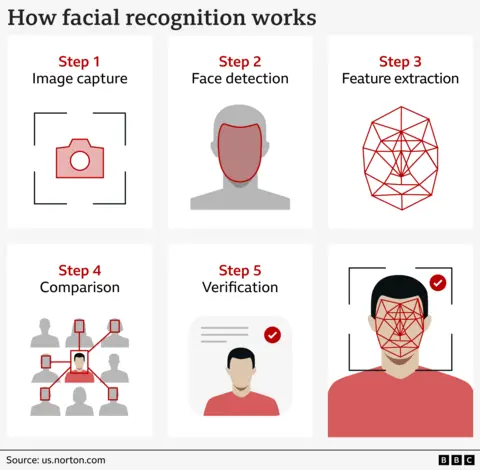
The three types of facial recognition technology currently available to police are:
- Retrospective: Used to search images from crime scenes against pictures taken of people on arrest
- Live: Using live video footage of people passing cameras and comparing their faces to wanted lists
- Operator-initiated: A mobile application that allows officers to check someone’s identity without having to arrest them
The Metropolitan Police – the UK’s largest force – has made 1,300 arrests using the technology since 2023, including rapists and violent offenders, according to the Home Office.
However, the Association of Police and Crime Commissioners said a review of retrospective facial recognition published on Thursday found the tech had “in-built bias”.
This meant that “in some circumstances, it is more likely to incorrectly match black and Asian people than their white counterparts”, it said, adding that the tool had been deployed “without adequate safeguards”.
The government invested £12.6m in facial recognition in 2024, of which £2.8m was spent on live recognition.
A further £6.6m has been invested this year supporting the adoption, evaluation, and roll-out of facial recognition technology.
This includes £3.9m for the development of a new, national facial matching service, which will be tested sometime in 2026.
It aims to give police a new way to carry out retrospective searching and have another national database of custody images.
The new database, which would be run by the Home Office, would improve upon and replace the current national police database, and could hold millions of images, similar to the numbers on the police national database.
The facial matching service is also being trialled separately to help identify and find people being sought by immigration enforcement.
Jones said: “We will expand [facial recognition’s] use so that forces can put more criminals behind bars and tackle crime in their communities.”
Big Brother Watch’s Silkie Carlo said the consultation was overdue and called for a pause in using facial recognition while it was ongoing.
She believes “facial recognition surveillance is out of control” and that the country is “hurtling towards an authoritarian surveillance state”.
National Police Chiefs’ Council lead for facial recognition, Lindsey Chiswick, said live facial recognition was already subject to strong safeguards, but stressed that “public trust is vital”.
“We want to build on that by listening to people’s views,” she said.
Ruth Ehrlich, head of policy at Liberty, told BBC Breakfast: “We do really welcome the fact that there is going to be a debate on how facial recognition technology is regulated and used across police forces.
“But we’re obviously disappointed that this comes alongside a government commitment to ramp up its use before we’ve understood its dangers.”
She added: “What we want to see are strict safeguards that say where and when police can use this technology.”
A new fleet of mobile vans was rolled out by 10 forces in November, expanding a pilot programme already led by the Met, South Wales Police and Essex Police.
The UK’s equality regulator has previously criticised the Met’s use of live facial recognition technology, saying the way it was being deployed was breaching human rights law – something the Met has denied.
www.bbc.com (Article Sourced Website)
#Facial #recognition #police #plans