
Canadian producers have long faced a frustrating challenge: optimizing multilateral well design and performance in cold flow heavy oil plays using incomplete or inconsistent public data. The Alberta Energy Regulator (AER) limits lateral reporting to just nine per well, leaving critical production and cost insights hidden or fragmented. Compounding the issue, these wells often produce through multiple wellbores, yet production is typically attributed to only one, skewing length-normalized metrics and misleading performance comparisons.
This data gap makes it difficult for operators to fully understand well behavior, benchmark against peers, and make informed decisions about future development strategies.
The Data Challenge: Why Multilateral Analysis Has Been So Difficult
Historically, the lack of comprehensive data has forced operators to rely on partial information, making it tough to answer key questions such as:
- Which designs deliver the highest recovery and EUR per meter or section?
- Do longer laterals and additional legs translate into better economics in your area of interest?
- How do your assets stack up against top-performing analogues?
- Are competitors experimenting with new designs or development strategies?
- Which operators are actively expanding or ramping up operations across the play?
Expanded Multilateral Identification & Enhanced Lateral Length Calculation
That’s changing now. With the latest enhancements in Enverus PRISM®, multilateral analysis is more accurate and powerful than ever. The multilateral identification algorithm has been expanded for Alberta wells, moving beyond Heavy Oil Play tags. By leveraging attributes like State Well Type, Wellbore Type and Trajectory, PRISM® now provides precise tagging of multilateral wells, while excluding abandoned wellbores to ensure only productive legs contribute to total producing lateral length.
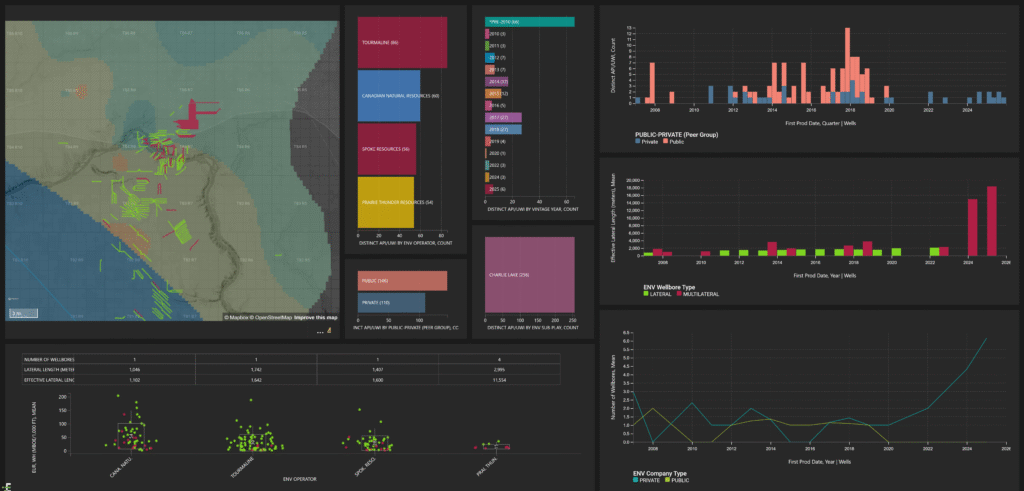
This means PRISM® can now correctly identify and normalize production metrics for any multilateral well in Alberta – even outside traditional heavy oil plays. These wells are easy to find in PRISM®, enabling users to quickly spot where operators are testing multilateral designs, including in emerging plays like Charlie Lake.
Key Features of PRISM®’s First-to-Market Solution
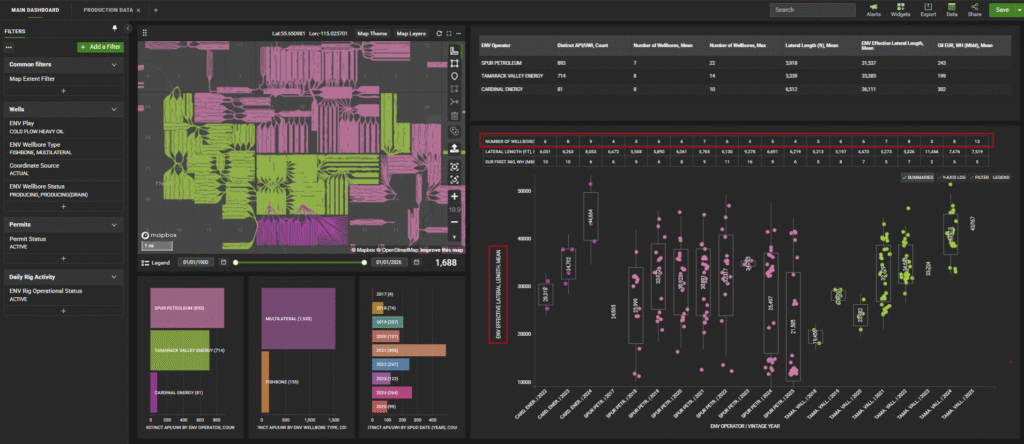
Enverus PRISM® digitizes an extensive set of additional legs from thousands of multilateral wells, giving Canadian operators the most complete and accurate dataset available. Users can now analyze and visualize all legs of a multilateral well, unlocking fast answers to critical questions.
Three new fields have been added to the Wells table for deeper clarity:
- ENV Effective Lateral Length: The total producing length used for length-normalized calculations in PRISM®, ensuring accurate and consistent normalization across all metrics by considering the full producing length, not just the reported wellbore.
- ENV Effective Lateral Length Source: Indicates the source of the length used in calculations (e.g., Perf Interval, Lateral Length, Total Lateral Length), adding transparency to how metrics are derived.
- Number of Wellbores: Displays the total number of wellbores associated with a well, offering a complete view of well architecture.
Practical Benefits for Operators
With these enhancements, Canadian operators can:
- Benchmark recovery per meter against peers and alternative designs.
- Evaluate the economics of longer laterals and additional legs.
- Identify emerging development strategies and operator activity.
- Reduce uncertainty and drive capital efficiency in multilateral developments.

Emerging Development Strategies: Multilaterals vs. Fishbone Wells
One of the most exciting trends visible in PRISM® is the rise of new development strategies, particularly the interplay between multilateral and fishbone wells. In some cases, operators are stacking these designs within the same field or even the same pad, increasing reservoir contact and potentially improving recovery and economics.
- Multilaterals: Wells with multiple branches, maximizing reservoir exposure and production potential.
- Fishbone Wells: Characterized by numerous short laterals branching off a main wellbore.
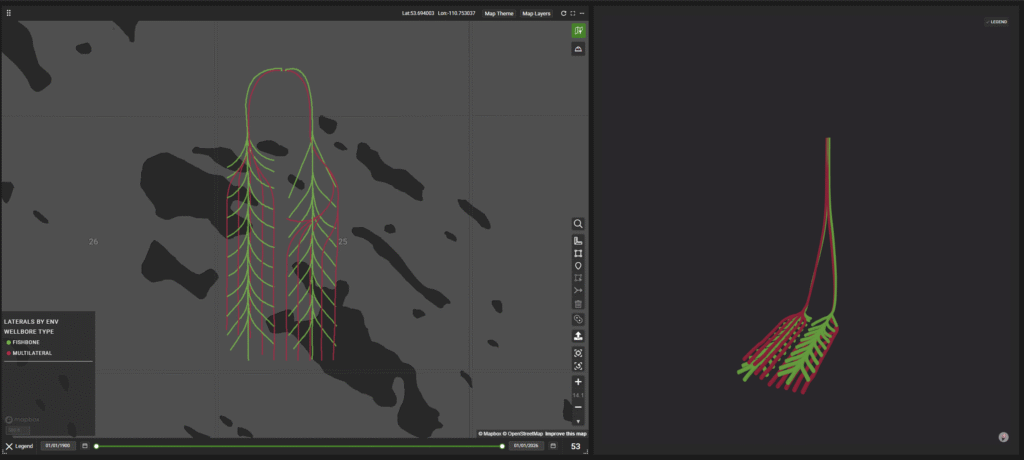
PRISM®’s expanded dataset and advanced analytics make it possible to compare these strategies, identify operators trialing innovative combinations, and track their impact on production metrics.
Case Example: Charlie Lake Wells
Thanks to expanded algorithm coverage, Charlie Lake wells are now correctly identified as multilaterals. This improvement enables more accurate normalization of production metrics and gives operators a clearer picture of asset performance in this evolving play.
Next Steps: Get the Full Picture With PRISM®
Whether you’re optimizing existing assets or planning new developments, PRISM® delivers the clarity and confidence you need to reduce uncertainty and drive capital efficiency in cold flow heavy oil plays. The platform’s comprehensive dataset and advanced analytics empower operators to make data-driven decisions, benchmark against top analogues, and stay ahead of emerging trends.
Ready to see the full potential of your multilateral wells? Let’s connect to walk through the new capabilities or set up a custom analysis for your team.
Interested in a deeper dive or a custom analysis for your assets? Reach out to schedule a walkthrough of PRISM®’s latest features and see how these enhancements can drive results for your operations.
www.enverus.com (Article Sourced Website)
#Canadian #Heavy #Oil #Optimize #Multilateral #Performance