
Heavy floodwaters swept across southwestern Jamaica, winds tore roofs off buildings and boulders tumbled onto roads Tuesday as Hurricane Melissa came ashore as a catastrophic Category 5 storm, one of the strongest Atlantic hurricanes on record.
Landslides, fallen trees and numerous power outages were reported as Melissa came ashore with 295 km/h winds near New Hope, with officials cautioning that the cleanup and damage assessment could be slow.
“There is no infrastructure in the region that can withstand a Category 5,” Prime Minister Andrew Holness said. “The question now is the speed of recovery. That’s the challenge.”
Floodwaters trapped at least three families in their homes in the community of Black River in western Jamaica, and crews were unable to help them because of dangerous conditions, said Desmond McKenzie, deputy chairman of Jamaica’s Disaster Risk Management Council.
“Roofs were flying off,” he said. “We are hoping and praying that the situation will ease so that some attempt can be made to get to those persons.”
On X, a person in Black River wrote, “I never knew concrete could shake like this.”
“Three windows broken. Doors shaking. Outside sounds like people screaming or a huge train passing by. I am terrified.”
McKenzie noted that extensive damage was reported in the southwestern parish of St. Elizabeth, which he said “is underwater.”
He said there are no confirmed reports of deaths but stressed that it was too early to talk about the extent of the damage because the hurricane — the strongest to hit the island since recordkeeping began 174 years ago — was still pummeling the country.

The view out the window of a home in northwestern Jamaica shows the intensity of Melissa as the storm made landfall as a Category 5.
Rohan Brown, with Jamaica’s Meteorological Service, warned that as Melissa moves off the coast, its counterclockwise rotation will bring a heavy storm surge to northern Jamaica through the night.
The storm is headed toward Cuba, where it was expected to make landfall as a major hurricane early Wednesday.
Nearly 15,000 people were in shelters in Jamaica and some 540,000 customers, or 77 per cent, were without power, officials said.
Colin Bogle, an adviser for the humanitarian aid organization Mercy Corps who is based near Kingston, told The Associated Press that many families in the Jamaican capital are staying put and sheltering in place, despite government evacuation orders.
Bogle was staying with his grandmother in Portmore, just west of Kingston, where everything went dark earlier this morning after a loud explosion.
“The noise is relentless,” he said of the hurricane. “People are anxious and just trying to hold on until the storm passes.”
Facing the aftermath
On Tuesday evening, Melissa had top sustained winds of 205 km/h and was moving north-northeast at 13 km/h as its centre moved into the Caribbean Sea, according to the U.S. National Hurricane Center in Miami.
The hurricane was centered about 80 kilometres east-northeast of Montego Bay, Jamaica, and about 260 kilometres southwest of Guantanamo, Cuba.
In Kingston, officials warned residents of the surrounding area to watch out for crocodiles that might be displaced from their habitats by flooding.
West of the capital, in Spanish Town, the historic Flat Bridge was completely submerged. The bridge is believed to have been built some time between 1724 and 1774. It’s not a tall bridge, but one that is important to Jamaican history.
Ive been watching these live feeds of traffic cams in Jamaica, and the difference between last night and right now on this Flatbridge feed is so scary <a href=”https://t.co/TO1t2WQgu3″>pic.twitter.com/TO1t2WQgu3</a>
—ImpatienTourist
McKenzie said the government was prepared for rescues immediately after the storm passes through: “We have boats, helicopters, you name it.”
The storm already was blamed for seven deaths in the Caribbean, including three in Jamaica, three in Haiti and one in the Dominican Republic, where another person remains missing.
After their flight home from Jamaica on Sunday was cancelled, Stephanie Brayford and her family are now sheltering in place in a hotel conference room in Negril on the island’s west coast.
The storm is “nothing like anything I’ve experienced,” Brayford told CBC News host Andrew Nichols.
“And I have experienced a tornado,” she said. “The winds just take your breath away.”
For now, she said, she and her family are safe, holing up with other guests in the conference room while sleeping on deck chair cushions.
Officials have said they hope to reopen the island’s airports by Thursday.
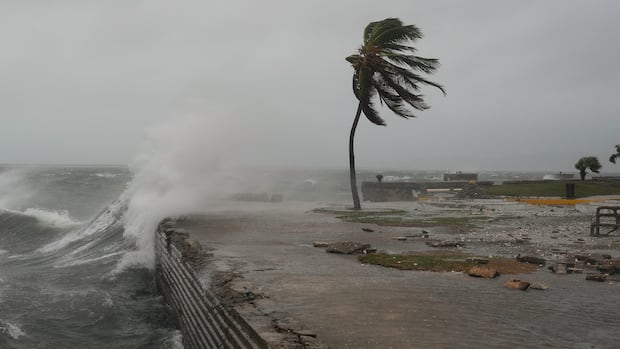
Hurricane Melissa barrelled into Jamaica with 320 km/h winds and torrential rain, knocking out power and causing catastrophic structural damage.
Heading for Cuba
Melissa was expected to make landfall in eastern Cuba late Tuesday or early Wednesday. Up to 51 centimetres of rain was forecast in areas, along with a significant storm surge along the coast.
In a televised address to the nation Tuesday, Cuban President Miguel Diaz-Canel urged the population to not underestimate the power of the storm, “the strongest ever to hit national territory.”
The Government of Canada’s travel advisory website says all travel to Cuba’s eastern provinces should be avoided. That includes Granma, Santiago de Cuba, Guantanamo, Holguin and Las Tunas.
Canada’s consular services is encouraging the in affected areas to sign up with Registration of Canadians Abroad to get updates.
The federal government has set up a dedicated emergency watch and response centre for Canadians affected by Hurricane Melissa.
Global Affairs Canada has posted a number of ways to get in touch with the centre in a post to its Foreign Policy CAN account on X.
(1/2) Canada stands with Jamaica, Cuba, and the broader Caribbean community as Hurricane Melissa impacts the region. We are closely monitoring the situation and stand ready to provide assistance, including humanitarian support. <a href=”https://t.co/e9ZfBXomHO”>pic.twitter.com/e9ZfBXomHO</a>
—CanadaFP
Eastern Canada could feel effects
The Canadian Hurricane Centre (CHC) issued its first advisory for the storm Tuesday afternoon.
“The CHC will be monitoring the evolution of Hurricane Melissa this week as it begins moving through the Caribbean. While the hurricane accelerates northward, a large area of low pressure will form over the northeastern U.S. bringing rain and strong winds to a large portion of eastern Canada,” the statement said.
“The wind circulation of Melissa is expected to track well offshore (likely near or over the southern Grand Banks) and not directly affect land. The large non-tropical low over eastern Canada could tap into some moisture from the hurricane that could influence its intensity and rainfall potential.”
www.cbc.ca (Article Sourced Website)
#Eye #Melissa #moves #Jamaica #hitting #strongest #hurricane #region #years #CBC #News