
Even the best SEO programs are starting to hit a ceiling. You can publish outstanding content, rank on page one, and still see traffic flatten. It’s not because SEO is broken — it’s because search itself has changed.
Instead of scrolling through 10 blue links, people are now asking AI tools like ChatGPT, Gemini, and Perplexity for quick, confident answers. When those systems reply, they summarize, cite, and recommend instead of showing options.
That’s a major shift for marketers, and we wanted to understand what it really means for visibility.
The Experiment: Running the Test on Ourselves
As an agency obsessed with discoverability, we decided to turn the microscope inward. Before advising clients on “AI visibility,” we needed to know how AI saw us.
So we ran an experiment using our own in-house visibility intelligence platform, Leverage, to track how large language models referenced Avalaunch Media in real-world queries.
We asked hundreds of generative questions the same way real users might:
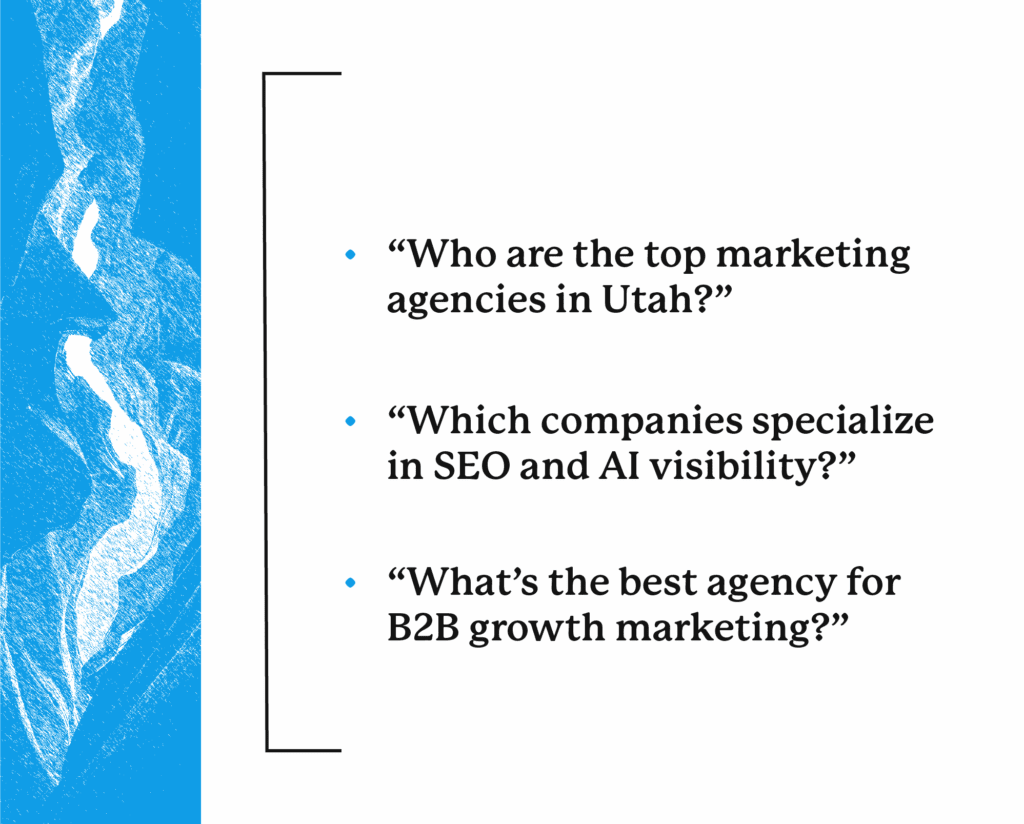
We then analyzed how often and in what contexts AI assistants mentioned or recommended Avalaunch, compared with competitors. We tracked the answers across multiple large language models, and the results were both fascinating and humbling.
Traditional SEO teaches us to optimize for scanners, i.e., people reading headlines, subheads, and snippets. AI models, on the other hand, read contextually. They analyze relationships between ideas, consistency of language, and how clearly you explain what you do.
Leverage helped us see this difference clearly. We noticed that punchy, fast, persuasive pages written for conversion sometimes got skipped by AI entirely. Meanwhile, the long-form, informative-style content performed better because it offered the depth and clarity LLMs rely on to synthesize accurate answers.
Takeaway: Clarity beats cleverness. The better your content teaches, the more likely AI is to trust and reference it.
In SEO, ranking first feels like winning. But in AI search, being mentioned is what counts.
When we analyzed our results, Leverage revealed that Avalaunch appeared frequently in AI-generated answers, but not always in the final recommendation. In some cases, AI read our content, synthesized it, and then cited another agency as the “best” source.
Ultimately, it came down to how well our messaging matched the query’s intent and how consistently that story appeared across the web.
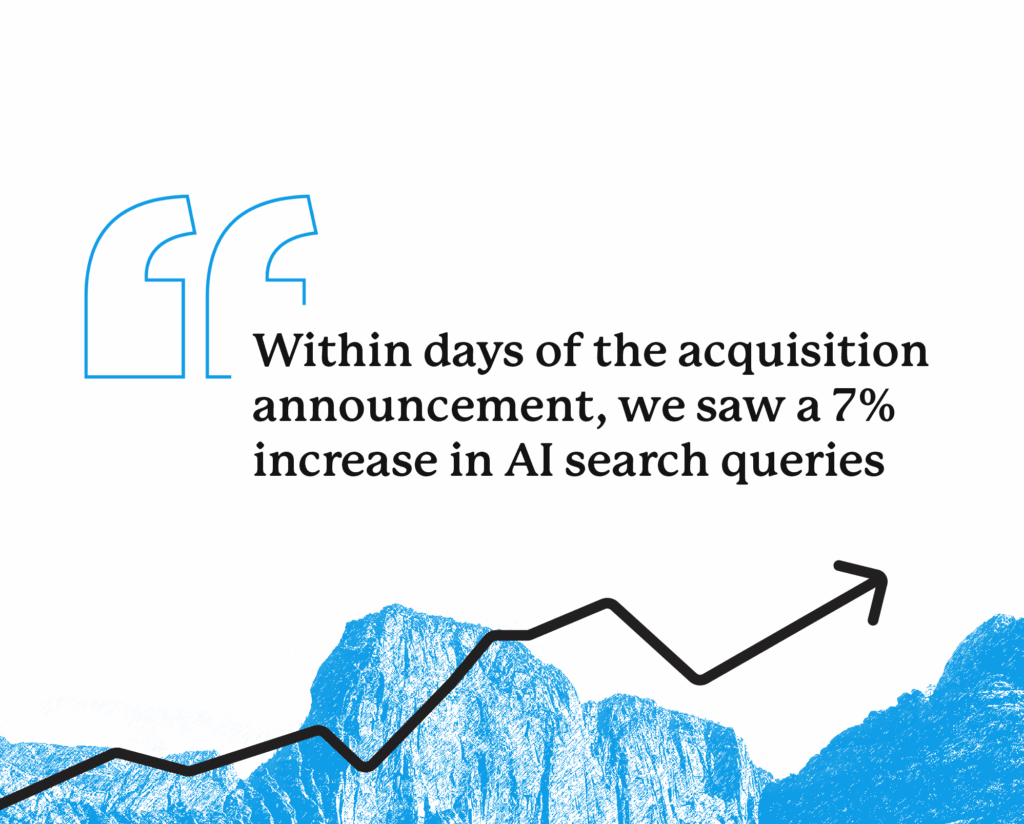
A perfect example of query intent came after we were acquired by Amplēo in September 2025. Within days of the acquisition announcement, we saw a 7% increase in AI search queries. Even without prompting, LLMs referenced our press release to contextualize who we are and what we do.
Takeaway: Visibility is now measured in citations and context, not just clicks.
AI systems rely on patterns of credibility. They cross-reference what they read with external sources, such as Wikipedia, directories, reviews, and press mentions.
If AI systems see the same information validated in multiple trusted places, confidence increases. If that information is inconsistent or incomplete, confidence drops. Our experiment showed that even small mismatches, like a service name listed differently on two pages, could cause AI to skip citing us.
When we ran Leverage, it identified gaps between how we described our services on our site and how others described us off-site. That inconsistency mattered — and fixing it immediately improved how often AI cited us.
Takeaway: Brand consistency isn’t cosmetic anymore: It’s algorithmic. AI rewards truth, repetition, and transparency.

Technology alone doesn’t create visibility. What mattered most wasn’t the data Leverage provided: It was what our team did with it.
We treated the data like a roadmap:
- Which topics did AI trust us on?
- Where were we overlooked?
- Which external sources shaped the answers most?
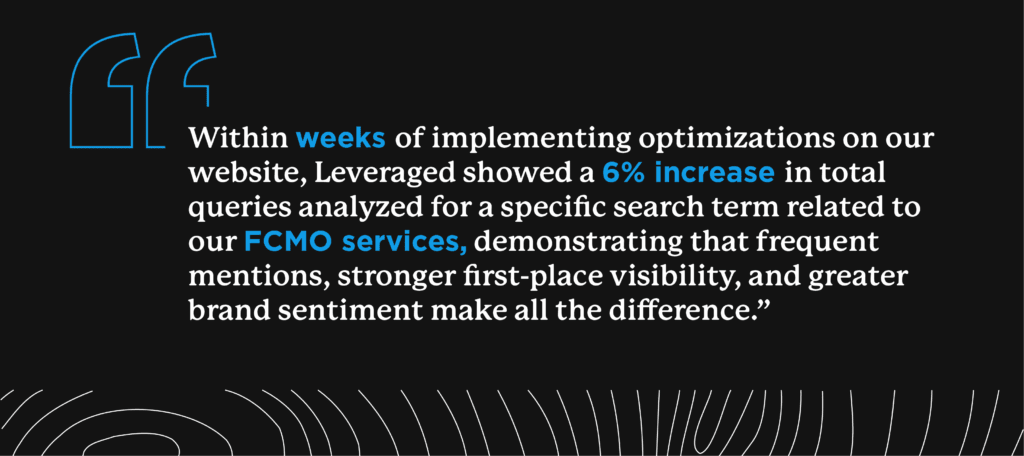
From there, our strategists updated messaging, refined page structure, and reinforced off-site authority where AI was looking. Within weeks of implementing optimizations on our website, Leveraged showed a 6% increase in total queries analyzed for a specific search term related to our FCMO services, demonstrating that frequent mentions, stronger first-place visibility, and greater brand sentiment make all the difference.
Takeaway: Success in AI search still depends on strategy, or connecting human insight to machine logic.
One of the biggest debates around AI visibility is ethics. Some companies are scraping data or manipulating prompts to force mentions. That might work temporarily, but it risks compliance issues and reputational damage.
Leverage is built to do the opposite. It captures direct, human-verified AI interactions without scraping, hacking, or shortcuts. That means the data from our experiment reflected how real users actually experience AI search results, and it keeps us and our clients compliant with the platform’s terms of service. It also helps us produce more reliable results and earn lasting credibility in AI responses.
Takeaway: In the long run, the most sustainable way to win visibility is to earn it.
What Marketers Can Do Right Now
The bar has been raised for brands to maintain a clear, consistent digital presence that truly reflects their customers’ needs. You need to define your ideal customer, showcase what sets your brand apart, and highlight features, case studies, and authentic reviews, all to tell a story compelling enough for LLMs to reference.
- Ask five AI engines about your category. How often does your brand appear in the answers?
- Check which sources they cite. Are those sites referencing your company? If not, could they?
- Review your messaging for clarity. Does your site clearly explain who you are and why you’re credible?
- Strengthen authority where AI looks. Update your directory listings, case studies, and external mentions.
- Document and repeat. AI responses change quickly, so it’s vital to track progress like keyword rankings.
These steps will give you a clearer picture of your standing in AI-driven discovery.
The Bigger Picture: Search Is Becoming Conversation
What we learned running this experiment on ourselves changed how we think about SEO altogether.
- Search and discovery are converging.
- Most LLMs rely on search APIs for relevant information.
- SEO is the foundation for sustained LLM visibility.
- AI tools behave less like databases and more like decision-makers.
- AI tools summarize what they believe to be true and who they consider trustworthy.
That means visibility is no longer a passive metric: It’s an active, ongoing dialogue between your brand and the systems people rely on to find information.
The question every marketer should be asking isn’t “How do I rank higher?” It’s “What does AI say about me?”
In the next era of marketing, visibility won’t just be about being found: It’ll also be about being seen.

We started this journey curious about our own visibility. We ended it understanding something bigger: The future of search is conversational, contextual, and deeply human.
With Leverage, we now measure and understand that confidence at scale for ourselves and for the brands we serve.
If you’re curious how AI describes your brand today or whether it recommends you at all, we can show you and help you shape the conversation — ethically and strategically.
FAQ
avalaunchmedia.com (Article Sourced Website)
#Lessons #Learned #Measuring #Visibility